 ISO Certified Company
+91-9233973156
ISO Certified Company
+91-9233973156
ISO Certified Company
+91-9233973156
ISO Certified Company
+91-9233973156

Transform your digital storefront into a high-converting acquisition engine. AdZio delivers enterprise Google Merchant Center management, precision feed optimization, SKU-level query sculpting, and profit-driven bidding architectures designed to maximize retail returns without speculative media waste.
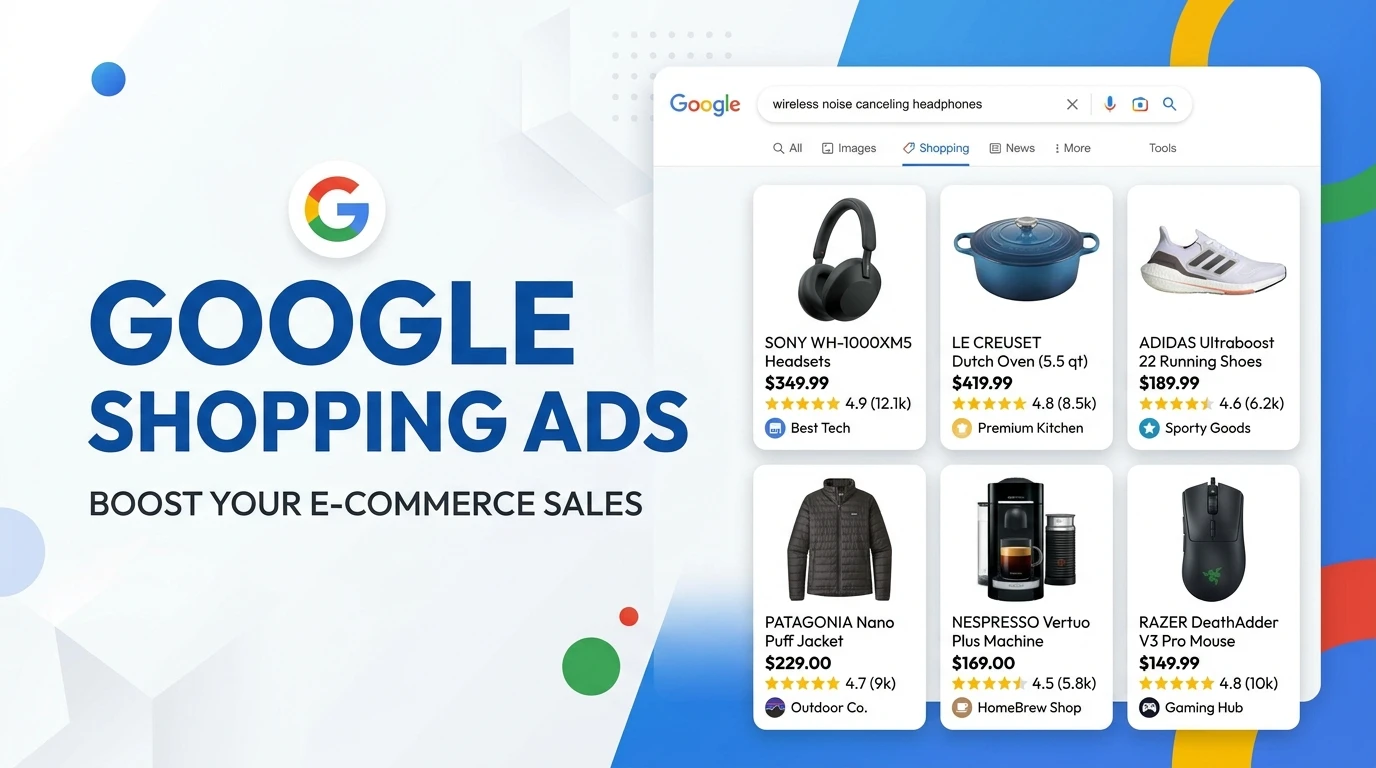
A comprehensive look at how visual product listing ads bridge consumer transactional intent with e-commerce product inventories across the Google ecosystem.
Google Shopping Ads—historically known as Product Listing Ads (PLAs)—represent the premier transactional advertising format for online retailers, direct-to-consumer (D2C) brands, and multichannel merchants. When high-intent consumers search for specific products on Google, Shopping Ads present an intuitive, visual snapshot of available offerings directly at the very top of the search engine results page (SERP), above traditional organic listings and text-based search ads. Each Shopping Ad unit showcases a crisp product photograph, exact title, current selling price, merchant or brand identity, delivery promises, and social proof elements such as star ratings and promotional badges.
Unlike conventional Google Search Ads, where advertisers research, bid upon, and match text keywords, Google Shopping Ads operate on a sophisticated algorithmic product-graph matching mechanism. Advertisers do not submit keyword lists; instead, they curate and maintain a continuous data feed within Google Merchant Center. Google's semantic indexing engines scan this structured catalog—analyzing titles, descriptions, brand taxonomy, global trade item numbers (GTINs), and product categories—to deterministically pair relevant inventory with exact consumer shopping intent in real time.
This fundamental operational shift transforms the shopping interaction. Because shoppers visually evaluate the product image, check the price, and verify availability before committing a click, traffic originating from Google Shopping Ads exhibits substantially higher conversion propensity than general informational browsing. It filters casual curiosity upfront: a consumer who clicks a ₹4,999 running shoe ad has already evaluated the shoe's aesthetic and acknowledged its cost, drastically shortening the path from impression to final checkout.
High-definition product imagery coupled with prominent pricing pre-qualifies consumer interest before an ad click occurs, reducing wasted spend on uncommitted exploratory visitors.
Visual EngagementAutomated catalog synchronizations ensure your inventory status, variant pricing, discounts, and regional shipping rates remain accurate to avoid customer bounce.
Data AccuracyEligible product listings seamlessly populate across Google Search, the dedicated Google Shopping Tab, Google Images, YouTube Shopping cards, and Google Discover networks.
Omni-Channel DistributionUnderstanding the multi-tier journey from e-commerce database ingestion to the millisecond SERP auction.
The technical execution of Google Shopping Ads operates through a continuous, three-pillar ecosystem: your e-commerce store backend (Shopify, WooCommerce, Magento, or custom headless build), Google Merchant Center (GMC), and your active Google Ads campaign architecture. When an online merchant adds or updates an item in their web store, an automated XML, TSV, or Content API feed conveys that data into Merchant Center. GMC acts as an enforcement clearinghouse, validating each SKU against rigorous Google Shopping policies, verifying landing page price parity, and inspecting image quality benchmarks.
Once approved in Merchant Center, products become eligible for auction participation within Google Ads. When a user submits a search query—such as "ergonomic mesh office chair with lumbar support"—Google does not consult a list of keywords you bid on. Instead, Google's Natural Language Processing (NLP) models deconstruct the query into semantic entities (Category: Furniture, Sub-category: Office Chairs, Material: Mesh, Feature: Lumbar Support). Google then queries its global product index, identifying all approved catalog items across all advertisers whose product attributes match those entities.
For all matching candidate SKUs, Google conducts a split-second ad auction. The Ad Rank for each product listing is calculated by multiplying your maximum Cost-Per-Click (CPC) bid (or algorithmic target ROAS equivalent) by the ad's Quality Score—determined by historical CTR, landing page relevance, feed data completeness, and competitive pricing parity. The winning products are rendered into the iconic horizontal carousel or grid format, ready for consumer interaction.
Your e-commerce database pushes real-time inventory, pricing, variant attributes, and high-res imagery via API or scheduled feed.
Google validates tax, shipping, GTIN accuracy, and landing page price parity, maintaining clean diagnostic approval status.
Natural language models cross-reference live user search queries against enriched product titles, descriptions, and categories.
Ad Rank dynamically calculates bids and quality score to display the most relevant, competitive product cards on the SERP.
Why modern online retailers allocate over 70% of their search advertising budgets directly to product listing formats.
For e-commerce enterprises, Google Shopping Ads provide commercial advantages that traditional search or social display advertising cannot match. The principal advantage lies in capturing consumers at the bottom of the purchase funnel—individuals who have progressed past initial problem definition and are actively comparing specific SKUs, brand reputations, and price points. By placing your product photography, pricing, and promotional delivery guarantees directly in their field of view at this decisive moment, Shopping Ads capture market share before competitors can present counter-offers.
Furthermore, Shopping Ads offer unprecedented catalog scale. A traditional text ad campaign with 10,000 SKUs would require thousands of ad groups, hundreds of thousands of keywords, and complex dynamic keyword insertion logic that is tedious to build and prone to budget drift. In contrast, a well-architected Google Shopping campaign automatically synchronizes your entire 10,000-SKU catalog. New products are automatically ingested, out-of-stock items are instantly paused to prevent wasted ad spend, and price changes are reflected immediately without manual ad copy revision.
At AdZio, our strategic focus centers on commercial viability rather than vanity traffic. We align Google Shopping Ads with our clients' actual inventory margins, customer lifetime value (LTV), and cash flow cycles. This ensures your advertising budget actively prioritizes high-margin bestsellers, liquidates stagnant inventory, and protects bottom-line profitability.
Eliminate manual ad drafting. Dynamic feed ingestion automatically advertises new catalog items and pauses exhausted inventory in real time.
Segment catalogs by gross profit margins using custom labels, allowing aggressive bidding on high-profit items while capping bids on tight-margin lines.
Shoppers land directly on the exact Product Detail Page (PDP) corresponding to the ad unit, removing navigation friction and driving higher conversion rates.
Comparing visual product listings with headline-driven text search to formulate an optimal blended digital strategy.
While both Google Shopping Ads and Google Search Ads inhabit the search results page, their targeting mechanisms, creative formats, and user psychology differ substantially. Search Ads rely on textual headlines, descriptions, and extensions triggered by specific keyword match types (exact, phrase, and broad). They provide complete control over exact marketing copy, making them ideal for communicating brand stories, announcing seasonal promotions, or bidding on abstract service-related queries.
In contrast, Google Shopping Ads are visual, product-specific entities triggered by catalog feed attributes. An advertiser cannot manually write custom ad copy for each individual Shopping impression; the title, image, and price are pulled straight from the Merchant Center feed. This visual transparency gives Shopping Ads a distinct advantage for physical consumer goods: buyers can immediately confirm whether a shoe matches their desired colorway, whether a laptop meets their aesthetic preferences, or whether a piece of furniture fits their room decor before spending a click.
Rather than treating these two formats as adversarial alternatives, sophisticated e-commerce brands orchestrate them collaboratively. Running simultaneous Search and Shopping campaigns enables "SERP Domination," where an advertiser occupies both the visual top carousel and the top text ad slot for high-value transactional brand queries, effectively capturing double the visual real estate and squeezing out third-party competitors.
| Strategic Dimension | Google Shopping Ads | Google Search Ads |
|---|---|---|
| Targeting Mechanism | Product feed attributes (titles, categories, GTINs) matched semantically by Google algorithms. | Keyword lists (Exact, Phrase, Broad match) actively chosen and bid upon by the advertiser. |
| Ad Creative Format | Visual card containing product photo, real-time price, store name, reviews, and delivery tags. | Text-based headlines, descriptions, callouts, sitelinks, and structured snippets. |
| User Pre-Qualification | High: Users see the exact price and visual styling before clicking the ad. | Moderate: Users read descriptive value propositions but may not see pricing until landing. |
| Catalog Scalability | Effortless: Automated sync handles tens of thousands of SKUs without manual ad drafting. | Complex: Requires extensive ad group structuring, negative match curation, and dynamic text logic. |
| Query Sculpting Control | Achieved via negative keyword lists and campaign priority settings (High, Medium, Low). | Direct control through keyword match types and targeted ad group bidding. |
| Best Use Cases | Physical e-commerce goods, retail apparel, consumer electronics, home goods, FMCG. | Brand protection, digital services, complex B2B solutions, promotional sales events. |
Analyzing the trade-offs between dedicated Standard Shopping control and automated multichannel Performance Max delivery.
With the introduction of Google Performance Max (PMax), retail advertisers face an architectural decision: whether to deploy automated PMax campaigns or retain dedicated Standard Shopping structures. Performance Max is Google's all-in-one campaign type that dynamically allocates budget across Search, Shopping, YouTube, Display, Discover, and Maps based on automated machine learning bidding models. For e-commerce retailers seeking rapid multichannel coverage with minimal manual management, PMax provides broad reach.
However, Performance Max's comprehensive automation comes at the cost of granular operational transparency. In PMax, advertisers have limited visibility into which specific search queries triggered product spend, cannot natively sculpt query hierarchies using campaign priority tiers, and often suffer from budget cannibalization where low-intent display or video impressions consume capital meant for bottom-funnel Shopping carousels.
At AdZio, we frequently engineer hybrid architectures. For mature e-commerce stores, we utilize Standard Shopping campaigns for high-priority core inventory where strict negative keyword filtering, SKU-level bid adjustments, and transparent query reporting are critical to preserving net margins. Concurrently, we deploy carefully ring-fenced PMax asset groups to capture incremental volume across Discovery and YouTube, ensuring total control over your customer acquisition costs.
Offers total query transparency, manual or target ROAS bidding, campaign priority tiers (High/Medium/Low), and exhaustive negative keyword sculpting to protect unit profitability.
Max Control & TransparencyUnlocks automated multichannel reach across YouTube, Gmail, Maps, and Display alongside Shopping. Highly effective when backed by robust first-party audience signals and conversion volume.
Algorithmic Multichannel ScaleMaximizing incremental retail revenue by unifying sponsored SERP placements with organic Merchant Center product surfaces.
Many e-commerce merchants are unaware that Google Merchant Center unlocks two distinct avenues of visibility: paid Google Shopping Ads and Free Product Listings (formerly known as Surfaces Across Google). Free Product Listings populate the organic section of the dedicated Google Shopping tab, Google Search rich product results, and Google Images without requiring any media spend. Eligibility requires an active Merchant Center account, a validated product feed, and compliance with Google's merchant trustworthiness policies.
While Free Product Listings represent highly valuable, zero-cost traffic, their visibility is primarily confined to users who actively click into the secondary "Shopping" navigation tab or browse deep organic SERP modules. Paid Google Shopping Ads, by contrast, command the prime commercial real estate on the main search results page, appearing directly below the search bar where the vast majority of consumer clicks originate.
The optimal strategy does not choose between free and paid; it activates both through a unified data feed. When your Merchant Center catalog is optimized with rich titles, accurate GTINs, high-resolution lifestyle photography, and detailed category breadcrumbs, you simultaneously strengthen your paid Ad Rank and secure prominent organic placement across Google's free retail surfaces.
Contrasting high-intent intent pull marketing against passive social lifestyle discovery across Meta and Instagram.
Advertising physical retail products on social media platforms like Meta (Facebook & Instagram) operates fundamentally as "push" marketing. Social users are engaged in entertainment, messaging, and community connection; your product ad interrupts that feed based on algorithmic demographic, behavioral, or interest-based targeting. Social commerce excels at visual storytelling, impulse purchasing, and introducing novel, disruptive products that consumers do not yet know how to search for by name.
Google Shopping Ads, conversely, represent the pinnacle of "pull" marketing. A consumer who types "genuine leather laptop bag 15 inch" into Google has already identified a need, established specific product criteria, and is actively seeking a trusted store to purchase from. This search intent results in drastically lower conversion latency and higher immediate return on ad spend (ROAS) for utility, replacement, and catalog-based retail categories.
At AdZio, we build cross-channel attribution models where social advertising stimulates top-of-funnel desire and brand awareness, while Google Shopping Ads captures that demand downstream when the shopper turns to Google to compare prices, verify store reputation, and finalize the transaction.
A candid assessment of catalog readiness, competitive pricing dynamics, and technical infrastructure required for profitable deployment.
While Google Shopping Ads are exceptionally powerful, they are not universally appropriate for every business or product catalog. Because Shopping Ads display your price directly beside competitor offerings in a visual comparison carousel, products that are severely overpriced compared to prevailing market rates without clear brand justification will struggle to convert, leading to high click costs without corresponding checkout volume.
Google Shopping Ads are exceptionally well-suited for businesses with:
Conversely, custom bespoke services, highly conceptual B2B SaaS solutions, or businesses with highly volatile stock availability are better served by dedicated Google Search Ads or Lead Generation campaigns.
The central command platform responsible for catalog ingestion, policy enforcement, diagnostic monitoring, and programmatic distribution.
At the heart of every profitable Google Shopping campaign sits Google Merchant Center (GMC). Far from being a passive file storage repository, Merchant Center is a rigorous data processing and policy engine that bridges your e-commerce platform with Google's ad serving infrastructure. GMC continuously parses your catalog, verifying that listed prices match the actual checkout amount on your website, ensuring advertised stock matches inventory availability, validating shipping configurations, and scanning images for unauthorized watermarks or promotional text overlays.
Data ingestion into Merchant Center can be executed through several pathways depending on catalog complexity and updating frequency. For large e-commerce enterprises with thousands of dynamically fluctuating SKUs, the Content API for Shopping provides the gold standard, delivering instantaneous price and stock updates directly from your database. For mid-sized stores, scheduled FTP/SFTP server uploads or automated XML feed fetches (using RSS 2.0 or Atom formats) provide reliable, synchronized daily updates.
AdZio's technical team establishes robust data feed pipelines with automated supplemental feeds and feed transformation rules. This allows our specialists to enrich raw product titles, map custom taxonomy, inject high-margin custom labels, and rectify missing attributes without requiring engineering intervention from your core web development team.
Setting up Merchant Center properly requires verifying website URL ownership through Google Search Console, establishing regional shipping speed tables (defining handling times, transit days, and carrier rates), creating granular tax rules where applicable, and linking Google Business Profiles for omnichannel Local Inventory Ads. A deficiency in any of these foundational settings causes Google's crawlers to issue account-level warnings that jeopardize overall campaign eligibility.
Real-time Content API integration or automated scheduled fetches keep your live catalog perfectly synchronized with Google's advertising index.
Implement dynamic title concatenation, category standardization, and custom label tagging directly within GMC without modifying your backend store.
Continuous monitoring of item disapproval warnings, price mismatch alerts, and landing page 404 errors before they harm campaign delivery.
The structural anatomy of a high-converting product feed: aligning required parameters with high-impact custom enrichment.
In Google Shopping Ads, your product feed is your advertising copy, your keyword target list, and your bidding architecture all rolled into one. If your product feed contains sparse, erroneous, or incomplete data, your products will remain virtually invisible in the auction, or worse, trigger impressions for irrelevant search queries that waste budget.
Every professional e-commerce product feed relies on two distinct tiers of data: Mandatory Technical Attributes that Google requires to approve an item, and Strategic Enrichment Attributes that empower advanced algorithmic matching and profit-based segmentation.
Below is an illustrative structural example of an optimized Google Merchant Center product record in standard XML RSS 2.0 format, showcasing how mandatory parameters are seamlessly combined with enriched custom labels:
Product titles are the single most influential variable determining which search queries trigger your Shopping Ads. Test and optimize titles using AdZio's interactive architecture.
Because Google Shopping Ads do not use keyword bidding, Google's search algorithms scan your [title] attribute to establish search relevance. The order of words matters tremendously: Google places exponential weight on terms located at the beginning of the title, and mobile SERP carousels typically truncate titles after the first 65–70 characters. Consequently, front-loading critical purchase-identifying attributes is non-negotiable.
Effective title structures differ by vertical. In apparel, the proven hierarchy is Brand + Gender + Product Category + Defining Attribute + Color + Size. In electronics, the formula shifts to Brand + Model + Product Type + Key Specification (Storage/RAM/Screen). In home goods, searchers prioritize Brand + Style + Material + Dimension + Product Type.
| Category | Weak / Unoptimized Title (Standard Store Output) | AdZio Algorithmic Optimized Title |
|---|---|---|
| Men's Apparel | Casual Linen Shirt - Navy | AdZio Men's Slim-Fit 100% Pure Linen Casual Shirt Long Sleeve - Navy Blue, Size 40 |
| Running Footwear | Nike Pegasus 40 | Nike Air Zoom Pegasus 40 Men's Road Running Shoes Breathable Engineered Mesh - Black/White UK 9 |
| Consumer Electronics | Sony WH1000XM5 | Sony WH-1000XM5 Wireless Noise Cancelling Over-Ear Headphones with Mic 30Hr Battery - Silver |
| Home Furniture | Wooden Coffee Table | LivingCraft Solid Sheesham Wood Coffee Table with Storage Shelf Natural Teak Finish (90x50x45 cm) |
| Beauty & Skincare | Vitamin C Serum 30ml | PureGlow 15% Vitamin C & Ferulic Acid Face Serum for Brightening & Dark Spots - 30ml Dropper Bottle |
| Fine Jewellery | Diamond Solitaire Ring | Aura 18K Yellow Gold 0.50 Carat Round Brilliant Solitaire Diamond Engagement Ring (BIS Hallmarked, IGI) |
Build and preview an algorithmically weighted Google Shopping Ad title in real time.
First 70 characters shown on mobile SERP carousels without truncation. Keep critical terms front-loaded.
Empowering Google's secondary algorithmic matching with comprehensive, technical, and benefit-rich descriptions.
While the product title carries the highest initial relevance weight, the [description] attribute serves as Google's semantic indexing canvas. Shoppers rarely read full product descriptions directly within the Shopping SERP carousel; however, Google's search algorithms scan the entire description (up to 5,000 characters permitted) to identify long-tail search matches, secondary features, compatibility specifications, and niche technical nuances.
A high-performing product description must balance natural readability with rich semantic density. At AdZio, our optimization protocols mandate detailing:
Crucially, Merchant Center strictly prohibits promotional fluff, promotional discount codes, all-caps text, or links to external websites within product descriptions. Violations trigger automatic item disapprovals that silence ad delivery.
The visual asset standards that dictate click-through rates and prevent devastating Merchant Center disapprovals.
In Google Shopping Ads, the product photograph represents approximately 80% of the visual ad card. No matter how perfectly your bids are structured, a substandard, dark, or pixelated image will depress click-through rates and degrade your Quality Score. Furthermore, Google enforces the most rigid automated image screening policies in digital advertising.
For your primary [image_link], Google mandates a clear, well-lit photograph showing the exact product on a pure, solid white or neutral light gray background. Overlays containing text such as "50% OFF", "FREE SHIPPING", store logos, or promotional borders are strictly prohibited and detected by computer vision systems within seconds, resulting in immediate SKU suspension.
However, Google allows and encourages secondary images via the [additional_image_link] attribute. We populate these secondary slots with high-resolution lifestyle photography, scale shots, close-up texture captures, and angle variations. When a shopper hovers over or swipes through your product card on mobile or desktop, these lifestyle assets create emotional desire and drive immediate click engagement.
Mandatory for the primary image. Removes visual distractions and ensures seamless compliance with Google's automated visual policy crawlers.
Provide at least 800x800 pixels (1200x1200 recommended). Crisp zoom fidelity allows shoppers to inspect textures and finishes with confidence.
Never include watermarks, brand logos, sale badges, or shipping guarantees on image files. Keep imagery pristine and product-focused.
Experience how AdZio conducts systematic diagnostic inspections of e-commerce catalog feeds to identify compliance roadblocks.
Inspect diagnostic health across sample SKUs representing common e-commerce catalog states.
How AdZio uses campaign priority settings and negative keyword sculpting to channel search intent toward exact bid tiers.
The fatal flaw made by inexperienced e-commerce advertisers is running a single, monolithic Shopping campaign containing their entire catalog with a uniform target ROAS or flat CPC bid. In a flat structure, high-intent brand search queries (e.g. "AdZio ergonomic chair model x") are bid at the exact same price as generic, low-converting exploratory queries (e.g. "chair").
AdZio deploys the proven Three-Tier Priority Bidding Framework, leveraging Google Shopping's unique Campaign Priority mechanism (High, Medium, Low) coupled with shared negative keyword lists:
Catches broad, low-intent queries ("office furniture", "shoes"). Bids are kept intentionally low to capture affordable awareness without overspending.
Negative Filter: Brand & SKU termsFilters specific product categories ("ergonomic mesh chair"). Moderate bids match users actively researching defined feature sets.
Negative Filter: Specific Brand SKUsBypassed queries land here: highly specific brand & model searches ("AdZio Pro Mesh Chair"). Aggressive bids ensure 100% impression share.
Negative Filter: None (Pure Conversion)Transforming broad catalogs into precision-managed asset tiers based on gross margins, inventory velocity, and commercial seasonality.
Explore how AdZio structures product subdivisions across custom business criteria.
Premium proprietary lines and exclusive collections. We apply aggressive target ROAS thresholds (e.g. 280%) to maximize market share.
Core catalog staples with balanced competition. Balanced bidding strategy engineered around a 450% target ROAS to safeguard profits.
Third-party consumer commodities. High target ROAS constraints (650%+) and strict cost caps prevent ad spend from eating remaining margins.
High-converting hero products that command consistent consumer demand. Priority budget allocation ensures uninterrupted search impression share.
Solid volume contributors. Continuous search term mining and negative keyword sculpting help upgrade mid-tier performers into bestsellers.
Overstocked SKUs requiring rapid liquidation. Discount pricing coupled with targeted shopping exposure accelerates capital recovery.
Gifting collections and festive ethnic wear. Scaled budgets and automated intraday bid adjustments capture seasonal buyer demand.
Weather-dependent categories such as air cooling, waterproof gear, or linen apparel. Scheduled budget ramp-ups match search trends.
Baseline consumables and timeless apparel. Operates on steady-state algorithmic target ROAS bidding throughout the calendar year.
Fast decision-making cycle. High conversion rates justify competitive bidding, paired with checkout upsell cross-selling.
Standard retail basket values. Remarketing audiences and rich product reviews play a vital role in closing initial comparison shoppers.
Multi-day consideration journeys. We integrate Google Shopping with first-party CRM remarketing to nurture prospects through final purchase.
Deconstructing the spectrum of consumer queries to align feed semantics with high-converting transactional readiness.
Consumer search behavior on Google is fundamentally multi-layered. When evaluating digital advertising performance, e-commerce managers often view search traffic as homogeneous. In reality, a shopper's query reveals their exact stage within the decision lifecycle. Understanding these intent tiers allows AdZio to sculpt search queries so that premium ad bids are reserved exclusively for consumers ready to transact today.
Shopping search intent spans four primary phases:
Example: "living room furniture ideas" or "running shoes"
The shopper is gathering inspiration. Transactional urgency is low. We use high campaign priority tiers with low CPC caps to harvest cost-effective brand visibility while filtering out expensive waste.
Example: "solid teak wood dining table 6 seater"
The buyer has narrowed their criteria down to exact materials and dimensions. Optimized product titles that match these exact specifications trigger high-relevance card placements.
Example: "Sony WH-1000XM5 vs Bose QuietComfort"
The shopper is actively evaluating competitive price points, shipping delivery dates, and return policies across competing retailers. Parity in pricing is essential here.
Example: "buy iPhone 15 Pro 256GB natural titanium online"
The pinnacle of purchase readiness. The consumer has their payment method ready. Low campaign priority tiers with aggressive bid strategies ensure 100% impression share.
By implementing negative keyword sculpting across priority tiers, we prevent high-intent brand and model queries from matching in broad generic campaigns. Instead, they flow seamlessly into dedicated brand campaigns with targeted high bids, ensuring that budget is spent where conversion probability is mathematically greatest.
Why the post-click experience dictates both Google Merchant Center compliance and final e-commerce checkout completion.
A flawless Google Shopping ad campaign is rendered useless if the post-click destination introduces friction, confusion, or policy discrepancies. Google's Merchant Center crawlers continuously inspect the destination URL specified in your [link] attribute. If the price displayed in the Shopping Ad differs by even a single rupee from the price on the landing page, or if a product advertised as "in stock" appears as "sold out" on site, Google initiates immediate algorithmic disapproval for that SKU, and chronic violations lead to total account suspension.
Beyond algorithmic compliance, landing page experience governs your commercial return. When a user clicks a Shopping Ad for a specific color or size variant (e.g. Size 10 in Olive Green), the landing page must automatically pre-select that exact variant. Forcing the visitor to manually re-select their size or search through unrelated catalog options causes immediate abandonment.
AdZio collaborates seamlessly with your internal development teams or leverages our dedicated E-Commerce Website Development and Conversion Rate Optimization (CRO) specialists to engineer ultra-fast, mobile-optimized Product Detail Pages (PDPs). We implement clear trust badges, sticky "Add to Cart" buttons, transparent delivery estimations, and frictionless single-page checkouts.
Crucially, we ensure that every Product Detail Page embeds valid Schema.org Product and Offer structured data. When Google's search crawlers inspect your HTML, the structured JSON-LD data enables automated micro-crawling, allowing Google Merchant Center to update product prices and stock availability within minutes of changes on your website, preventing price mismatch suspensions during flash sales or rapid inventory depletions.
Dynamic automated price crawling ensures complete consistency between feed values and website checkout pricing, preventing Merchant Center warnings.
Deep-linking URLs directly load the clicked size, color, and finish, eliminating customer confusion and reducing immediate bounce rates.
Mobile shoppers abandon pages that take over 3 seconds to load. We audit Core Web Vitals to maximize post-click conversion rates.
Establishing rigorous, privacy-compliant revenue telemetry to feed Google's Smart Bidding machine learning algorithms.
Modern algorithmic bidding—such as Target ROAS (tROAS) or Maximize Conversion Value—is completely dependent upon the quality, completeness, and latency of your conversion data. If your tracking implementation only records generic "lead form" submissions or fails to pass dynamic transaction values and currency parameters, Google's bidding algorithms are forced to operate blind, optimizing for low-value transactions rather than high-margin purchases.
AdZio engineers enterprise-grade e-commerce tracking architectures utilizing Google Analytics 4 (GA4) and the Google Ads Conversion Tag with Enhanced Conversions for Web. We map the entire customer purchasing funnel through standardized e-commerce data layer events:
view_item: Tracking specific product engagement to populate dynamic remarketing audiences.add_to_cart: Measuring initial intent and pinpointing cart abandonment bottlenecks.begin_checkout: Identifying friction points during shipping and payment selection.purchase: Passing dynamic transaction value, order ID, currency, tax, shipping, and purchased SKU arrays.Below is an illustrative standard Data Layer push for a successful e-commerce transaction that feeds accurate revenue data to Google Ads:
Through Enhanced Conversions, first-party customer data provided at checkout (such as hashed email addresses and phone numbers) is securely encrypted and matched against signed-in Google accounts. This recovers 5% to 15% of conversion events typically obscured by browser tracking restrictions, cookie deprecation, and cross-device buying journeys.
Decoupling vanity reporting metrics from fundamental retail balance sheet health.
In digital e-commerce advertising, Return on Ad Spend (ROAS) is universally celebrated—yet frequently misunderstood. Many agencies boast of delivering "10x ROAS" (1,000%), without acknowledging that those numbers were achieved exclusively on existing brand search queries or on heavily discounted commodity products where cost-of-goods-sold (COGS) and return rates eradicated all operational profit.
At AdZio, our commercial analysis evaluates ROAS through the lens of actual unit profitability. We analyze key performance indicators within their holistic business context:
Measures the percentage of total eligible Shopping impressions your ads captured. Reveals whether your campaign is limited by daily budget or low Ad Rank.
Google's comparative index comparing your average cost-per-click and click-through rate against direct market competitors in identical product subcategories.
Tracking basket size shifts. A campaign with a 400% ROAS driven by higher order values is often far more profitable than one driven by high transaction volume with micro-baskets.
Engineering advertising budgets around product contribution margins rather than top-line revenue illusions.
E-commerce sustainability is determined by gross contribution margin. Every product in your catalog bears specific unit economics: manufacturing or wholesale COGS, payment gateway fees (typically 1.8% to 2.5%), pick-and-pack fulfillment costs, outbound shipping subsidies, and anticipated return/restocking allowances (which can exceed 25% in apparel).
If an e-commerce brand operates with an average gross margin of 30%, their Break-Even ROAS is 333% (1 / 0.30). Any campaign operating below 333% ROAS is actively destroying operational capital. Conversely, on proprietary product lines with 70% gross margins, the break-even threshold drops to 142% ROAS, allowing the business to bid substantially more aggressively to capture market dominance.
AdZio ingests your margin brackets into Merchant Center custom labels ([custom_label_0]). This allows us to establish differential target ROAS bidding models across your product tiers, ensuring tight-margin lines never overspend while high-margin winners receive maximum market liquidity.
Below are the core mathematical formulas that guide AdZio's e-commerce financial engineering:
Break-Even ROAS = 1 / Gross Margin %
For example, if a product line yields a 40% gross margin: Break-Even ROAS = 1 / 0.40 = 250% (or 2.5x). Any ROAS above 250% generates positive cash flow.
Target ROAS = 1 / (Gross Margin % - Target Net Profit %)
If you aim for a 15% net profit margin on a 45% gross margin product: Target ROAS = 1 / (0.45 - 0.15) = 333% (or 3.33x).
Specialized feed taxonomies, attribute requirements, and competitive dynamics across diverse retail sectors.
Focuses on variant grouping, gender/age demographics, color taxonomy, and high-fidelity mobile zoom imagery.
Highlights metal purity, gemstone certification, hallmarking trust badges, and macro photography details.
Demands exact MPN/GTIN mapping, model numbers, storage capacities, voltage specifications, and warranty terms.
Emphasizes dimension specifications, materials (solid teak, engineered wood), assembly status, and freight shipping.
Prioritizes skin-type compatibility, natural formulations, volume (ml/oz), and policy-compliant health claims.
Focuses on equipment specifications, weight ratings, training levels (beginner/pro), and seasonal outdoor shifts.
Requires year/make/model compatibility filtering, OEM part numbering, and weather-resistant material tags.
Strict Merchant Center policy compliance, verified ingredient disclosures, expiry monitoring, and certified lab seals.
Optimizes organic certifications, dietary tags (vegan, gluten-free), bundle pricing, and regional shelf-life stability.
Features certified authenticity disclosures, luxury packaging visuals, insured courier guarantees, and dedicated concierges.
Tailored Google Shopping architectures engineered to address vertical-specific buyer behaviors and regulatory constraints.
Every retail industry possesses unique friction points, buying consideration windows, and catalog velocity profiles. A luxury diamond retailer cannot apply the same bidding logic or title structure as a fast-turnaround smartphone accessory store. AdZio tailors feed taxonomy, bidding aggression, and negative query architecture specifically for your sector.
Intensive size/color variant mapping and dynamic retargeting to combat seasonal fashion turnover and high return rates.
Aggressive price-match bidding and GTIN-level competitiveness monitoring against large marketplace aggregators.
High-ticket brand protection, certification highlights, and white-glove delivery guarantees to reassure buyers.
Regional shipping rate tables and room-setting lifestyle imagery to justify investment-grade price points.
Benefit-driven title structuring (e.g. "Sulfate-Free", "Dermatologist Tested") adhering strictly to Google advertising policies.
Seasonal budget scaling for New Year fitness resolutions, paired with clear home-delivery dimension disclaimers.
Deep SKU compatibility filtering to prevent expensive wrong-part orders and subsequent customer returns.
Contractor bundle offerings, technical specification sheets, and volume pricing tiered via custom labels.
Intense holiday flighting around Diwali, Rakhi, and New Year, paired with countdown delivery badges.
Rigorous safety certifications, non-toxic material highlighting, and repeat-order replenishment incentives.
Breed-specific and dietary targeting with automated subscription upsells on post-click landing pages.
Showcasing authentic regional heritage, handmade craftsmanship attributes, and custom gift customization.
Bridging online digital discovery with immediate in-store physical retail fulfillment.
For multi-location retail brands and brick-and-mortar storefronts with digital presence, Local Inventory Ads (LIAs) represent a transformative commercial bridge. When nearby shoppers search on Google for products they need urgently—such as "laptop charger near me" or "formal suit in stock nearby"—LIAs display the product with a prominent "In store" or "Pick up today" badge, detailing exact distance to your nearest branch.
Clicking a Local Inventory Ad directs the shopper to a Google-hosted local storefront or a merchant-hosted local store page displaying real-time local inventory, aisle location, store hours, and directions. This captures immediate high-margin foot traffic from shoppers unwilling to wait 2 to 3 days for standard courier delivery.
AdZio synchronizes your physical store point-of-sale (POS) inventory with Google Business Profiles and Merchant Center, unlocking seamless online-to-offline retail attribution.
AdZio's systematic, end-to-end operational roadmap for onboarding, auditing, launching, and scaling e-commerce campaigns.
Systematic troubleshooting methodologies for rectifying catalog feed errors, policy warnings, and algorithmic item suspensions.
In e-commerce advertising, product disapprovals can emerge overnight, silently halting ad spend on your most profitable hero products. Google Merchant Center operates continuous automated crawlers that inspect your feed against strict advertising guidelines. When discrepancies are detected, items are downgraded or suspended.
Cause: Feed price differs from website checkout price due to delayed feed caching or currency conversion glitches.
Resolution: Deploy automated Content API syncing or enable Merchant Center automatic item updates.
Cause: Product photographs containing logos, watermarks, "Free Delivery", or sale borders.
Resolution: Clean primary image assets to pure white backgrounds; move promotional badges to custom attributes.
Cause: Submitting fake GTINs or failing to include universal barcodes for recognized retail brands.
Resolution: Ingest manufacturer barcodes; for custom handmade goods, set [identifier_exists] to FALSE.
Cause: Products deleted or URLs altered in store backend without feed synchronization.
Resolution: Automated feed script catches and pauses discontinued product links before Google crawlers flag them.
Cause: Leaving [google_product_category] blank or using shallow top-level buckets.
Resolution: Map products down to the 5th tier of Google's official numerical taxonomy for max relevance.
Cause: Inadequate return policy details, missing business contact info, or unclear shipping charges.
Resolution: Comprehensive audit of store footer terms, refund policies, and transparent shipping tables.
Cause: Overly restrictive robots.txt rules blocking Googlebot or Googlebot-Image from crawling product pages.
Resolution: Update web server configuration to grant full crawl permissions to Google's shopping and image user agents.
Cause: Advertising in INR while checkout defaults to USD or failing to disclose mandatory GST inclusive pricing.
Resolution: Align landing page default currency and tax disclosures strictly with the target country of sale.
Cause: Submitting thumbnail imagery below Google's minimum 100x100 pixel threshold (250x250 for apparel).
Resolution: Re-encode catalog images at high-resolution (1200x1200 recommended) for crisp retina display rendering.
Experience the granular catalog telemetry AdZio uses to monitor SKU-level velocity, ROAS health, and search impression share.
| Product Name / SKU | Impressions | Clicks | Avg. CPC | Orders | Conv. Value | ROAS |
|---|
* All metrics, order numbers, and revenues displayed are simulated for demonstration purposes. AdZio never publishes confidential client performance data.
Model projected traffic, order volume, and revenue potentials based on sector-specific CPC benchmarks and basket sizes.
Select your industry sector and slide monthly advertising budget to inspect simulated campaign economics.
Target CPC: ₹12.50
Modeled CVR: ~2.6%
Projected ROAS: 385% (Sample Projection)
Capitalizing on explosive Indian and international retail spikes: Diwali, festive surges, and year-end inventory clearing.
In the Indian e-commerce landscape, seasonal shopping periods—anchored by festivals like Diwali, Dussehra, Raksha Bandhan, and Republic Day sales—generate a massive percentage of total annual retail revenue. During these peak windows, consumer search volume triples, but advertising competition also spikes aggressively, driving up market-wide auction CPCs.
Winning during peak seasonal periods requires systematic pre-flight engineering rather than last-minute budget increases:
Populating [sale_price], [sale_price_effective_date], and promotional merchant promotions to trigger eye-catching sale tags before the shopping rush begins.
Relaxing target ROAS constraints and adjusting automated bid multipliers to capture morning and late-night festive buying spikes without hitting budget caps early.
Transitioning remaining seasonal stock to Custom Label 1 (Clearance) with aggressive liquidation discount pricing to free up working capital for the upcoming cycle.
| Retail Season / Event | Primary Target Categories | Recommended Feed Preparation | Bidding Strategy Shift |
|---|---|---|---|
| Diwali & Dussehra Mega Sales (Oct - Nov) | Ethnic Apparel, Fine Jewellery, Electronics, Home Decor, Gifting Hampers | Inject sale_price attributes 3 weeks prior; create dedicated Festive Custom Labels. | Expand daily budget limits by 150-300%; lower target ROAS to maximize absolute gross volume. |
| Republic Day & New Year (Jan) | Fitness Equipment, Winter Apparel, Smart Electronics, Productivity Gear | Clearance tagging on remaining winter inventory; bundle accessories. | Target aggressive bottom-funnel SKU terms for fitness and self-improvement queries. |
| Akshaya Tritiya & Wedding Season (Apr - May) | Gold & Diamond Jewellery, Bridal Wear, Luxury Watches, High-End Kitchenware | Ensure BIS Hallmarking and certified gemstone disclosures in product descriptions. | Prioritize high-AOV product groups with high-ticket remarketing audience signals. |
| Monsoon & Mid-Year Refresh (Jul - Aug) | Waterproof Gear, Home Appliances, Mid-Year Fashion Clearances | Promote seasonal utility bundles and free delivery guarantees. | Maintain disciplined target ROAS thresholds focused on healthy inventory turnaround. |
Critical strategic pitfalls that drain retail budgets, degrade quality scores, and lead to catalog disapprovals.
[google_product_category] or mapping only to top-level buckets.Comprehensive, expert answers covering Google Merchant Center, product feed architecture, bidding models, and catalog optimization.
[title] attribute to maximize algorithmic search query relevance. Because Google places heavy weight on the beginning of titles, front-loading critical attributes—such as Brand, Product Category, Model, Material, Size, and Color—within the first 70 characters significantly elevates Ad Rank and click-through rates.
[identifier_exists] to "no" or "false". For recognized commercial brand products, providing legitimate GTINs is mandatory for full auction eligibility.
[availability] attribute to "out_of_stock". Google instantly pauses ad serving for that SKU until restocked, completely eliminating ad spend on unfulfillable items.
[item_group_id]), high-resolution imagery, and accurate demographic attributes (gender, age group, size system).
Connect with AdZio's e-commerce advertising specialists. We will analyze your Google Merchant Center feed hygiene, title optimization, and bidding architecture to uncover wasted ad spend.
Partner with AdZio to align your Google Merchant Center product feed, query sculpting architecture, and unit margins into a sustainable commercial engine.