
Google Merchant Center Setup, Optimization & Product Data Management
Turn your online store's product inventory into a structured, policy-compliant catalog that powers rich product discovery across Google Shopping, Search, YouTube, and high-converting Shopping Ads campaigns.
For modern retailers and direct-to-consumer brands, visibility on Google does not begin in an advertising dashboard—it begins inside Google Merchant Center. AdZio delivers enterprise-grade catalog architecture, scheduled automated feed synchronization, rigorous attribute mapping, and real-time diagnostic remediation to safeguard your product listings against disapprovals and maximize marketplace impression share.

The Foundational Engine of Modern E-Commerce Discovery
Why precision product data is the single most critical asset in digital retail merchandising.
In the contemporary e-commerce landscape, consumer purchasing journeys are increasingly decentralized. Prospective buyers in India and globally rarely confine their product exploration to a single retail storefront or a generic search result. Instead, shoppers actively compare real-time pricing, stock availability, consumer ratings, shipping speeds, and high-resolution visual variants directly within Google's dedicated Shopping tab, visual image cards, YouTube shelf integrations, and local inventory overlays. Google Merchant Center serves as the foundational data translation layer that makes this ubiquitous visibility technically possible.
At its operational core, Google Merchant Center is not a front-facing marketplace or an auction-bidding dashboard. It is an industrial-strength data ingestion and regulatory verification engine. It accepts your raw store inventory—whether comprising fifty artisanal jewelry pieces or two hundred thousand consumer electronics SKUs—and subjects every title, price, currency symbol, barcode, and landing page URL to Google's stringent product specification requirements. When product information is clean, comprehensive, and updated continuously, Google's algorithmic search systems can confidently surface your offerings to high-intent shoppers ready to transact.
Conversely, neglect of product data infrastructure introduces severe commercial risk. Mismatched prices between your shopping cart and your feed, outdated availability flags, unverified shipping tables, or missing Global Trade Item Numbers (GTINs) do not merely suppress impressions—they trigger immediate automated product disapprovals and account-level suspension warnings. At AdZio, we treat Google Merchant Center not as an afterthought checklist item, but as an active technical asset that demands disciplined architecture, real-time monitoring, and continuous strategic refinement.
Structured Merchandising
Organize chaotic store catalogs into standardized Google Product Taxonomies with precise material, size, color, age group, and variant attributes.
Continuous Price & Stock Parity
Maintain automated synchronization between on-site checkout prices, currency declarations, stock counts, and Merchant Center data to eradicate policy strikes.
Multi-Surface Discoverability
Deploy product feeds across Free Product Listings, Performance Max asset groups, Standard Shopping Ads, and local pickup inventory panels.
What Is Google Merchant Center?
Understanding product data infrastructure versus front-end advertising campaigns.
A frequent misconception among emerging e-commerce brands is confusing Google Merchant Center with Google Ads or Google Shopping. While intimately connected, these platforms execute entirely distinct functions within your commercial digital marketing stack. Google Merchant Center is strictly an **infrastructure platform for product data and merchant compliance**. It does not possess an auction interface, does not manage maximum cost-per-click bids, and does not configure target return on ad spend (tROAS) goals. Its singular responsibility is verifying that your products exist, that their technical specifications meet international standards, that your business identity is authentic, and that your store offers a trustworthy consumer purchase journey.
Think of your e-commerce website as the manufacturing warehouse, Google Merchant Center as the customs clearance and quality inspection terminal, and Google Shopping or Google Ads as the retail display windows and sponsored highway billboards. No matter how expansive your advertising budget might be, your product promotions cannot enter the Google auction until your items have successfully cleared inspection inside Merchant Center. Google's automated review spiders continuously crawl submitted landing pages, verifying that the price advertised in INR or USD precisely matches the price presented to the shopper at final checkout, inclusive of applicable Indian GST and disclosed shipping charges.
Crucially, Google Merchant Center also powers Free Product Listings on the Google Shopping tab across India and international territories. Eligible retailers with verified domains and healthy data feeds can generate significant organic traffic and e-commerce transactions without spending a single rupee on paid media. Understanding this dual role—as both a prerequisite for paid Shopping Ads and an organic discovery channel in its own right—highlights why Merchant Center data quality is paramount to digital retail longevity.
| Functional Dimension | Google Merchant Center | Google Shopping (Organic) | Google Ads (Shopping / PMax) |
|---|---|---|---|
| Primary Role | Product data storage, feed validation, policy compliance & diagnostics | Consumer discovery interface showcasing free & organic product cards | Paid advertising auction, bidding algorithms & audience targeting |
| Cost Model | 100% Free platform tool provided by Google to merchants | Zero media cost; ranking governed by data relevance & trust factors | Paid media spend (CPC / Target CPA / Target ROAS auctions) |
| Direct Output | Approved product catalog status and item health diagnostics | Organic product carousel and comparison listings on Shopping tab | Sponsored Shopping carousels at top of Search, YouTube, Gmail & Maps |
| Core Control Levers | Attributes, GTINs, supplemental feeds, feed rules & currency parity | Title semantic clarity, customer reviews & merchant trust signals | Budgets, negative keywords, bidding targets, asset groups & margins |
How Google Merchant Center Works: The Data Lifecycle
From your store database to global consumer touchpoints—the six stages of automated catalog ingestion.
The pipeline that transforms a newly created product in your warehouse database into a live shopping card on Google Search involves a sophisticated series of ingestion, validation, normalization, and distribution events. Understanding this lifecycle enables merchants to quickly diagnose why certain SKUs underperform or encounter indexing friction, and how AdZio orchestrates this end-to-end data flow with surgical precision.
E-Commerce Catalog Source
Products reside in your store platform (Shopify, WooCommerce, Magento, or custom Headless SQL database) containing SKUs, prices, stock levels, and media assets.
Structured Feed Formulation
Store data is extracted and mapped into standardized XML RSS 2.0, TSV, Google Sheets, or pushed directly through the real-time Google Content API for Shopping.
Merchant Center Ingestion
Merchant Center receives the payload on a set cron schedule or webhook trigger, executing schema validation on required attributes (ID, title, price, link, image).
Automated Diagnostic Review
Google algorithms cross-check landing pages, test checkout flows, audit image backgrounds, verify GTIN barcode authenticity, and scan for policy infractions.
Multi-Surface Distribution
Approved products populate Google's retail indexing graph, becoming eligible for Free Listings, Local Inventory Ads, and YouTube shopping shelves.
Google Ads Auction Sync
Linked Google Ads accounts consume approved item attributes to dynamically populate Performance Max and Shopping campaign ad creatives.
Google Merchant Center Account Setup & Verification
Building an unshakeable, policy-compliant foundation that safeguards your store against account suspension.
Establishing a Google Merchant Center account requires meticulous attention to operational legitimacy. Google enforces strict consumer protection policies to prevent fraudulent merchant operations, misleading pricing practices, and counterfeit merchandise. The onboarding process is substantially more demanding than simply creating a standard marketing account; it requires full legal and technical verification of your online storefront.
The first mandatory milestone is Website Claim and Verification. AdZio configures domain ownership verification via Google Search Console HTML meta tags, DNS TXT record insertion, or Google Tag Manager container deployment. Once verified, the domain is claimed exclusively by your Merchant Center account, preventing unauthorized third parties from advertising your products. In parallel, your physical business address, registered legal entity name, corporate contact email, and active customer support phone number must be submitted and validated against publicly accessible data.
Crucially, Google's policy bots inspect your storefront's on-site infrastructure prior to granting feed approval. Your website must have a working SSL certificate (HTTPS), a fully transparent checkout process, explicit shipping calculation tables, an accessible return and refund policy (stating clear return windows, shipping fee liabilities, and restocking policies), and clearly stated payment methods. In India, stores must explicitly declare prices inclusive of GST or detail tax rules transparently. Failure to present these policies in your store footer is the leading cause of the dreaded "Misrepresentation" account suspension.
Mandatory Store Verification Checklist
- Verified Domain Claim: Exclusive DNS or Search Console ownership lock.
- Clear Contact Information: Physical business address, email, and phone verified.
- Transparent Return Policy: Prominently linked terms detailing return windows and refund methods.
- Secure Payment Process: Valid SSL encryption and verified gateway checkout flows.
- Accurate Shipping Settings: Realistic delivery timelines and fee tables configured in GMC.
India Compliance Considerations
When merchandising products for Indian consumers, Merchant Center requires exact alignment with national e-commerce norms. All prices displayed in feeds must either be GST-inclusive or adhere to transparent tax surcharge rules defined in your Merchant Center tax settings. Furthermore, your website must clearly identify customer grievance contact information as mandated by the Consumer Protection (E-Commerce) Rules. AdZio audits these requirements comprehensively before a single product feed is ingested.
Product Feed Management & Ingestion Methods
Architecting robust, automated synchronization between store inventory and Google's catalog servers.
A Product Feed is the structured digital document or API stream that conveys every granular detail about your catalog to Google Merchant Center. It contains systematically organized columns or JSON attributes representing product identifiers, descriptive copy, media links, inventory states, and pricing values. Managing a product feed is not a static one-off upload; it is an active data pipeline that must reflect inventory shifts within minutes of real-world stock fluctuations.
Depending on your catalog scale and technical infrastructure, AdZio establishes the optimal feed ingestion protocol:
- Content API for Shopping: Direct programmatic integration that synchronizes price and inventory updates in real time whenever changes occur on your e-commerce platform.
- Scheduled Server Fetch: Automated hourly or daily retrieval of dynamically generated XML (RSS 2.0 / Atom 1.0) feeds hosted on your secure e-commerce server.
- Supplemental Feeds: Modular secondary feeds utilized to enrich missing product attributes (e.g., custom labels for campaign tiering, GTIN overrides, seasonal promo tags) without altering core store database records.
- Google Sheets Integration: Cloud-connected spreadsheets ideal for boutique catalogs, allowing manual curation of bespoke attributes and product titles.

Crucially, modern feed management utilizes Feed Rules inside Google Merchant Center. Feed rules allow AdZio's engineers to programmatically transform raw store data during ingestion. For instance, if your internal product titles omit the brand or color, feed rules can automatically prepend the [Brand] attribute and append [Color] and [Size] without requiring modifications to your storefront codebase. This agility ensures your catalog remains optimized for search queries while preserving on-site aesthetic simplicity.
Product Data Quality: The Currency of Algorithmic Trust
Why complete, consistent, and structured product data dictates marketplace impression velocity.

In Google's automated shopping ecosystem, algorithms cannot physically touch or inspect your merchandise. They evaluate your products entirely through the fidelity of your data feed. When your product feed provides exhaustive, granular attributes—including exact fabric composition, precise color terminology, standard international sizing systems, and verified barcode identifiers—Google's intent-matching models can accurately align your listings with high-intent customer search queries.
Conversely, degraded data quality triggers a cascade of algorithmic friction. Products with vague titles, generic descriptions, missing GTINs, or incomplete attribute fields suffer from severe impression throttling. Google prioritizes consumer experience above all; if an automated crawl cannot determine with absolute certainty that an item is in stock, accurately priced, and eligible for standard delivery, it will withhold that product from top-tier Shopping carousels to preserve shopper trust.
AdZio enforces an uncompromising product data quality framework. We audit catalogs across eight critical dimensions: title search relevance, description clarity, pricing currency parity, stock count precision, image compliance, taxonomy accuracy, landing page URL integrity, and GTIN authenticity. This structured rigor ensures your catalog earns maximum algorithmic authority across Google's retail surface graph.
Exhaustive Completeness
Populating 100% of applicable standard and optional attributes, leaving zero empty data hooks for Google's crawlers.
Landing Page Parity
Ensuring that prices, currencies, variants, and stock flags in the feed precisely mirror the live customer checkout page.
Standardized Taxonomies
Categorizing every item into its most granular Google Product Category tier rather than resting at high-level umbrella buckets.
Clean Visual Merchandising
Deploying pristine, high-resolution product photography that adheres to Google's strict no-watermark, neutral-background criteria.
Product Titles and Descriptions: The Linchpin of Search Matching
Writing high-converting product metadata optimized simultaneously for algorithmic indexing and human purchase intent.
Your product title is the single most influential textual attribute inside Google Merchant Center. Unlike standard text ads, where you bid directly on specific keywords, Google Shopping and Performance Max campaigns rely heavily on your product title to determine which search terms are relevant to your merchandise. If a customer searches for "men's slim fit linen shirt olive green size 40", Google's semantic matcher scans your product title and description to establish contextual relevance. If your title is merely "Linen Shirt - Green", you forfeit the auction before it even begins.
However, title optimization is not an exercise in spammy keyword stuffing. Google explicitly penalizes titles that repeat promotional phrases such as "Best Price", "Free Delivery", or "50% Off", or that use all-caps formatting. Effective title engineering requires a systematic formula tailored to your specific product category. Front-load the most critical commercial attributes—such as Brand, Gender, Primary Material, Key Model, and Color—within the first 70 characters so they remain visible on mobile shopping carousels before being truncated.
Similarly, product descriptions must provide comprehensive, structured prose between 500 and 5,000 characters. Incorporate secondary technical specifications, care instructions, compatibility models, and styling notes. Well-crafted descriptions do not just aid Google's semantic indexing; they provide the essential reassurance shoppers require when exploring expanded product cards on the Shopping tab.
AdZio Product Title Architecture Generator
Test category-specific title formulas and observe how structured attribute sequencing enhances search visibility and prevents mobile truncation.
Product Imagery: The Primary Driver of Click-Through Engagement
Strict compliance rules, resolution benchmarks, and visual merchandising guidelines for Google's shopping carousel.
When a prospective buyer scrolls through Google Shopping search results, your product image is the first element that captures their attention. A superior image directly amplifies click-through rates (CTR), establishes premium brand perception, and pre-qualifies shopper interest before any advertising spend is incurred. However, Google enforces rigorous visual policies that disqualify substandard or deceptive assets.
The cardinal rule of Google Merchant Center imagery is the absolute prohibition of promotional text, watermarks, retailer logos, border frames, and artificial badges. Overlaying slogans such as "Free Shipping", "Sale", or "Best Seller" on your product image will trigger immediate automated item disapprovals under Google's "Promotional overlay on image" policy. Your primary image (`image_link`) must showcase the actual product clearly against a clean, solid white or neutral light grey background without distracting studio props.
Furthermore, AdZio optimizes your catalog by supplying up to ten Additional Image Links (`additional_image_link`). While the primary image must remain pristine and focused on the isolated product, additional images can illustrate real-world lifestyle context, dimensional close-ups, packaging views, and model angles. Supplying rich visual arrays enables Google's 3D spin and virtual try-on features where supported.

Resolution Requirements
Minimum 100x100 pixels for general merchandise; minimum 250x250 pixels for apparel. AdZio mandates 1000x1000 pixels or higher for crisp rendering across retina displays.
Zero Overlay Rule
Strictly free of watermark stamps, promotional text, sale icons, borders, or retailer URLs. Products must be the exclusive focus of the primary photograph.
Accurate Variant Alignment
Every SKU variant (e.g., Red vs Navy Blue) must link to an image depicting that exact colorway, preventing post-click customer disappointment and cart abandonment.
Unique Product Identifiers: The Universal Language of E-Commerce
Understanding GTIN, MPN, and Brand—why authentic barcodes unlock competitive bidding efficiency.
In a global marketplace featuring millions of merchants, Google relies on Unique Product Identifiers (UPIs) to recognize identical products sold across competing retailers. The most critical identifier is the Global Trade Item Number (GTIN), typically manifested as an EAN in India and Europe (13 digits), a UPC in North America (12 digits), or an ISBN for books. Paired with the Manufacturer Part Number (MPN) and Brand name, these identifiers enable Google to group merchant offers into unified comparison cards and product knowledge graphs.
Supplying authentic GTINs yields immense commercial advantages. Products with verified GS1 barcodes receive preferential matching across shopping carousels and can appear in Google's "Compare prices from 5+ stores" modules. Conversely, inventing fake barcodes or submitting invalid checksums triggers immediate item disapprovals under the "Invalid GTIN value" diagnostic error. Google's algorithms query GS1's global database in real time to verify that the barcode prefix aligns with your brand's registered entity.
For bespoke, custom-manufactured, or white-label merchandise that lacks official GS1 barcodes—such as custom handcrafted jewelry, bespoke tailoring, or private-label home goods—AdZio correctly configures the `identifier_exists: no` attribute. This explicitly informs Google that the product is genuinely custom-made, preventing erroneous disapproval penalties while preserving catalog indexing rights.
AdZio GTIN & Product Identifier Health Checker
Test your product identifier combinations to verify whether your merchandise requires GTINs, MPNs, or custom goods exceptions.
Google Product Categories & Deep Variant Attributes
Mapping internal store hierarchies to Google's standardized taxonomy to eliminate indexing ambiguities.
Google maintains a comprehensive public taxonomy known as the Google Product Category (GPC), comprising thousands of categorized branches ranging from `Apparel & Accessories > Clothing > Outerwear > Coats & Jackets` (ID: 5598) to `Home & Garden > Kitchen & Dining > Cookware` (ID: 672). While Google's AI can attempt to auto-categorize products based on titles, relying on automated categorization frequently leads to erroneous categorization—such as classification of luxury silk scarves under industrial safety apparel.
AdZio explicitly maps every SKU to its exact numeric or string GPC path. In conjunction, we structure your internal store navigation into the `product_type` attribute (e.g., `Home Decor > Living Room > Handwoven Rugs > Kilims`). This preserves your internal merchandising architecture, enabling precision product grouping and granular bid management inside Google Ads campaigns.
For variant-heavy categories like apparel, footwear, and consumer goods, defining deep variant attributes is mandatory. Google requires explicit declaration of `item_group_id` to link related child variants (different sizes, colors, and patterns) to a single parent product. Furthermore, attributes such as `color`, `size`, `size_type` (regular, petite, plus), `size_system` (IN, UK, US, EU), `gender` (male, female, unisex), `age_group` (newborn, infant, toddler, kids, adult), and `material` must be explicitly populated. Complete variant trees ensure shoppers can seamlessly navigate between sizes and shades directly on the Google Shopping interface.
Google Product Category
Standardized taxonomy ID ensuring Google matches products to relevant commercial verticals and applicable tax/shipping classifications.
Product Type Hierarchies
Custom breadcrumb strings matching your store's native menu, essential for structuring Shopping campaign asset groups and negative keyword lists.
Item Group ID Pairing
Unifying parent-child SKUs so color swatches and sizing dropdowns render cohesively within Google Shopping comparison panels.
Merchant Center Diagnostics: Continuous Catalog Health Auditing
Navigating account-level, feed-level, and item-level issues before they impact commercial revenue.

The Diagnostics tab within Google Merchant Center is the command center for catalog health. It provides granular, real-time reporting on the operational state of your product data, categorized into three distinct operational tiers: Account Issues, Feed Issues, and Item Issues.
Google flags issues using a strict color-coded hierarchy:
- Red Errors (Disapprovals): Critical violations that prevent products from serving. These include price mismatches, missing GTINs on branded goods, unverified domains, or landing page 404 crawl errors.
- Yellow Warnings: Impending problems that do not immediately halt impressions but severely penalize search ranking and can escalate to full disapproval if unaddressed (e.g., missing recommended attributes or sub-optimal image resolution).
- Blue Notifications: Algorithmic suggestions to enrich product feeds with supplemental data, such as promotional badges or local inventory availability.
AdZio provides daily diagnostic monitoring for enterprise clients, ensuring that unexpected website changes—such as out-of-stock database flags or altered checkout redirects—are intercepted and resolved before they trigger account suspension notices.
Product Disapprovals: Root Causes & Strategic Resolution
Systematic workflows for deciphering policy strikes, resolving data mismatches, and restoring catalog approvals.
Encountering product disapprovals in Google Merchant Center is one of the most frustrating experiences for online merchants. When an item is disapproved, its impressions instantly drop to zero, halting commercial momentum. Worse still, if disapproved items exceed a critical threshold across your catalog, Google triggers an Account-Level Warning, granting the merchant a short window (typically 7 to 28 days) to rectify data inconsistencies before all products are suspended.
Disapprovals stem primarily from three vectors:
- Data Mismatches: The price or availability stated in your feed diverges from the live landing page crawled by Googlebot (e.g., feed says ₹1,499 in stock, but checkout displays ₹1,799 or "Out of Stock").
- Identifier Inaccuracies: Supplying invalid GTIN barcodes, mismatched brands, or attempting to pass commercially manufactured branded items as custom goods.
- Policy & Trust Flags: Generic "Misrepresentation" strikes caused by missing legal business addresses, opaque refund terms, unverified phone numbers, or unsubstantiated claims.
AdZio treats disapprovals not with hurried guesswork, but through rigorous audit protocols. We inspect Googlebot crawl logs, validate on-site JSON-LD structured microdata, and synchronize cached inventory feeds to ensure complete compliance before requesting formal algorithmic reviews.

AdZio Disapproval & Policy Error Troubleshooter
Select a common Merchant Center error code to inspect its underlying technical cause and AdZio's proven resolution procedure.
AdZio Resolution Plan: 1) Audit on-page Schema.org/Product JSON-LD to ensure priceCurrency and price precisely mirror the feed; 2) Enable Merchant Center Automatic Item Updates; 3) Shift feed ingestion from static daily files to real-time Content API updates.
Website and Merchant Center Synchronization
Bridging your live store database with Google's indexing servers via schema microdata and automatic item updates.
In a dynamic retail environment, inventory and pricing are never static. Flash sales launch, flash discounts expire, stock levels fluctuate as orders are fulfilled, and promotional banners update on your storefront. If your Merchant Center feed relies on a static daily XML upload generated at midnight, every price adjustment or stock exhaustion that occurs between midnight and the next scheduled crawl introduces data divergence. When a customer clicks a shopping ad showing an item at ₹999, but arrives at a page where the flash sale ended and the price reverted to ₹1,499, customer friction is immense—and Google penalizes the store immediately.
To maintain unbroken data parity, AdZio deploys two critical synchronization safeguards:
1. Schema.org Structured Microdata
We implement comprehensive JSON-LD structured data markup directly inside your store's theme templates. When Googlebot visits your product pages, it immediately parses machine-readable schema for `price`, `priceCurrency`, `availability` (`InStock` / `OutOfStock`), `itemCondition`, and `gtin`. This structured code eliminates ambiguity caused by complex JavaScript rendering or currency selectors.
2. Automatic Item Updates
We configure Google Merchant Center's built-in Automatic Item Updates feature. When enabled, if Google's crawler detects that an item's price or availability on the live page has changed since the last feed upload, Merchant Center automatically updates the catalog in real time rather than disapproving the SKU. This keeps your listings running continuously while your core feed catches up.
For high-volume merchants processing hundreds of orders per hour, we bypass file-based feeds entirely and integrate directly with the Google Content API for Shopping. Inventory changes inside your ERP or store backend trigger immediate webhook pings to Google, achieving sub-minute inventory synchronization.
Google Merchant Center Across Modern E-Commerce Platforms
Tailored integration architectures for Shopify, WooCommerce, Magento, and Custom Headless retail stacks.

No two e-commerce technology stacks operate identically. A multi-vendor marketplace built on custom React/Node microservices requires a fundamentally different feed architecture than a direct-to-consumer lifestyle brand operating on Shopify Plus or WooCommerce. AdZio designs platform-specific data pipelines engineered for stability and minimal server load.
Shopify & Shopify Plus
While the standard Google & YouTube app handles basic sync, high-volume stores quickly hit attribute bottlenecks. AdZio implements custom metafield architectures, supplemental feed overlays for custom labels, and automated multi-currency feeds that preserve international checkout accuracy.
WooCommerce (WordPress)
WooCommerce requires careful server optimization to prevent XML generation scripts from timing out or depleting PHP memory on large catalogs. We deploy optimized server-side caching, automated cron fetches, and granular attribute mapping for custom product attributes.
Custom & Headless Frameworks
For custom Next.js, Nuxt, Laravel, or Python architectures, AdZio constructs direct REST/GraphQL data pipelines communicating with the Google Content API for Shopping, ensuring sub-second inventory sync and zero dependency on third-party plugins.
Google Merchant Center vs. Google Shopping
Distinguishing the back-end catalog infrastructure from the front-end consumer shopping portal.
To succeed in e-commerce merchandising, executive teams must clearly distinguish the operational boundaries between Google Merchant Center and Google Shopping. While the terms are frequently conflated in casual conversation, treating them as interchangeable leads to misallocated marketing resources and flawed technical troubleshooting.
Google Merchant Center is strictly the merchant-facing data platform. Shoppers never visit Merchant Center; they never see its diagnostic reports, never interact with its feed rules, and never experience its attribute tables. Merchant Center is where your digital catalog is registered, scrubbed, validated, and held in compliance with international commercial standards. It is the behind-the-scenes warehouse infrastructure.
Google Shopping is the consumer-facing product discovery experience. Accessible via the "Shopping" tab on Google Search, through dedicated visual carousels, and within mobile app discovery feeds, Google Shopping is where consumers compare prices, browse visual variants, filter by brand or delivery speed, and read customer reviews. Google Shopping does not hold any inventory data of its own; it dynamically pulls approved product listings directly from Google Merchant Center.
In summary: You manage your catalog in Google Merchant Center so that your products can successfully appear, rank, and convert across Google Shopping. Understanding this relationship ensures your engineering and marketing teams focus their efforts where they actually yield commercial leverage.
Google Merchant Center (Back-End)
- Ingests XML, TSV, and Content API data payloads.
- Enforces compliance with Google's Merchant Policies and Indian GST rules.
- Monitors product disapprovals, price discrepancies, and broken URLs.
- Distributes verified product data to eligible Google destinations.
Google Shopping (Front-End)
- Surfaces visual product comparison cards to high-intent shoppers.
- Displays price history, merchant ratings, and estimated delivery windows.
- Facilitates direct customer click-throughs to your store checkout page.
- Hosts both Free Organic Product Listings and Sponsored Shopping Ads.
Google Merchant Center and Google Ads: Unlocking Shopping Ad Dominance
Linking your verified catalog to Performance Max and Standard Shopping campaigns for maximum commercial ROI.
While Merchant Center powers organic Free Listings, its greatest revenue-generating potential is unlocked when seamlessly linked to your Google Ads account. Once linked, Google Ads gains programmatic access to your entire approved product catalog, enabling your advertising campaigns to bid dynamically on product searches across Google Search, YouTube, Gmail, Discover, and the Google Display Network.
Unlike traditional Google Search Ads where ad copy and keywords are manually written, Google Shopping Ads and Performance Max campaigns automatically generate ad creatives directly from your Merchant Center attributes—pulling your high-resolution image, exact sale price, merchant name, and promotional badge into the ad unit in real time.
To achieve elite return on ad spend (ROAS), AdZio architects advanced Custom Labels (custom_label_0 through custom_label_4) inside your Merchant Center feed. By segmenting your catalog based on gross profit margin tiers, inventory velocity (bestsellers vs slow movers), seasonality, or price points, we empower Google Ads bidding algorithms to allocate high bids to high-margin products while suppressing spend on low-margin commodities.

Custom Label Tiering
Assigning profit-margin and inventory-velocity tags in GMC so your Google Ads campaigns prioritize high-value SKUs over break-even items.
Performance Max Asset Groups
Supplying verified product listing groups into Performance Max, ensuring Google's AI matches products to multi-channel buyer touchpoints.
Dynamic Remarketing
Passing exact item IDs between your on-site tracking tags and GMC catalog to retarget abandoned cart visitors with the precise products they viewed.
Google Merchant Center Tailored for 10 Retail Verticals
Every commercial sector demands distinct attribute mapping, compliance protocols, and visual strategies.
Merchandising requirements are not uniform across the e-commerce spectrum. What constitutes a flawless feed for an electronics retailer selling serialized hardware is fundamentally insufficient for an apparel brand managing multi-dimensional variant matrixes, or a fine jewelry house selling certified diamond solitaires. Google Merchant Center incorporates specialized attribute specifications designed specifically to address the unique commercial characteristics of diverse retail sectors.
At AdZio, we configure bespoke catalog architectures adapted to your specific industry dynamics, ensuring your products adhere to sector-specific requirements and capture high-intent commercial searches.
1. Fashion & Apparel
Demands rigorous variant mapping using `item_group_id`. Every child SKU must define exact `size`, `size_system` (e.g., IN/UK), `color`, `gender`, and `material`. High-resolution lifestyle additional images and clean primary shots on models ensure high CTR.
2. Precious Jewellery & Watches
Requires strict policy compliance regarding precious metal purity (e.g., 14K/18K/22K Gold), certified diamond grading (IGI/GIA), and hallmarking disclosures. For custom bespoke pieces, we implement `identifier_exists: no` exceptions.
3. Consumer Electronics
Centrally governed by authentic GS1 GTINs and Manufacturer Part Numbers (MPNs). Titles must prioritize technical specifications: processor models, screen sizes, RAM/storage configurations, and connectivity standards.
4. Furniture & Home Decor
Heavy freight goods require sophisticated shipping configuration tables in Merchant Center based on package weight and postal pincodes. Attribute fields must clearly communicate dimensions (L x W x H) and wood/finish types.
5. Beauty & Cosmetics
Shade-driven merchandising requires individual child SKUs for each lipstick, foundation, or nail lacquer shade. Feed descriptions must declare ingredient formulations, dermatological testing claims, and volume metrics (ml/g).
6. Home & Lifestyle Goods
Cookware, bedding, and storage products thrive on structured multi-pack declarations (`multipack`) and bundle attributes (`is_bundle`). Titles front-load utility, capacity, and material durability.
7. Automotive Accessories
Fitment compatibility is paramount. We structure product titles and custom descriptions to incorporate exact vehicle make, model, and manufacturing year ranges, alongside OEM part interchange numbers to prevent mispurchases.
8. Sports & Fitness Gear
Requires explicit mapping of `sport_type`, weight capacities, resistance levels, and size grades. Technical apparel attributes ensure gym wear and outdoor gear appear in specialized athletic search categories.
9. Packaged Foods & FMCG
Packaged consumer goods mandate unit pricing measures (`unit_pricing_measure` and `unit_pricing_base_measure`) allowing shoppers to compare cost per 100g or per liter, alongside expiration disclosures.
10. Specialty, Artisanal & Regional Handlooms
India's rich heritage of handloom textiles, regional handicrafts, and artisanal goods requires specialized catalog handling. Because these unique creations lack mass-manufactured GTIN barcodes, AdZio establishes authenticated brand profiles and custom craft classifications that protect these premium cultural treasures from barcode-related disapproval penalties while highlighting their unique artisanal origin.
Google Merchant Center for Small & Emerging E-Commerce Stores
How focused digital retailers can outperform marketplace behemoths through catalog agility and data precision.
Small and emerging e-commerce brands often assume that Google Shopping is dominated exclusively by multi-million-rupee retail conglomerates and massive marketplace aggregators. In reality, Google's shopping algorithms prioritize data precision, product relevance, and local merchant trust just as rigorously as advertising budget scale. A boutique retailer with an impeccably structured Merchant Center feed, high-resolution original photography, transparent shipping policies, and stellar customer reviews can consistently outrank generic marketplace listings for high-intent long-tail search queries.
For smaller retailers, managing Merchant Center requires an agile, disciplined strategy:
Boutique Catalog Agility
Maintain 100% stock accuracy across your 50 to 500 core SKUs. Smaller catalogs can achieve zero-error diagnostic records much faster than massive marketplaces.
Capitalize on Free Listings
Leverage Google's organic Shopping tab to drive consistent e-commerce transactions without committing to heavy upfront pay-per-click budgets.
Rich Long-Tail Descriptions
Marketplace aggregators use automated, robotic product descriptions. Small brands can win organic search queries by writing detailed, human-first styling and technical copy.
AdZio provides accessible Merchant Center setup and management frameworks designed specifically to give emerging Indian direct-to-consumer (D2C) brands enterprise-grade catalog capabilities from day one.
Managing Enterprise Catalogs: 10,000 to 500,000+ SKUs
High-throughput data pipelines, multi-warehouse inventory segmentation, and automated crawl optimization.
As an e-commerce catalog scales beyond ten thousand SKUs into hundreds of thousands of inventory records, standard file-based feed uploads become technically unviable. Static XML files expand into gigabytes, scheduled server cron jobs strain database CPU resources, and the lag time between warehouse inventory adjustments and Google's crawl window widens dangerously. At enterprise scale, a 1% error rate translates to thousands of disapproved products and significant daily revenue loss.
AdZio engineers enterprise-grade catalog pipelines designed to handle vast inventory complexity:
Continuous Content API Streaming
We replace static file uploads with direct RESTful calls to the Google Content API for Shopping. Changes in inventory, pricing, or product availability are streamed to Google instantaneously via asynchronous message queues (e.g., Redis or Kafka), ensuring sub-minute catalog parity across hundreds of thousands of SKUs.
Multi-Warehouse & Regional Inventory
For enterprise retailers with multi-city fulfillment hubs across India, we implement Google's Regional Inventory and Pricing specifications. Products dynamically reflect delivery availability and local transit times based on the shopper's geographic location, optimizing conversion rates.
Supplemental Feed Rule Stacking
Rather than rewriting the core catalog database, we utilize automated supplemental feeds to layer dynamic business intelligence—such as clearance tags, high-margin flags, and seasonal promotional badges—directly into Google Merchant Center.
Automated Crawl Rate & Server Health
When Googlebot crawls hundreds of thousands of product landing pages to verify prices, it can strain origin web servers. We configure intelligent caching layers and HTTP 304 Not Modified headers, ensuring rapid crawler response without depleting server resources.
Product Feed Optimization: Turning Raw Data into Revenue
The continuous iterative methodology that expands commercial impression share and lowers acquisition costs.
Achieving a zero-error status in Google Merchant Center is only the foundational prerequisite; the real commercial battle lies in Feed Optimization. Feed optimization is the deliberate, ongoing discipline of refining product titles, attributes, images, and category paths to capture maximum relevant search volume, enhance click-through rates, and reduce cost-per-click in advertising auctions.
AdZio executes a systematic four-tier optimization cycle:
Search Query Mining
We analyze historical Google Ads search query reports to identify the exact descriptive phrases consumers use when converting, identifying high-value modifiers missing from current product titles.
Algorithmic Title Re-Sequencing
We deploy Merchant Center Feed Rules to dynamically re-sequence titles—front-loading high-intent attributes (brand, fit, color, material) within the mobile-visible 70-character threshold.
Merchant Promotions Integration
We configure Google Merchant Promotions feeds to display eye-catching promotional tags (e.g., "Special Offer", "Flat ₹500 Off", "Buy 1 Get 1") directly within Google Shopping carousels to elevate CTR.
Dynamic Margin Tagging
We populate `custom_label` tags with real-time gross margin data, empowering Google Ads smart bidding algorithms to bid aggressively on high-margin winners while throttling low-margin items.
Merchant Center and Product Landing Pages: The Post-Click Experience
Why feed excellence must be paired with lightning-fast, mobile-optimized, and schema-compliant product pages.
A flawless product feed is only half of the e-commerce equation. When a customer clicks on your product listing or Shopping ad, they transition instantly from Google's environment to your store's product landing page. If that landing page takes five seconds to load, fails to display the selected color variant, hides shipping costs until the final checkout screen, or presents a clumsy mobile interface, the shopper will immediately bounce.
Google's automated review systems actively crawl and grade your landing pages across three strict dimensions:
Data Consistency Verification
The price, currency, availability, and variant displayed to the user must be immediately evident without requiring complicated button clicks or mandatory account logins.
Mobile Usability & Speed
Over 75% of Indian e-commerce traffic originates on mobile devices. Landing pages must pass Core Web Vitals, feature rapid responsive rendering, and offer one-tap checkout options.
JSON-LD Schema Microdata
Valid Product, Offer, and AggregateRating schema markup must be embedded in the HTML source to facilitate automated price and availability crawlers.
Through AdZio's integrated Website Development and Ecommerce SEO practices, we ensure your store templates deliver an unshakeable post-click customer experience that maximizes conversion rates and safeguards your Merchant Center compliance standing.
Merchant Center Performance Measurement & Feed Health
Differentiating feed health metrics from commercial advertising performance indicators.
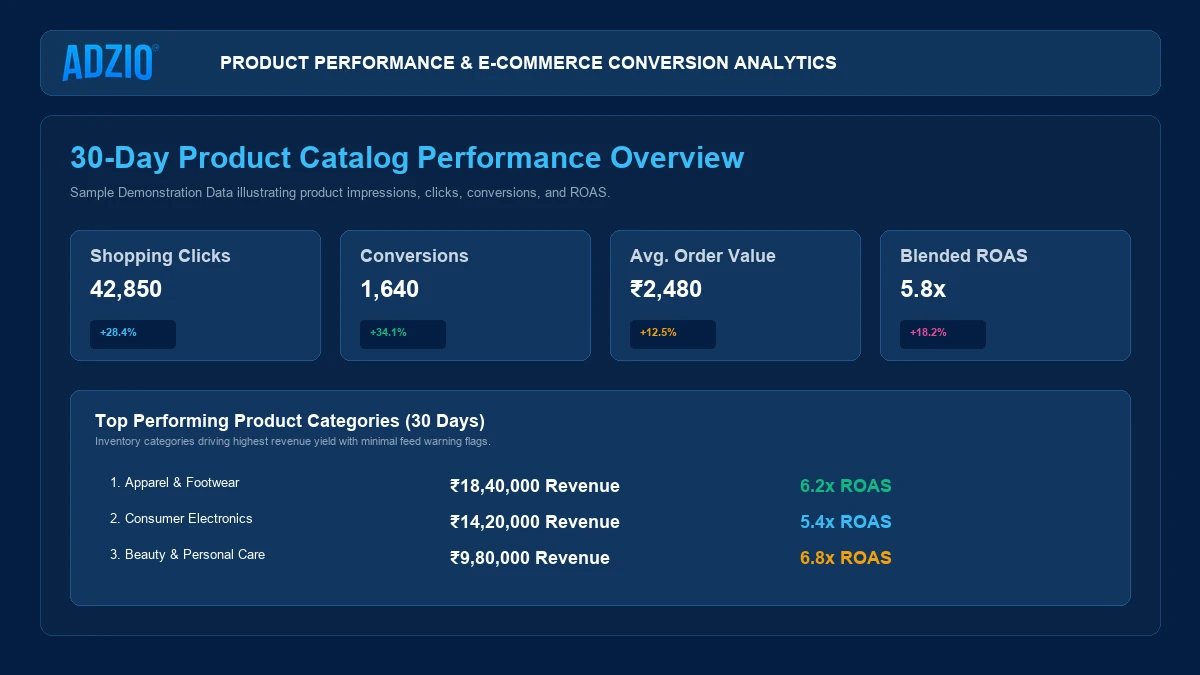
Effective measurement in Google Merchant Center requires analyzing two distinct data domains: Feed Health Metrics and Commercial Performance Metrics. Conflating these two realms leads to incomplete strategic conclusions.
Feed Health Metrics quantify the operational integrity of your data pipeline. These include your Catalog Approval Rate (targeting 98%+ active approval), Warning Frequency, Crawl Error Frequency, and API Synchronization Latency. A healthy feed is the structural prerequisite; if items are disapproved or throttled by warnings, no amount of marketing genius can generate sales.
Commercial Performance Metrics measure consumer interaction across Google surfaces. Inside Merchant Center's Performance tab, merchants can track Organic Impressions, Organic Clicks, and Click-Through Rate (CTR) for Free Product Listings. When integrated with Google Ads, these metrics expand to include Cost-Per-Click (CPC), Conversion Rate, Return on Ad Spend (ROAS), and Product-Level Gross Profitability.
AdZio 30-Day Catalog Health & Performance Simulator
Simulate how feed attribute optimization and disapproval remediation translate into expanded organic visibility and commercial returns.
12 Costly Google Merchant Center Mistakes to Avoid
Common technical and compliance blunders that trigger account suspensions and waste advertising budget.
1. Price & Currency Mismatches
Displaying prices in the feed that differ from the live checkout total, frequently triggered by automated currency converters or dynamic shipping surcharges.
2. Invented or Fake Barcodes
Generating random 13-digit numbers to bypass GTIN requirements. Google validates checksums against GS1 databases, triggering automated item bans.
3. Promotional Image Watermarks
Adding "Sale", "Free Shipping", or logo stamps onto primary product photos, violating Google's pristine visual background policies.
4. Generic Keyword-Stuffed Titles
Writing titles like "Best Shirt Buy Online Cheap" instead of structured attributes (Brand + Item + Material + Color + Size), destroying search matching relevance.
5. Opaque Refund & Return Terms
Omitting a dedicated, transparent Return and Refund policy in the website footer, the number one trigger for "Misrepresentation" account suspensions.
6. Out-of-Stock Desynchronization
Failing to update inventory availability flags in real time, causing shoppers to click paid ads on products that cannot be purchased.
7. Broken Landing Page URLs
Submitting expired product links or 404 redirect chains that fail Googlebot's automated crawling verification tests.
8. High-Level Taxonomy Dumping
Assigning generic top-level Google Product Categories rather than drilling down into the most granular sub-tier available in the taxonomy.
9. Inconsistent Shipping Rates
Configuring shipping rates in Merchant Center that are cheaper than what is charged at actual checkout, flagged as misleading commercial practice.
10. Neglecting Variant Parent-Child Links
Failing to populate `item_group_id` across size and color variants, resulting in fragmented, competing listings on the Shopping carousel.
11. Ignoring the Diagnostics Tab
Allowing yellow warnings to accumulate until they escalate into a full account suspension notice with a ticking remediation deadline.
12. Missing GST Transparency in India
Failing to clarify whether catalog prices include Goods and Services Tax (GST), creating checkout friction and regulatory non-compliance.
Master Comparison: GMC vs. Google Shopping vs. Shopping Ads vs. SEO
Understanding how each digital marketing discipline functions within a unified commercial retail strategy.
| Strategic Vector | Google Merchant Center | Google Shopping | Google Shopping Ads | Ecommerce SEO |
|---|---|---|---|---|
| Core Purpose | Product data architecture, feed validation, and policy compliance. | Front-end consumer product comparison and discovery portal. | Paid advertising auction to capture high-intent commercial buyers. | Organic search engine optimization of store landing pages. |
| Primary Target | Google catalog algorithms and policy review crawlers. | Active shoppers browsing categories, comparing prices and reviews. | High-intent transactional shoppers searching specific keywords. | Organic web search crawlers and informational searchers. |
| Cost Structure | 100% Free tool provided by Google. | Zero media cost for Free Product Listings. | Pay-per-click (CPC) or target ROAS advertising auction. | Organic traffic; ongoing optimization investment. |
| Data Driver | XML/API product feeds, microdata, and feed rules. | Approved Merchant Center catalog attributes and trust signals. | Merchant Center feed linked to Google Ads campaign bids. | On-page HTML, site speed, backlinks, and schema markup. |
| Commercial Leverage | Guarantees data accuracy and unlocks all Google retail surfaces. | Generates steady, zero-cost organic e-commerce traffic. | Delivers immediate, scalable revenue and customer acquisition. | Builds compounding, long-term brand search equity. |
AdZio's 11-Stage Google Merchant Center Merchandising Framework
Our proven, end-to-end operational blueprint for flawless catalog setup, optimization, and scaling.
Business & Catalog Discovery
We review your retail business model, gross margins, shipping logistics, target geographic markets, and legal entity requirements across India and global territories.
Inventory Architecture Assessment
We audit your store database, analyzing SKU taxonomy, variant relationships, barcode availability (GS1 GTIN status), and inventory velocity patterns.
Merchant Center Setup & Domain Claim
We establish your verified Google Merchant Center account, execute DNS/Search Console domain claiming, and configure tax and shipping tables.
Data Pipeline Engineering (API / XML)
We construct an automated, high-resilience product feed using direct Content API webhooks or scheduled server XML fetches, eliminating manual file uploads.
Title & Attribute Optimization
We craft high-converting product titles using category-specific formulas, map deep variant attributes (size, color, material), and assign granular Google Product Categories.
Visual Asset Compliance Audit
We verify that all product photography complies with Google's no-watermark standards, optimize resolutions to 1000x1000+ pixels, and configure multi-angle secondary image arrays.
Diagnostics & Policy Triage
We perform pre-launch diagnostic scrubbing, resolving all item warnings, schema validation errors, and policy friction to achieve a 98%+ initial approval rate.
Microdata & Landing Page Alignment
We inspect on-site Schema.org JSON-LD microdata to ensure automated crawlers detect perfect price and availability parity, enabling Automatic Item Updates.
Google Ads & PMax Synchronization
We link Merchant Center to Google Ads, architect custom labels (margin tiers, seasonality, bestsellers), and structure high-performing Performance Max asset groups.
Tracking Validation & Free Listing Growth
We activate Free Product Listings across the Google Shopping tab and verify that conversion tracking tags capture dynamic revenue values with 100% precision.
Continuous Monitoring & Seasonal Scaling
We provide ongoing catalog supervision, daily diagnostic error triage, search query title refinement, and merchant promotion management during major shopping festivals.
Who Should Consider Google Merchant Center?
The essential retail infrastructure for any business with physical or digital goods to sell online.
Google Merchant Center is an indispensable asset for any enterprise operating in the modern retail economy. Whether you are an ambitious direct-to-consumer brand scaling in the Indian market or an established multi-brand retail chain with nationwide distribution, Merchant Center is the gateway to Google's commercial search ecosystem.
D2C E-Commerce Brands
Direct-to-consumer lifestyle, fashion, beauty, and wellness brands looking to scale customer acquisition while building direct customer relationships.
Multi-Brand Retailers
Department stores and online retailers managing thousands of branded products requiring GTIN matching to compete against massive marketplaces.
Omnichannel Brick-and-Mortar
Retailers with physical stores utilizing Local Inventory Ads to showcase real-time in-store stock availability to nearby local shoppers.
B2B & Industrial Distributors
Manufacturers and wholesale distributors selling equipment, replacement components, and business supplies with fixed, transparent catalog pricing.
Frequently Asked Questions About Google Merchant Center
Authoritative, clear answers to common questions regarding catalog setup, feeds, and policy compliance.
Google Merchant Center is a dedicated back-end platform provided by Google that enables online retailers to store, manage, validate, and synchronize structured product information. It serves as the data foundation that allows your products to appear across Google's retail surfaces, including organic Free Product Listings on Google Shopping and paid Shopping Ads in Google Ads.
Yes, creating and maintaining a Google Merchant Center account is completely free. Uploading your product feed and participating in organic Free Product Listings across the Google Shopping tab incurs zero media charges from Google. Costs only arise if you choose to link your Merchant Center account to Google Ads to run paid advertising campaigns (such as Performance Max or Standard Shopping Ads).
Merchant Center operates by ingesting your store's product feed via API, XML files, or scheduled Google Sheets. Google's automated systems audit the data against strict formatting and policy specifications, verify that prices and stock match your live landing pages, and index approved items into Google's commercial search graph for distribution across Shopping, Search, Images, and YouTube.
Account setup involves: 1) Registering your business details and legal contact info; 2) Verifying and claiming your website domain via DNS, HTML tag, or Google Search Console; 3) Configuring your tax rules and shipping fee tables; 4) Ensuring your website possesses compliant checkout, refund, and contact pages; and 5) Creating and submitting your primary product feed.
Products can be added using several methods: 1) Direct Content API synchronization from platforms like Shopify or WooCommerce; 2) Scheduled XML/RSS server feeds hosted on your website; 3) Google Sheets feeds with automated daily fetch; 4) Manual SFTP/FTP data file uploads; or 5) Direct website product crawling via automated structured data discovery.
A product feed is a structured digital file (typically XML, TSV, or JSON via API) containing detailed columns or keys for every product in your catalog. It conveys required attributes such as unique ID, title, description, landing page URL, image URL, price, currency, availability, brand, GTIN barcode, and category.
Core required attributes for all products include: `id`, `title`, `description`, `link`, `image_link`, `price`, `availability`, and `brand`. For commercially manufactured goods, a valid `gtin` is required. Apparel products additionally require `item_group_id`, `color`, `size`, `gender`, and `age_group`. Shipping configurations must also be specified.
A Global Trade Item Number (GTIN) is an internationally recognized numerical barcode issued by GS1 that uniquely identifies a commercial product worldwide. Examples include 13-digit EANs in India/Europe and 12-digit UPCs in the USA. Submitting authentic GTINs allows Google to match your listing against identical items sold by competitors and feature your store in comparison panels.
Common causes include: price or availability mismatches between feed and website checkout; watermarks or promotional text on product images; invalid or fabricated GTIN barcodes; broken landing page URLs (404 errors); restricted product categories (pharmaceuticals, dangerous goods); and website trust issues such as missing contact info or unclear return policies.
Errors are resolved by: 1) Inspecting the Diagnostics tab to identify affected SKU IDs and specific policy codes; 2) Updating the raw store data or modifying Merchant Center Feed Rules to fix attribute formatting; 3) Verifying on-page Schema.org JSON-LD microdata; and 4) Re-submitting the feed or requesting an algorithmic review once data parity is restored.
Shopify integrates with Merchant Center via the official Google & YouTube app or through advanced XML feed management apps. AdZio configures custom Shopify metafields to populate granular Google attributes (GPC, age group, gender, custom labels) that the default app often truncates, unlocking maximum bidding control in Google Ads.
WooCommerce integrates via specialized feed generation plugins (such as Product Feed PRO) or custom REST API endpoints. AdZio optimizes server caching and cron execution schedules to ensure feed generation does not exhaust server memory or slow down customer browsing on your WordPress storefront.
Google Merchant Center is the merchant-facing back-end tool where you upload, validate, and manage your raw product data. Google Shopping is the consumer-facing front-end discovery interface where shoppers search, compare prices, and click product listings to buy from your store.
Merchant Center holds your verified product data and ensures policy compliance. Google Ads is the paid advertising platform where you set budgets, bidding strategies, and target ROAS goals. Google Ads pulls product information from Merchant Center to automatically generate Shopping and Performance Max ads.
Absolutely. In fact, Merchant Center is one of the most effective tools for small retailers because it allows them to list products for free on the Google Shopping tab. By maintaining clean product data and descriptive titles, boutique stores can outrank large marketplaces for specific, long-tail commercial search queries.
Google requires feeds to be refreshed at least once every 30 days, or products will expire. However, for active e-commerce stores, AdZio recommends real-time Content API synchronization or automated daily XML fetches. Enabling Automatic Item Updates ensures price and stock fluctuations are captured continuously.
Data optimization includes: 1) Structuring titles to place high-intent keywords and key attributes within the first 70 characters; 2) Providing exhaustive product descriptions; 3) Using high-resolution imagery with neutral backgrounds; 4) Mapping exact Google Product Categories; 5) Ensuring 100% authentic GTINs; and 6) Utilizing custom labels for profit margin segmentation.
AdZio delivers enterprise-grade catalog management through an 11-stage framework: business discovery, catalog architecture assessment, domain claim, automated API/XML feed engineering, title and attribute optimization, image compliance audits, diagnostic remediation, on-site schema alignment, Google Ads linkage, and continuous seasonal optimization.
Ready to Build a Better Product Data Strategy?
Eliminate disapprovals, automate inventory synchronization, and unlock the full commercial power of Google Shopping and Performance Max with AdZio's proven catalog engineering frameworks.