 ISO Certified Company
+91-9233973156
ISO Certified Company
+91-9233973156
ISO Certified Company
+91-9233973156
ISO Certified Company
+91-9233973156

Connect with prospective customers at the exact micro-moment they search for your products and services. Google Search Ads place your business at the very top of search engine results pages, capturing high-intent commercial demand with measurable precision, transparent spend control, and verified business conversions.
Target prospects actively seeking vendors, pricing, and immediate solutions — not passive browsers scrolling social feeds.
Hardcode account-level negative keyword lists to eliminate job hunters, free inquiries, and irrelevant query waste before spend occurs.
Achieve above-average expected CTR, ad relevance, and landing page speed to win top SERP positions at 30% to 50% lower CPCs.
Campaigns operate directly inside your Google Ads account. Transparent billing, full search query visibility, and zero proprietary lock-in.
Understanding the core mechanics of Google's paid search advertising platform and why it represents the single highest-intent advertising channel in modern digital marketing.
Google Search Ads are text-based sponsored listings that appear at the very top and bottom of Google search results pages when a user enters a query matching an advertiser's targeted keywords. Distinguished by a subtle “Sponsored” tag, these ads align directly with the user’s immediate information need or commercial requirement. Unlike display banners or social media ads that interrupt users while they are browsing news feeds or watching videos, Search Ads operate on a fundamentally different mechanism: inbound intent capture.
This distinction between “pull advertising” and “push advertising” is why paid search remains the backbone of customer acquisition for commercial enterprises. When an individual in India types “industrial packaging equipment manufacturers” or “best commercial property lawyer near me”, they are not seeking passive entertainment. They have already acknowledged a specific problem, established active buyer intent, and are conducting decisive research. Search advertising allows your business to present a relevant, compelling solution at the exact moment that commercial decision is being formulated.
In the Indian digital marketplace, Google commands over 95% of search engine query volume across mobile and desktop devices. This massive search penetration means that every day, millions of high-value commercial transactions begin with a simple search query. Whether a business operates as a local healthcare clinic, a regional automobile dealership, an enterprise B2B machinery provider, or an e-commerce brand, Google Search Ads provide immediate visibility on terms that matter most to bottom-line profitability.
Furthermore, Google Search advertising functions on a pay-per-click (PPC) model. Advertisers incur a cost only when an interested user actively clicks on their ad to visit their landing page. Coupled with precise budget capping, dayparting schedules, and geographic targeting down to city and postal code levels, paid search gives businesses unprecedented financial and strategic control over their customer acquisition investments.
From the millisecond a query is entered to the final conversion on your landing page: unpacking Google's real-time auction, Ad Rank formula, and Quality Score economics.
Every time a user submits a search query on Google, an automated real-time auction occurs in a fraction of a second. Google scans its index of advertisers to identify accounts that have targeted keywords relevant to that search query. However, unlike traditional advertising auctions where the highest monetary bid automatically secures the premier placement, Google employs a sophisticated Vickrey-style second-price auction that balances commercial revenue with user search satisfaction.
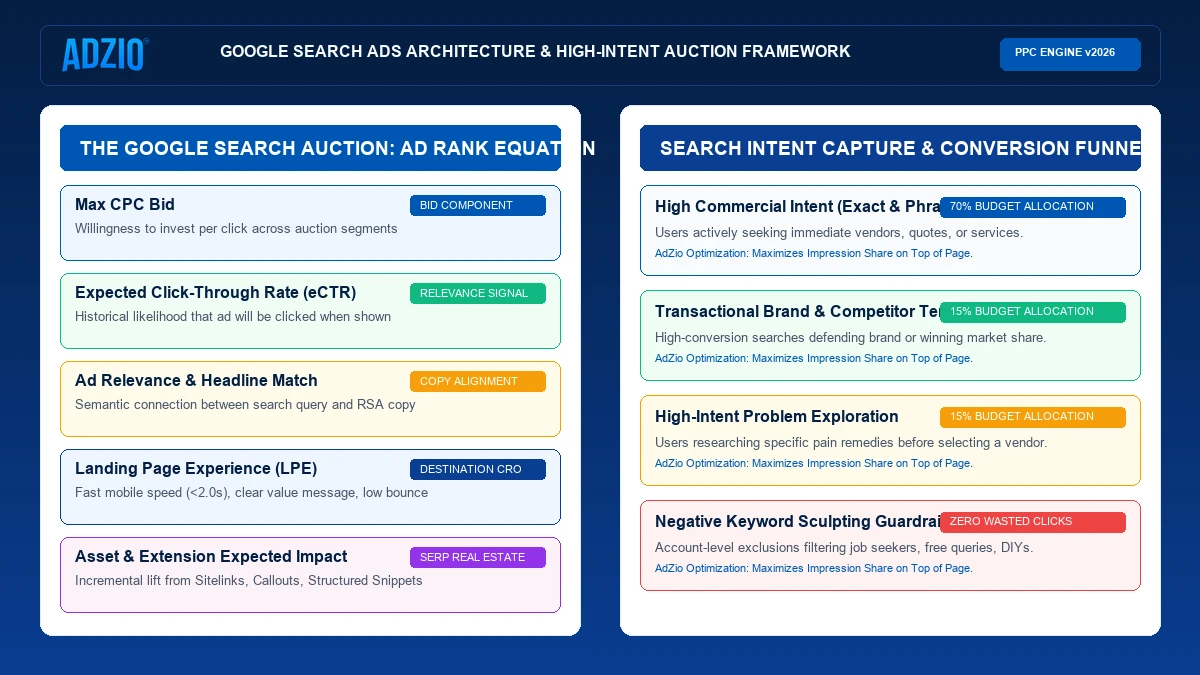
The position of each eligible ad on the search results page is determined by Ad Rank. Google calculates Ad Rank using a multi-factor formula: your maximum cost-per-click (CPC) bid multiplied by your Quality Score, plus the anticipated impact of your ad assets (such as sitelinks, callout extensions, and structured snippets) and the context of the user's search (device, location, time of day, and implied intent).
Quality Score is Google's diagnostic rating on a scale of 1 to 10 that assesses the relevance and quality of your advertising experience. It is composed of three equally critical pillars: Expected Click-Through Rate (eCTR), which predicts how likely your ad is to earn clicks based on past auction performance; Ad Relevance, which gauges how tightly your headline and description copy match the searcher's query; and Landing Page Experience, which measures whether your destination page loads rapidly, operates frictionlessly on mobile devices, and delivers on the exact promise made in the ad copy.
Because Quality Score serves as a direct multiplier in the Ad Rank equation, an advertiser with a high Quality Score (such as 8 or 9 out of 10) can consistently achieve top-of-page ad rankings while paying substantially lower actual cost-per-click than a competitor bidding twice as much with a poorly structured campaign and irrelevant landing page. At AdZio, our Google Search Ads management is engineered specifically to maximize Quality Score metrics, driving down acquisition costs while securing dominant search market presence.
User types an explicit commercial query into Google Search signaling an active problem or purchase requirement.
Google checks keyword eligibility, negative exclusions, match types, and computes Ad Rank across competing bidders.
The winning Responsive Search Ad appears with relevant assets (sitelinks, phone numbers, location information).
The visitor lands on a fast, message-matched page and completes a verified call, form submission, or inquiry.
Keywords without intent analysis are merely words. Aligning campaigns with commercial and transactional intent is what separates profitable client acquisition from wasted ad spend.
In search engine marketing, search intent represents the primary objective of a user when entering a query into Google. Search queries fall into four primary classifications: informational (learning a concept or finding facts), navigational (locating a specific website or brand login), commercial investigation (comparing solutions, reading reviews, and examining pricing), and transactional (ready to purchase, book, or hire immediately). In Google Search Ads, failing to distinguish between these intent layers is the leading cause of unprofitable advertising campaigns.
For instance, when an individual searches for “what is commercial air conditioning”, they possess informational intent — likely a student, junior researcher, or curious reader. Serving a paid search ad for an industrial HVAC contractor on this query burns valuable budget on someone who will never convert into a paying client. Conversely, when a facilities manager searches “commercial chiller AMC rates in Pune” or “hire industrial HVAC installation contractor”, they are exhibiting high-intent commercial and transactional behavior. Capturing this specific query yields immediate inbound inquiries.
Many self-managed accounts and inexperienced marketing agencies make the fatal error of chasing raw search volume over commercial intent. Broad, single-word or two-word terms like “real estate”, “dentist”, or “car repair” may generate thousands of monthly searches across India, but their intent is intensely ambiguous. Bidding on such terms floods the advertising account with accidental clicks, job applicants, DIY hobbyists, and competitor staff, depleting daily budgets before genuine buyers can ever discover the ad.
At AdZio, our keyword architecture is built from the bottom of the purchase funnel upwards. We prioritize transactional and high-consideration commercial investigation queries that demonstrate concrete buying signals. By tailoring ad messaging and landing page experiences specifically to address the user’s immediate problem, budget expectations, and urgency, we maximize conversion rates while maintaining rigorous cost-per-acquisition control.
The searcher is ready to purchase, hire, or request an immediate quote.
“hire commercial litigation lawyer”“buy 500kva industrial diesel generator”“orthopedic robotic knee surgery cost”
The searcher has identified their problem and is actively comparing specific vendors or solutions.
“top real estate developers reviews”“best b2b inventory management software india”“commercial truck dealership near me”
The searcher types your exact brand name, or you strategically bid on a competitor's name.
“adzio search ads agency”“competitor alternative for enterprise”“brand pricing plans”
The searcher wants free information, tutorials, or academic definitions — not to buy.
“what is search ads in marketing”“free google ads templates pdf download”“digital marketing jobs salary”
How AdZio builds scalable, waste-resistant keyword portfolios through rigorous keyword research, match type discipline, negative keyword sculpting, and continuous search query auditing.
A high-performing keyword strategy is not an indiscriminate compilation of hundreds of search terms exported from a research tool. It is a carefully engineered portfolio structured around clear business themes, revenue priorities, and customer psychology. At AdZio, our keyword research begins with deep commercial discovery: understanding your exact service offerings, margin profiles, geographic service boundaries, and customer lifetime value. We then identify the high-specificity long-tail keywords that prospective buyers naturally utilize when searching for solutions.
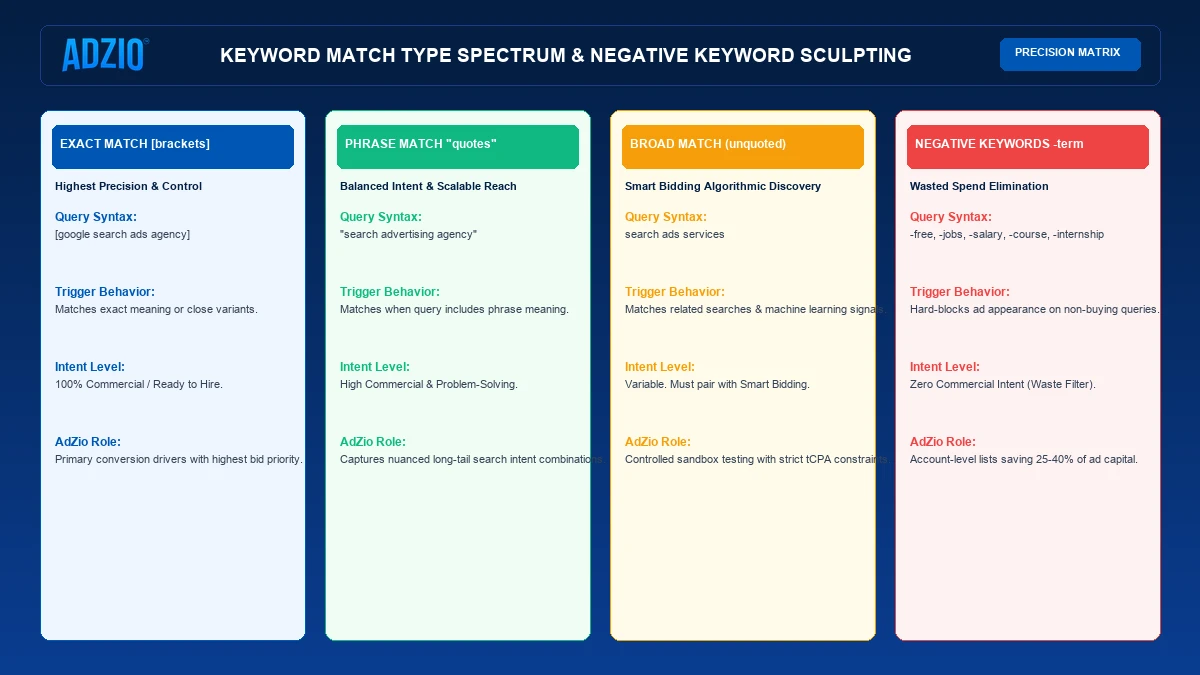
Modern keyword targeting requires disciplined application of Google’s three match types: Exact Match ([keyword]), Phrase Match (“keyword”), and Broad Match. Exact Match grants maximum precision, triggering ads only when the search query shares the identical meaning of your keyword. Phrase Match captures queries that include your core phrase or close variants, offering a healthy balance between control and incremental volume. While Google increasingly advocates for Broad Match combined with automated Smart Bidding, unleashing Broad Match without extensive negative keyword defenses and established conversion history often results in catastrophic budget waste on loosely related queries.
Negative keywords represent the unsung heroes of paid search profitability. A negative keyword list instructs Google never to display your ads when specific words or phrases appear in the user's search query. Before launching any campaign, AdZio implements comprehensive account-level negative keyword lists covering universal non-buyer terms — including “free”, “jobs”, “salary”, “internship”, “course”, “definition”, “DIY”, “wholesale login”, and “customer care number”. This proactive defense prevents thousands of rupees from bleeding into non-converting clicks.
Finally, keyword strategy is not a static setup; it requires continuous optimization through weekly audits of the Search Terms Report. This report reveals the exact, unvarnished queries that users typed before clicking your ads. By reviewing this data systematically, AdZio performs two vital actions: harvesting newly emerging, highly profitable long-tail terms to add as dedicated exact match keywords, and identifying unwanted query patterns to immediately block as negative keywords. This compounding refinement process consistently reduces cost per lead over time.
| Match Type | Syntax Example | Matching Behavior | AdZio Deployment Rule |
|---|---|---|---|
| Exact Match | [commercial litigation lawyer] |
Matches searches with the exact meaning or close semantic variants with identical intent. | Primary Foundation (50-60% Budget): Used for top revenue-driving commercial terms. Maximum bid control, highest Ad Relevance. |
| Phrase Match | “industrial diesel generator” |
Matches searches that include the core meaning of the phrase, allowing words before or after. | Expansion Engine (30-40% Budget): Captures relevant long-tail variations and local modifiers while preserving core commercial context. |
| Broad Match | orthopedic hospital consultation |
Matches queries related to the keyword concept, synonyms, or algorithmic associations. | Selective Scaling Only (<10% Budget): Deployed only in mature campaigns with 50+ monthly conversions, strict Target CPA, and extensive negatives. |
How AdZio crafts high-converting Responsive Search Ads using multi-asset frameworks, strategic headline pinning, compelling value propositions, and relevant ad extensions.
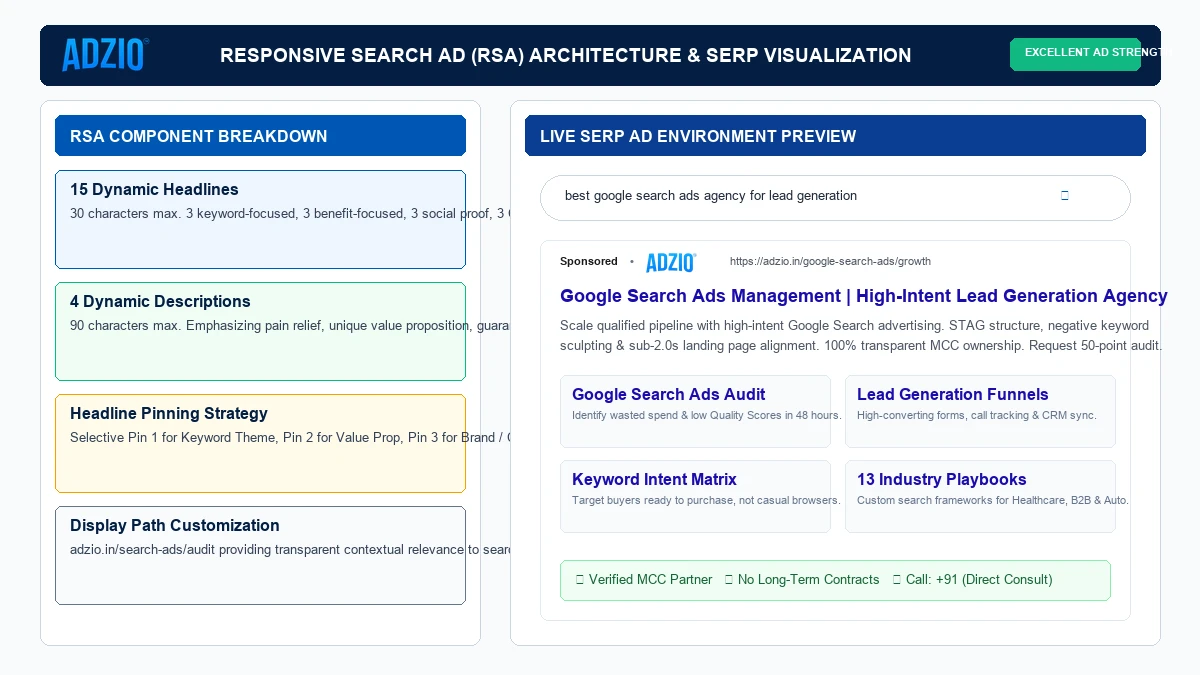
In Google Search advertising, your ad copy represents the sole interface between a prospective customer’s urgent need and your business solution. With Google’s transition to Responsive Search Ads (RSAs) as the default search ad format, effective copywriting has evolved from crafting rigid static lines to architecting dynamic messaging systems. An RSA permits up to 15 distinct headlines (30 characters each) and 4 comprehensive descriptions (90 characters each). Google’s machine learning algorithm dynamically tests combinations of these assets to assemble the ad deemed most likely to maximize click-through rate for each user’s unique context.
However, relying entirely on unguided algorithmic assembly often produces repetitive, nonsensical, or legally non-compliant ads. Many advertisers fill their headline slots with slight variations of the same keyword — such as “Commercial Lawyer”, “Top Commercial Lawyer”, and “Best Commercial Lawyers” — leaving Google with no meaningful differentiation to test. At AdZio, we implement a structured 5-category headline methodology: Category A (exact keyword-matching headlines), Category B (unique value propositions and quantitative proof), Category C (frictionless calls-to-action), Category D (geographic trust signals), and Category E (risk-reversal warranties).
Strategic asset pinning is another crucial technique in professional RSA management. By thoughtfully pinning mandatory brand terms or specific regulatory disclaimers to Headline 1 or Description 1, we ensure that critical business messaging appears consistently while permitting Google’s algorithms full creative flexibility across secondary positions. This hybrid approach delivers both brand protection and continuous algorithmic performance gains.
Furthermore, text ads must never stand alone. Google Ad Assets (formerly extensions) — including Sitelinks, Callouts, Structured Snippets, Call Assets, and Location Assets — expand your visual footprint on the search results page by up to 100%. These assets provide searchers with direct pathways to specific sub-services, phone numbers, and physical addresses while pushing competitor listings further down the viewport. Google explicitly includes asset usage as an active component in Ad Rank calculations, making full asset implementation non-negotiable for serious campaigns.
Reduce commercial electricity costs by up to 70%. High-efficiency tier-1 solar panels. On-grid & hybrid installations with institutional subsidy support. Get a customized quote.
View verified plant installations
Estimate payback period online
Book technical engineer visit
Zero upfront CAPEX lease options
A search ad can only deliver qualified visitors to your door; what happens on your destination page dictates whether that traffic converts into profitable business revenue.
The most common tragedy in Google Search advertising is spending significant resources generating high-intent clicks only to send visitors to an unfocused, slow, or generic corporate homepage. A user who searches for “commercial chiller maintenance contract” expects to land on a page dedicated exclusively to commercial chiller maintenance — complete with contract tiers, emergency response times, certified technician credentials, and an immediate inquiry form. Forcing that user to land on a generic homepage and hunt through navigation menus creates cognitive friction, triggers immediate bounces, and squanders ad budget.
This principle is known as Message Match, and it directly governs both user conversion psychology and Google’s Landing Page Experience rating within the Quality Score algorithm. Strong message match requires that the core keyword query, the ad headline, and the landing page H1 headline share identical linguistic and thematic harmony. When a user experiences seamless message match, their subconscious confirmation bias is validated: they immediately recognize they have arrived at the exact right destination.
Beyond conceptual relevance, technical landing page performance is paramount — particularly in the mobile-first Indian internet ecosystem where network speeds vary across regions. Google penalizes landing pages that exhibit sluggish load times, cumulative layout shifts (CLS), or delayed interactivity. Every campaign landing page developed or audited by AdZio is engineered for rapid Core Web Vitals performance: sub-2.0 second load speeds, clean responsive layouts, and frictionless form completion on all mobile devices.
Finally, a dedicated Google Ads landing page must feature a singular, unambiguous conversion path. Unlike broad corporate websites designed for multi-stakeholder exploration, a conversion-focused landing page eliminates distracting external links, headers, and secondary menus. By focusing the visitor’s attention on a clear, compelling call-to-action — whether scheduling an appointment, requesting a customized quotation, or initiating a direct phone call — we maximize the percentage of paid clicks that translate directly into verified business leads.
Landing page headlines directly mirror the exact search query and ad copy, confirming immediate relevance and eliminating visitor bounce rates.
Optimized for Core Web Vitals to deliver lightning-fast loading across 4G and 5G mobile networks throughout urban and regional Indian markets.
Streamlined contact forms, instant tap-to-call mobile buttons, and integrated WhatsApp business click triggers designed for maximum inquiry capture.
A disciplined account hierarchy is the bedrock of search advertising profitability. How AdZio structures campaigns to prevent budget cannibalization, maximize Quality Score, and maintain granular control.
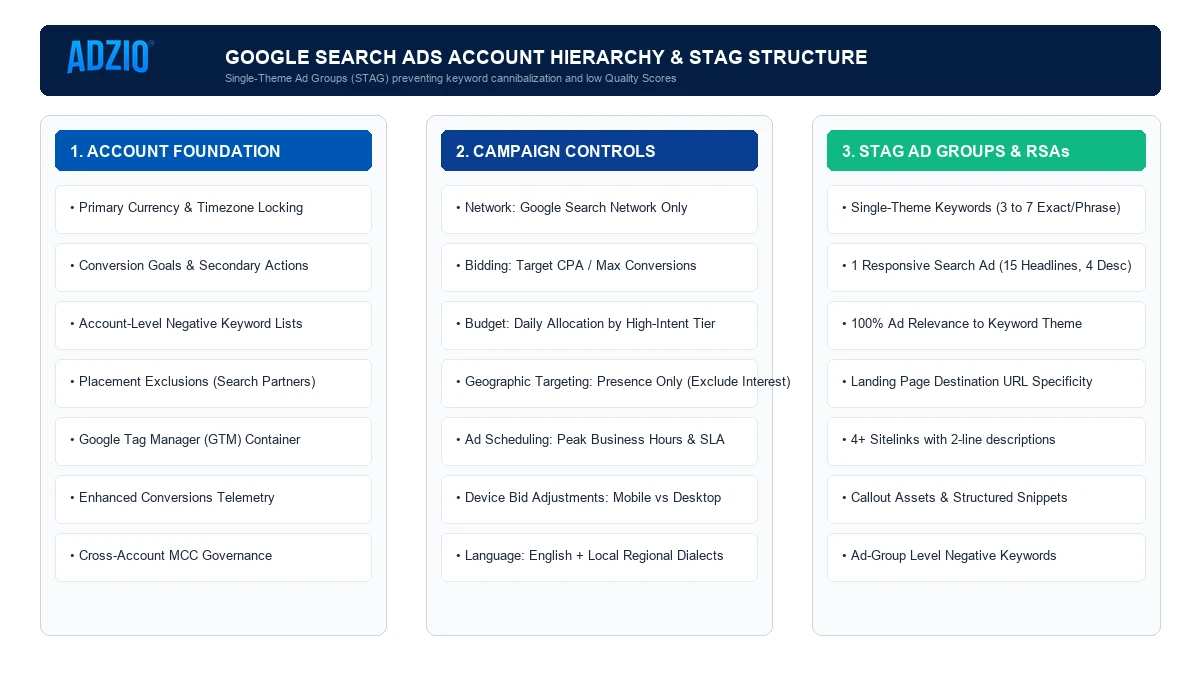
The architecture of a Google Ads account dictates everything from bid efficiency and budget control to ad relevance and reporting clarity. When an account is haphazardly organized — with dozens of unrelated keywords crammed into a single ad group — it becomes impossible to serve tightly tailored ad copy, allocate daily budgets intelligently, or isolate which specific products are generating profitable returns. AdZio engineers institutional-grade account structures designed for transparency, scalability, and relentless algorithmic efficiency.
Google Ads follows a 3-tier operational hierarchy: Account Level, Campaign Level, and Ad Group Level. Critical strategic parameters are governed exclusively at the Campaign level — including daily spend budgets, geographic targeting boundaries, language selection, network distribution, ad scheduling (dayparting), and automated bid strategy selection. Therefore, businesses must separate distinct service lines, high-margin versus low-margin offerings, and regional territories into discrete campaigns to prevent aggressive keywords from consuming budget intended for high-priority revenue drivers.
Within each campaign, AdZio implements Single-Theme Ad Groups (STAG). Rather than packing 50 disparate terms together, each STAG contains only 3 to 7 tightly focused keywords sharing identical user intent. This disciplined segmentation enables our copywriters to draft Responsive Search Ads where every single headline speaks directly to the specific terms in that ad group, naturally achieving top-tier “Above Average” Ad Relevance ratings from Google's diagnostic systems.
Furthermore, an essential structural requirement is the strict separation between Brand Search Campaigns and Non-Brand Search Campaigns. Users searching for your company’s specific name already know who you are; these branded clicks exhibit extremely high conversion rates at tiny CPCs. Blending branded keywords with non-branded discovery terms artificially masks poor non-brand performance, creating an illusion of high account ROAS while non-brand budget is silently wasted. By isolating brand and non-brand campaigns into separate silos with dedicated budgets, we maintain pristine performance telemetry.
The master container linked to business billing, user access permissions, account-wide negative keyword lists, and verified conversion tracking actions.
Strategic containers where daily monetary budgets, geographic boundaries, bidding strategies, and device bid modifiers are established and controlled.
Sub-clusters organizing 3 to 7 keywords of identical commercial intent paired with dedicated, message-matched Responsive Search Ads.
Calibrating search campaigns across hyper-local neighborhood radii, tier-1 metropolitan centers, tier-2/tier-3 growth markets, and nationwide pan-India expansion.
Geographic precision is one of the most commercially transformative capabilities of the Google Search Ads platform. Whether a business operates a localized medical clinic serving patients within a 15-kilometer radius or an enterprise software firm marketing solutions across all 28 Indian states, search campaigns can be calibrated with pinpoint geographic accuracy. Crucially, successful search advertising is not one-size-fits-all; local consumer behavior, search query phrasing, and competitive auction density vary dramatically between neighborhood catchments and nationwide markets.
For local and service-area businesses — such as diagnostic centers, automobile dealerships, legal practitioners, and luxury retail showrooms — search advertising captures high-intent customers at the decisive moment of physical or immediate service need. Queries containing explicit local modifiers (such as “orthopedic doctor in South Delhi” or “jewellery showroom near Salt Lake Kolkata”) and implicit “near me” mobile searches exhibit conversion rates unmatched by any passive marketing medium. AdZio integrates local campaigns directly with verified Google Business Profiles, deploying Location Assets that showcase physical street addresses, store hours, and direct tap-to-call mobile buttons.
A vital technical setting in local search configuration is Google’s location option: “Presence” versus “Presence or Interest”. By default, Google targets users who are physically located in, or who have expressed interest in, your targeted location. For a local clinic or repair center, leaving this on default causes budget waste on searchers located hundreds of kilometers away who merely researched the city. AdZio strictly configures physical presence targeting for local clients, ensuring ad spend is deployed exclusively to individuals actually residing within or visiting the immediate service territory.
Conversely, for businesses with national Indian reach — such as D2C e-commerce brands, B2B industrial manufacturers, higher education institutes, and financial services — campaign architecture requires strategic tier segmentation. Metropolitan hubs (such as Mumbai, Delhi NCR, Bengaluru, and Hyderabad) feature elevated cost-per-click levels and intense auction competition, while Tier-2 and Tier-3 commercial centers (such as Jaipur, Lucknow, Bhubaneswar, Guwahati, and regional hubs) often provide substantial search demand at substantially lower acquisition costs. By segmenting national campaigns into metropolitan and regional tiers with independent budget allocations, AdZio ensures clients capture high-margin demand across India without overpaying in hyper-competitive auctions.
Define a precise 5km to 35km radius around your physical facility, clinic, or showroom with strict physical presence verification to capture immediate footfall and phone inquiries.
Segment multi-branch businesses into dedicated city campaigns. Allocate budgets according to branch capacity, local market demand, and regional search volumes.
Scale nationwide with segmented metro and tier-2/tier-3 campaign tiers. Prevent high-cost metro auctions from draining budgets intended for high-ROI regional markets.
How search intent, auction economics, compliance guidelines, and conversion architectures adapt across key commercial sectors in the Indian marketplace.
While the fundamental auction mechanics of Google Search Ads remain consistent, search intent dynamics, buyer journey latency, and regulatory constraints vary radically across different industry sectors. An emergency dental clinic operating in a bustling urban neighborhood faces fundamentally different search behavior than a B2B enterprise supplying industrial packaging machinery to manufacturing plants. Applying a generic, templated campaign structure across diverse business models inevitably leads to misallocated bids, poor lead quality, and disappointing conversion outcomes.
In high-consideration sectors like healthcare, real estate, and automobile dealerships, the search journey often involves multiple research micro-moments. Prospective car buyers or real estate investors conduct extensive comparison searches regarding specifications, pricing, amenities, and financing options before ever requesting a test drive or scheduling a site visit. Here, search campaigns must deploy rich Sitelinks, Price Assets, and Callout Assets to satisfy commercial investigation queries while capturing direct appointment bookings.
In contrast, urgent service sectors — including emergency medical specialists, commercial plumbing, equipment repairs, and time-critical legal counsel — are defined by immediate transactional urgency. Searchers in these verticals require immediate telephone access rather than lengthy informational content. AdZio tailors campaign structures for these sectors with prominent Call Assets, dedicated Call-Only campaigns on mobile devices, and landing pages featuring one-tap instant dialers and rapid WhatsApp inquiry connections.
Furthermore, specific Indian industries operate under stringent advertising policies enforced by Google. Healthcare and pharmaceutical advertisers must navigate strict certification requirements and substance restrictions; financial services require verified regulatory credentials; and educational institutes must maintain strict truth-in-advertising compliance. AdZio engineers industry-specific search strategies that ensure full policy compliance while capturing high-value commercial search intent.
Healthcare search advertising connects patients actively seeking medical consultations, diagnostic procedures, or specialist treatments with certified providers. Pull-based search ensures ads appear only when patients or family members type explicit medical need queries.
Automobile buyers and commercial fleet owners conduct extensive online research prior to visiting physical showrooms. Search ads allow authorized vehicle dealerships to capture customers actively evaluating specific models, booking test drives, or seeking authorized service appointments.
Property buyers use Google Search with intense commercial purpose. High ticket sizes mean a single converted property buyer covers months of paid search investment, making search ads the preeminent channel for luxury residences, commercial office spaces, and residential township projects.
While Shopping Ads and Performance Max play significant roles in e-commerce, Google Search Ads remain critical for capturing bottom-of-funnel transactional queries where buyers seek specific brands, SKU categories, or problem solutions with high purchase intent.
In the Indian jewellery sector, high-ticket bridal, gold, and certified diamond jewelry purchases combine intense digital research with physical showroom visits. Search ads bridge the gap between digital discovery and high-value in-store transactions.
Hotels, boutique resorts, and banquet venues rely on Google Search Ads to capture direct room bookings and high-margin event inquiries, reducing dependence on high-commission Online Travel Agencies (OTAs).
Travel agencies and customized tour operators capture vacationers and corporate travel planners actively researching itineraries, holiday packages, and guided expeditions across domestic and international destinations.
Higher education colleges, competitive exam coaching centers, and professional certification academies rely on Google Search Ads to drive student admissions during intensive annual enrollment windows.
Chartered accountants, corporate law firms, intellectual property attorneys, management consultancies, and architects acquire high-value retainers and commercial clients seeking specialized expertise.
Independent diagnostic centers, specialized repair workshops, local retailers, and service providers capture immediate neighborhood demand from customers ready to visit or call today.
B2B manufacturers, industrial component suppliers, wholesale distributors, and SaaS providers capture commercial buyers, procurement managers, and engineers specifying vendor shortlists.
Clicks and impressions are vanity metrics; qualified inquiries, scheduled appointments, and verified customer transactions represent genuine business success.
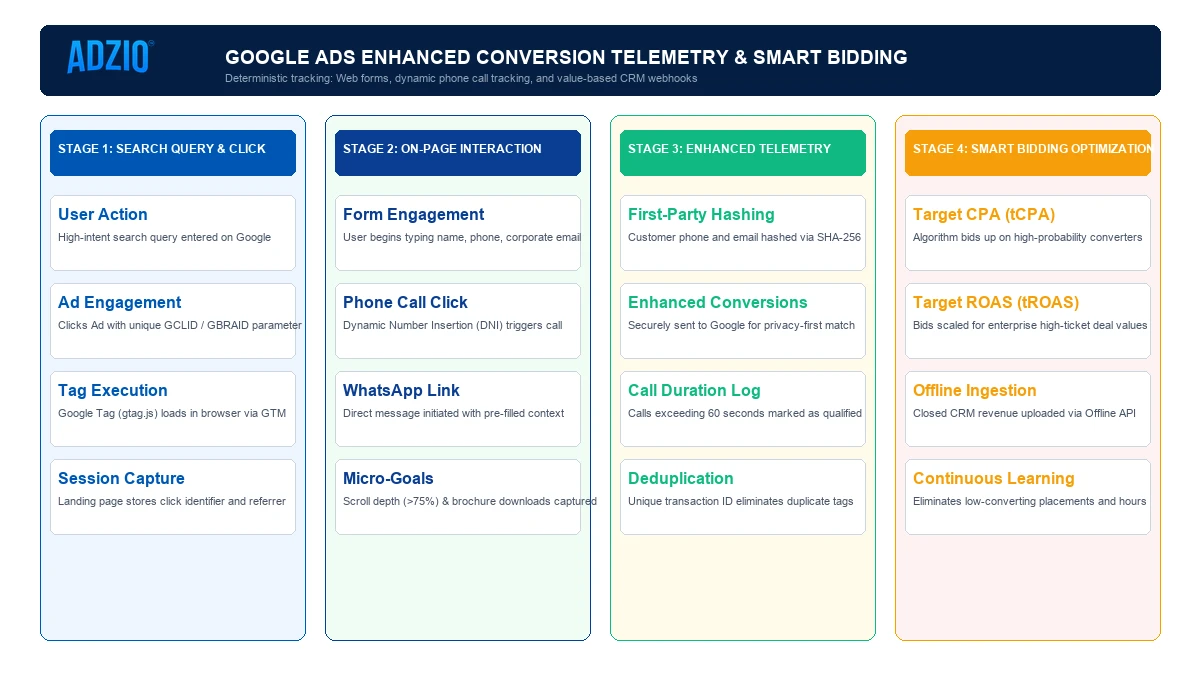
In Google Search advertising, traffic acquisition is merely an intermediate tactical step. An advertising campaign that generates thousands of clicks at an impressive click-through rate is an outright failure if those visits fail to produce qualified commercial actions that advance your business pipeline. At AdZio, our entire search management methodology is architected backward from the cash register: defining, measuring, and relentlessly optimizing for verified conversion events that directly reflect commercial growth.
Depending on your specific business model, conversions assume diverse forms across the buyer journey. For local service providers, medical clinics, and repair centers, the premier conversion action is typically an inbound phone call lasting over 60 seconds or an appointment booking request. For B2B industrial suppliers, legal consultants, and real estate developers, conversions materialize as detailed quotation inquiries and Request for Proposal (RFP) submissions. In the Indian digital market, direct WhatsApp business inquiries represent an increasingly vital conversion pathway that bridges high search intent with instant conversational sales engagement.
Reliable conversion optimization demands bulletproof technical measurement infrastructure. AdZio implements closed-loop tracking architectures utilizing Google Tag Manager (GTM), Google Analytics 4 (GA4), and native Google Ads conversion actions. We deploy Enhanced Conversions — a privacy-safe protocol that securely hashes first-party customer data (such as email addresses and phone numbers) to recover conversions that would otherwise be lost to browser privacy barriers, ad blockers, or cross-device journeys. This rich data stream provides Google’s Smart Bidding algorithms with high-fidelity signal quality, allowing automated bidding systems to pinpoint and bid aggressively on searchers most likely to convert.
Crucially, we evaluate campaign efficiency through true economic key performance indicators: Cost Per Lead (CPL), Cost Per Acquisition (CPA), and Return on Ad Spend (ROAS). By auditing search queries against lead quality feedback from your sales team, we continuously purge low-intent search terms and double down on keyword themes that generate high-ticket, closed transactions.
GTM triggers verified conversion events upon successful submission of detailed contact, quotation, or RFP forms on dedicated landing pages.
Dynamic Google forwarding numbers track calls originating from search ads and landing pages, filtering for calls exceeding 60 seconds to eliminate accidental dials.
Track clicks on WhatsApp chat buttons on landing pages as conversion signals, connecting search intent directly to your mobile sales team.
Capture direct online appointment confirmations, diagnostic test bookings, or consultation schedules with full attribution back to the triggering keyword.
A structured, disciplined 12-step workflow designed to engineer, launch, manage, measure, and continuously refine search advertising campaigns around actual business outcomes.
At AdZio, we do not view Google Search Ads as an automated “set-it-and-forget-it” software utility, nor do we rely on generic campaign templates. Successful search advertising is an ongoing operational discipline combining data science, behavioral copywriting, technical tracking engineering, and rigorous weekly account governance. Every client engagement follows an institutional 12-step lifecycle engineered to maximize capital efficiency and eliminate speculative ad spend.
The engagement begins with deep Business Understanding and Goal Quantification. We examine your profit margins, target customer lifetime value, geographic service boundaries, and current sales pipeline capacity. From this foundation, we conduct exhaustive Search Intent Analysis and Keyword Portfolio Research, identifying high-commercial-intent search queries while constructing account-level negative keyword fortifications to preemptively block non-converting traffic.
Next, our technical and creative teams build the operational foundation: architecting a logical Campaign Hierarchy using Single-Theme Ad Groups, writing compelling Responsive Search Ad Copy with full ad asset coverage, developing high-speed message-matched Landing Pages, and configuring airtight Conversion Telemetry through Google Tag Manager and Enhanced Conversions. Following a comprehensive 50-point pre-launch audit, campaigns are pushed live.
Post-launch is where true agency value compounds. We execute weekly Search Terms Audits to harvest emerging exact-match keywords and add newly detected negative terms; perform systematic Bid Optimization and device bid calibration; execute continuous A/B Testing across ad copy variants and landing page elements; and deliver transparent, plain-English Performance Reporting linking every rupee of ad spend directly to verified business inquiries and revenue outcomes.
Understanding your service lines, margins, target customer profile, and primary revenue goals.
Defining concrete conversion KPIs: target Cost Per Lead, phone call volume, and expected ROAS targets.
Mapping customer queries across informational, commercial, and transactional purchase intent tiers.
Building exact and phrase match portfolios paired with extensive universal negative keyword defenses.
Organizing Single-Theme Ad Groups (STAG) to maximize Quality Score and enable precise budget control.
Crafting 15-headline RSA frameworks, sitelinks, callouts, call assets, and structured snippets.
Ensuring strict message match, sub-2.0s mobile speed, and frictionless conversion inquiry forms.
Deploying Google Tag Manager, GA4, Enhanced Conversions, and qualified phone call tracking.
Executing a 50-point pre-launch quality checklist before initializing bids in client-owned accounts.
Weekly deep-dives into actual search queries to harvest new keywords and eliminate wasteful spend.
Calibrating Smart Bidding thresholds, geo bid adjustments, and ad relevance to lower Cost Per Lead.
Clear monthly performance reviews detailing search impression share, CPL trends, and pipeline revenue.
Evaluating whether Google Search advertising aligns with your current business model, customer economics, profit margins, and growth objectives.
Google Search Ads is an extraordinarily potent customer acquisition engine, but it is not universally appropriate for every business scenario. Because paid search operates on a cost-per-click model where advertisers compete in commercial auctions, profitability requires a fundamental alignment between advertising costs and customer economics. Understanding who benefits most from search ads — and recognizing when alternative channels are more suitable — is the hallmark of mature marketing stewardship.
First, businesses characterized by high problem urgency or high customer lifetime value (LTV) derive exceptional returns from Search Ads. Emergency medical practices, corporate legal consultancies, commercial HVAC contractors, industrial machinery suppliers, and real estate developers operate in markets where a single converted customer generates thousands or even lakhs of rupees in gross margin. For these enterprises, paying competitive CPCs to capture a prospect actively seeking immediate service is an undeniably sound economic investment.
Second, local and multi-location service providers who depend on geographic footfall, phone consultations, and scheduled appointments benefit immensely. Diagnostic centers, automobile dealerships, specialized clinics, and regional institutions can ring-fence their exact geographic territory, ensuring ad spend reaches only customers capable of patronizing their facilities. Similarly, early-stage startups and expanding businesses use Search Ads to achieve immediate market visibility, validate product-market fit, and generate instantaneous lead flow without waiting months for organic search equity to compound.
Conversely, there are specific situations where Search Ads may not be the primary recommended investment. If a company has invented an entirely novel, category-defining product for which zero search volume currently exists, prospective buyers cannot search for it on Google; in such cases, social media demand generation (Meta or YouTube ads) must precede search capture. Furthermore, businesses selling ultra-low-margin commoditized products without repeat purchase behavior, or businesses lacking a functional conversion landing page, will struggle to achieve profitability in competitive paid search auctions.
Ideal for industrial equipment, corporate services, SaaS platforms, and contract manufacturing where high deal values absorb competitive CPCs.
Ideal for healthcare clinics, repair services, legal defense, and dealerships where customers have immediate transactional purchase intent.
Ideal for growing brands entering new cities or launching high-intent offerings requiring immediate top-of-page SERP visibility.
An objective, balanced comparison of Google Search Ads alongside Search Engine Optimization, Meta Social Advertising, and Google Display Network.
A sophisticated digital marketing strategy does not rely on a single channel in isolation. Business leaders frequently ask whether they should invest in Google Search Ads or Search Engine Optimization (SEO), or whether social media advertising on Meta (Facebook and Instagram) represents a superior alternative. The truth is that each channel fulfills a distinct strategic function within the customer acquisition journey, characterized by differing intent profiles, cost structures, and latency periods.
The relationship between Google Search Ads and Organic SEO is deeply complementary rather than adversarial. Search Ads provide instantaneous top-of-page visibility within hours of campaign launch, granting immediate access to high-commercial-intent queries and providing invaluable real-world conversion data on which exact keywords produce revenue. SEO, on the other hand, builds compounding, sustainable long-term visibility without ongoing media costs per click. When deployed together, an integrated search strategy allows a brand to dominate both paid and organic real estate on prime SERP results.
When comparing Google Search Ads with Meta Ads, the fundamental difference lies in user intent. Meta advertising is push-based: it targets individuals based on demographics, interests, and behavioral profiles while they are passively browsing social feeds. This makes Meta ideal for visual storytelling, brand awareness, impulse consumer goods, and educating audiences about problems they did not know they had. In contrast, Google Search Ads is pull-based: it serves users who have actively typed an explicit commercial requirement. Consequently, Search Ads typically deliver significantly higher conversion rates on bottom-of-funnel queries.
Finally, when evaluated against the Google Display Network and Performance Max, Search Ads offer unmatched transparency and keyword control. Display banners reach vast passive audiences across third-party websites and apps, which is effective for broad retargeting and top-of-funnel reach, but suffers from low intent and accidental clicks. Text-based Search Ads ensure ad spend is deployed exclusively to active search queries within the search engine itself.
| Strategic Dimension | Google Search Ads | Search Engine Optimization (SEO) | Paid Social Ads (Meta/LinkedIn) | Google Display Ads |
|---|---|---|---|---|
| User Intent Profile | Explicit Inbound Demand: Users actively searching for immediate solutions or vendors. | Inbound Informational & Commercial: Users discovering organic content. | Passive Interruption: Target users based on demographics, interests, and past behaviors. | Passive Contextual Browsing: Banners served across third-party websites and apps. |
| Speed to Market | Immediate (Hours): Live ads can generate qualified inbound leads on day one. | Long-Term (4–12 Months): Compounding organic rankings require extended indexation and authority. | Fast (24–48 Hours): Fast creative testing, but requires algorithmic learning period. | Fast (Hours): High impression volume, but slow conversion latency. |
| Cost Structure | Cost Per Click (CPC): Pay only when a searcher clicks your text ad. | Fixed Production Cost: Content creation, technical fixes, and link acquisition. | Cost Per Mille (CPM): Pay for impressions delivered in user feeds. | Low CPM / CPC: Cheap clicks, but high accidental click volume. |
| Conversion Rate Potential | Very High (5% – 20%+): Direct alignment between search query and landing page offer. | Moderate to High (2% – 8%): High trust, but mixed search intent across organic pages. | Moderate (1.5% – 5%): Requires compelling creative offer to interrupt browsing. | Low (0.3% – 1.5%): Primarily useful for brand awareness and retargeting. |
| Negative Filtering | Total Control: Negative keywords prevent spend on irrelevant search terms. | No Control: Cannot prevent unwanted searchers from landing on organic pages. | Exclusion Audiences: Can exclude converted buyers or customer lists. | Placement Exclusions: Exclude junk apps and spam websites. |
| Placement Environment | Top of Google SERP: Above organic listings, commanding immediate prime screen space. | Organic SERP listings: Below paid ads, maps, and AI Overviews. | In-Feed & Stories/Reels: Mobile screen takeovers inside social apps. | 3M+ Websites & Apps: Banners on news sites, blogs, and mobile games. |
| Budget Scaling Predictability | Linear & Controllable: Scale spend based on Search Impression Share (IS) ceilings. | Non-Linear: Search algorithm updates can fluctuate rankings unpredictably. | Algorithmic: Scales via CBO, but vulnerable to rapid creative fatigue. | Broad: Huge volume capacity, but diminishing returns on lead quality. |
| Creative Requirements | Copywriting & Assets: 15 concise headlines, 4 descriptions, sitelinks, callouts. | Long-Form Content: 1,500+ word guides, technical architecture, schema markup. | High-Production Visuals: 9:16 vertical videos, lifestyle images, UGC hooks. | Graphic Banners: Multi-dimension display banners (HTML5, responsive). |
| Local Geo-Precision | Pinpoint: Target city, postal code, or 10-35km radius with physical presence rule. | Local SEO Dependent: Tied to Google Business Profile proximity and citations. | Radius Targeting: General geographic bounds with demographic overlays. | Geographic Bounds: Broad regional reach with banner impressions. |
| Primary Business Role | Lead Generation & Direct Sales: Capturing high-intent buyers ready to transact today. | Compounding Organic Authority: Sustainable evergreen visibility and zero-click brand equity. | Demand Generation & Brand Affinity: Educating cold audiences on new solutions. | Top-of-Funnel Reach & Retargeting: Staying top-of-mind across the web. |
Why up to 40% of paid search budgets in India are consumed by preventable structural errors, and how AdZio eliminates waste before capital is depleted.
Running Google Search Ads appears deceptively straightforward on the surface: select a few keywords, write an ad headline, set a daily budget, and launch. In reality, modern search advertising operates as an intricate financial market where subtle configuration choices dictate whether an account generates highly profitable customer acquisition or systematically bleeds capital. Independent audits of self-managed and agency-run Google Ads accounts consistently reveal that between 20% and 50% of ad spend is consumed by queries that possess zero commercial relevance to the advertiser.
The single most pervasive error is the unmonitored reliance on Broad Match keywords without negative keyword sculpting. When an advertiser adds broad match terms without an extensive exclusion framework, Google's semantic algorithms match ads to queries sharing loose conceptual associations — including job seekers, students seeking downloadable PDFs, DIY tutorials, and consumers looking for free services. Without weekly Search Terms Report auditing, these irrelevant queries quietly drain daily budgets while business owners wonder why their ad spend fails to yield inquiries.
A second catastrophic mistake is traffic misdirection to generic homepages. Directing paid traffic to a corporate homepage forces prospective buyers to decipher navigation menus to locate the specific service advertised. This destroys Message Match, tanks Quality Score ratings, inflates cost-per-click, and drives bounce rates exceeding 80%. Every paid search campaign must direct traffic to a dedicated, high-speed landing page engineered specifically around the searcher's exact query.
Finally, launching automated Smart Bidding strategies without sufficient conversion data frequently sabotages performance. Strategies like Target CPA or Target ROAS require at least 30 verified conversions within a 30-day window to formulate reliable algorithmic predictions. Enabling automated bidding on a brand-new account with zero data history causes Google's algorithms to bid blindly, leading to wild fluctuations in CPC and erratic impression delivery. AdZio protects client investments by managing initial phases with manual or enhanced CPC bidding, transitioning to automated bidding only when statistically robust conversion data is established.
Running campaigns without verified conversion actions means you cannot identify which keywords generate genuine leads versus which merely waste clicks.
Unrestrained Broad Match triggers ads on tangentially related queries, consuming 30% to 60% of budget on irrelevant non-commercial traffic.
Failing to exclude “jobs”, “free”, “salary”, and “course” allows unqualified researchers and job seekers to click ads at your financial expense.
Sending targeted searchers to a generic homepage breaks message match, degrades Quality Score, and causes immediate visitor abandonment.
Ads lacking specific differentiators, pricing signals, or clear UVPs produce depressed CTRs and fail to stand out against competing listings.
Packing 50 loosely related terms into one ad group makes headline relevance impossible, driving down Quality Score and inflating CPCs.
Leaving Google's default Display Network box checked drains search ad budget on random banner placements across gaming and spam websites.
Setting campaigns live and never reviewing actual user search queries allows non-converting search variants to bleed spend indefinitely.
Enabling Target CPA on brand-new campaigns with zero historical conversion data triggers erratic algorithm bidding and lost impressions.
Failing to configure sitelinks, callouts, call, and location assets reduces visual SERP presence by 50% and lowers expected Ad Rank.
Running B2B or lead-generation campaigns 24/7 when sales teams cannot respond to phone calls causes immediate lead decay and lost revenue.
Lumping branded keywords with non-branded terms creates misleading account ROAS, hiding unprofitable discovery spend behind existing brand equity.
Practical, in-depth answers to the most common questions business leaders ask about Google Search advertising, campaign costs, keyword targeting, and AdZio's management.
Google Search Ads are text-based advertisements that appear at the top and bottom of Google's search results pages when users search for specific queries matching targeted keywords. Labeled with a subtle “Sponsored” tag, these ads align directly with the user's immediate search inquiry. Unlike push advertising formats on social media that interrupt users while browsing entertainment content, Search Ads operate on inbound intent capture — reaching prospects at the exact micro-moment they are actively seeking products, services, or solutions.
Advertisers bid in real-time auctions on a pay-per-click (PPC) model, meaning you only pay when an interested user actively clicks on your ad to visit your destination landing page. Coupled with precise geographic boundaries, ad scheduling, and negative keyword filtering, Search Ads provide unmatched commercial control.
Every time a user submits a search query on Google, a real-time automated auction takes place in milliseconds. Google identifies all advertisers bidding on keywords relevant to that search query and evaluates their eligibility based on location targeting, device settings, and negative exclusions. However, the highest bidder does not automatically receive the premier ad position.
Google determines ad positions using Ad Rank, calculated as: Ad Rank = Maximum CPC Bid × Quality Score + Ad Assets Impact + Auction Context. Quality Score is a 1-to-10 rating reflecting your ad relevance, expected click-through rate, and landing page experience. An advertiser with a high Quality Score can outrank a competitor bidding significantly more money while paying a lower actual cost-per-click.
Google Search Ads do not have a fixed universal price in India. Advertising costs are determined dynamically by auction competition, industry vertical, targeted geographic territory, keyword commercial intent, and Quality Score. Cost-per-click (CPC) can range from a few rupees for low-competition regional terms to several hundred rupees for highly competitive legal, financial, real estate, or B2B enterprise queries.
Advertisers retain 100% control over their spending by setting daily budget limits and maximum cost-per-click caps. Rather than focusing solely on CPC, AdZio helps businesses evaluate investment efficiency through Cost Per Lead (CPL) and Return on Ad Spend (ROAS), ensuring that advertising investments remain profitable relative to client lifetime value and profit margins.
Yes, Google Search Ads are exceptionally effective for small and local businesses when structured properly. Unlike mass media channels like television, print, or billboards that require substantial upfront capital, Search Ads allow local businesses to compete effectively by ring-fencing their advertising strictly to their immediate geographic service radius (such as 10 to 25 kilometers from their clinic, workshop, or showroom).
Because you only pay when an interested searcher clicks your ad, and because campaigns can feature mobile Call-Only ads connecting customers with a single tap, small businesses can generate high-intent inquiries and appointments without wasting budget on audiences outside their operational reach.
Google Search Ads and Search Engine Optimization (SEO) are complementary components of search engine marketing, but they operate on fundamentally different timelines and cost models. Search Ads are paid placements that provide immediate top-of-page visibility within hours of campaign launch, operating on a pay-per-click basis where visibility ceases when ad spend stops.
In contrast, SEO focuses on earning organic rankings through website optimization, high-quality technical architecture, content creation, and authoritative backlink acquisition. SEO takes 4 to 12 months to compound, but provides sustainable organic traffic without ongoing media costs per click. AdZio frequently uses Search Ads to capture immediate commercial demand while simultaneously building long-term organic SEO authority.
PPC stands for Pay-Per-Click — the financial billing model that governs Google Search advertising. Under a PPC framework, you do not pay for your ad simply appearing on the search results page (known as an impression). Instead, you incur an advertising cost only when an interested user actively clicks on your text ad to visit your website or landing page.
This performance-based payment model ensures marketing capital is deployed exclusively to engage prospects who have demonstrated sufficient interest to take an active click action. Google Ads allows advertisers to establish exact maximum CPC bids and daily spending limits, providing full financial predictability.
Your business should prioritize high-intent commercial and transactional keywords that demonstrate explicit buying signals rather than broad informational terms. For example, bidding on “hire corporate tax consultant” or “industrial water chiller price” captures prospects ready to hire or purchase, whereas bidding on “what is corporate tax” attracts researchers and students who will never convert.
AdZio conducts thorough keyword research to identify specific long-tail keyword variations, local modifiers, and high-specificity terms relevant to your service lines. We organize these terms into Single-Theme Ad Groups (STAG) using Exact and Phrase match types to maintain strict relevance and prevent wasted spend.
Negative keywords are specific words or phrases you instruct Google never to match with your ads. When a search query contains a negative keyword, your ad is blocked from appearing in that auction. Negative keywords act as an indispensable financial shield that protects your daily ad budget from bleeding into unqualified searches.
Universal negative keywords include terms such as “jobs”, “salary”, “free”, “course”, “internship”, “DIY”, “pdf download”, and “customer care number”. Before launching any campaign, AdZio implements extensive account-level negative keyword lists, expanding them weekly through Search Terms Report audits to ensure zero budget is wasted on non-buyers.
While Google technically allows ads to link to any website URL, running Search Ads without a dedicated, message-matched landing page severely diminishes performance. Sending paid traffic to a general corporate homepage forces users to navigate menus to find what the ad promised, causing high bounce rates and destroying conversion rates.
A dedicated landing page directly mirrors the ad copy headline, loads in under 2.0 seconds on mobile devices, eliminates distracting external links, and presents a clear, frictionless call to action (such as an inquiry form or phone button). This strong Message Match elevates your Quality Score, reducing actual cost-per-click while maximizing conversion outcomes.
Conversion tracking is the technical setup that records when a user who clicked your search ad completes a meaningful business action on your website — such as submitting an inquiry form, placing a phone call over 60 seconds, scheduling an appointment, or completing a purchase.
Without conversion tracking, you are flying blind, unable to discern which keywords generate actual revenue versus which merely consume clicks. AdZio implements robust conversion measurement using Google Tag Manager, GA4, and Enhanced Conversions, evaluating campaign health via true commercial KPIs like Cost Per Lead (CPL) and Return on Ad Spend (ROAS).
Google Search Ads begin generating impressions and clicks immediately upon campaign launch. However, reaching optimal cost efficiency requires a structured learning and optimization period — typically 2 to 4 weeks for initial stabilization and 60 to 90 days for mature algorithmic calibration.
During the initial weeks, AdZio actively manages bids, audits the Search Terms Report to build negative keyword lists, tests Responsive Search Ad headlines, and accumulates conversion data. Once an account reaches 30+ monthly conversions, automated Smart Bidding strategies can be deployed to further scale conversion volume while driving down acquisition costs.
Yes. AdZio provides end-to-end Google Search Ads management for businesses across India. Our service encompasses everything from commercial discovery, competitor auction research, and keyword portfolio architecture to responsive ad copywriting, landing page optimization, technical conversion tracking setup, weekly search query auditing, and transparent monthly performance reporting.
All campaigns operate directly inside your own Google Ads account, ensuring 100% data ownership, complete billing transparency, and zero proprietary lock-in. Whether you are launching your first search campaign or looking to restructure an underperforming existing account, AdZio is ready to help.
Google Search Ads is one component of a full digital marketing strategy. Explore related services that work alongside search advertising to build a complete, high-performing marketing ecosystem for your business.
Every day, prospective customers across India are actively searching Google for the exact products, medical treatments, professional services, and commercial solutions you provide. Without a structured search advertising presence, those high-intent inquiries flow directly to your competitors.
At AdZio, we help businesses plan, structure, manage, measure, and continuously refine Google Search Ads around actual customer intent and concrete commercial objectives. Whether you are launching a brand-new search campaign or seeking an institutional audit of an underperforming account, our team is prepared to architect a search strategy that turns paid clicks into verified business growth.
Fill out the brief form below to discuss campaign architecture, keyword research, or account audit options with AdZio.