 ISO Certified Company
+91-9233973156
ISO Certified Company
+91-9233973156
ISO Certified Company
+91-9233973156
ISO Certified Company
+91-9233973156

Reach relevant audiences with visually engaging advertising across Google's expansive display ecosystem. Build sustained brand recognition, nurture consideration, and re-engage prospective buyers across websites, applications, and digital media throughout India.

Introduce your brand to target audiences while they read news, check sports scores, research topics, or use mobile applications.
Connect with prospective customers based on recent search intent, in-market buying signals, and custom demographic profiles.
Re-engage past website visitors who left without inquiring, guiding them back to dedicated landing pages with tailored visual messaging.
Track view-through impressions, qualified clicks, and verified conversion actions to evaluate display performance transparently.
Understanding where visual display campaigns fit within the modern customer journey and how businesses leverage the Google Display Network to expand commercial market share.
Digital advertising is broadly categorized into two fundamental mechanisms: active demand capture and passive audience engagement. While search engine advertising excels at capturing the small fraction of users who are actively searching for specific solutions at any given second, the overwhelming majority of an ideal customer's digital day is spent reading content, consuming articles, watching videos, and using mobile applications. Google Display Ads provide businesses with the visual medium required to engage prospective buyers during these expansive browsing moments.
Operating across the Google Display Network (GDN) — an expansive ecosystem of partner websites, digital publications, blogs, news portals, Gmail, YouTube, and mobile applications — Display Ads utilize imagery, brand typography, and persuasive calls-to-action to establish immediate visual recognition. Unlike text-only search ads that blend into search engine results pages, display creatives allow a business to showcase its brand aesthetic, product packaging, facility photography, and distinctive value propositions with rich visual impact.
In the rapidly expanding Indian digital market, consumer and business purchase cycles are increasingly multifaceted. A prospective homebuyer, healthcare patient, commercial fleet manager, or B2B enterprise procurement head rarely converts on their first digital interaction. Google Display Ads fulfill a critical role throughout this protracted decision-making journey: introducing brand awareness at the top of the funnel, maintaining top-of-mind consideration during vendor comparison stages, and delivering targeted remarketing reminders that guide interested prospects back to the conversion threshold.
At AdZio, we approach Google Display advertising as an engineered discipline rather than an arbitrary awareness exercise. By combining precise audience segmentation — such as In-Market buyers and Custom Intent clusters — with strict placement exclusions, frequency capping, and message-matched landing pages, we transform visual advertising from an untracked expense into a measurable contributor to business pipeline growth.
An in-depth explanation of Google's visual advertising platform and how banner creatives appear across eligible digital environments.
Google Display Ads are visual advertisements — consisting of graphic banners, responsive multi-asset combinations, or rich media units — served across third-party websites, mobile apps, and Google-owned properties that participate in Google AdSense, Google Ad Manager, or related advertising exchange networks. Rather than appearing on the search engine results page, display ads populate dedicated advertising placements situated within website headers, sidebars, inline editorial content, and mobile interfaces.
The scope of this visual ecosystem is vast. Websites spanning prominent national news portals, regional language publications, niche industrial forums, financial blogs, and entertainment platforms monetize their web traffic by reserving advertising inventory for Google's auction systems. Through this infrastructure, advertisers gain programmatic access to display placements across millions of digital destinations without needing to negotiate individual sponsorship agreements with individual publishers.
Crucially, Google Display Ads are not distributed randomly. Google evaluates contextual website content, user demographic profiles, geographic boundaries, and behavioral signals to determine ad eligibility. When an ad is displayed, it is rendered in formats tailored to the user's screen — ranging from standard IAB banner dimensions on desktop monitors to sleek, touch-friendly native units embedded within smartphone applications.
Modern display advertising has evolved significantly beyond static animated GIFs of the past. Today, advertisers utilize Responsive Display Ads (RDAs), providing Google with modular marketing assets — including high-resolution imagery, brand logos, concise headlines, descriptive copy, and call-to-action buttons. Google's machine learning then dynamically composites these assets into responsive formats that fit virtually any available ad slot, maximizing visual harmony and contextual relevance across devices.
From commercial objective to final landing page conversion: understanding the end-to-end operational pathway of a Google Display campaign.
The delivery of a Google Display Ad represents the culmination of a sophisticated, automated sequence that balances advertiser bids, audience targeting parameters, and user browsing context. The journey begins with the advertiser defining a specific commercial business goal — such as generating brand awareness for a newly opened healthcare facility, promoting an automotive test-drive offer, or re-engaging past visitors to an industrial equipment catalog.
Once the campaign objective is established, the advertiser configures audience targeting criteria. Instead of relying solely on keywords typed into a search bar, display campaigns leverage multidimensional audience signals: who the user is (demographics), what they are passionate about (affinity audiences), what commercial products they are actively researching (in-market audiences), or what specific websites and web topics they are currently consuming (contextual and placement targeting).
When a user visits a participating website or launches a mobile app, the publisher's ad tag sends an instantaneous bid request to Google's ad exchange. Google evaluates all eligible advertiser campaigns targeting that geographic region, audience segment, and content topic. A real-time programmatic auction occurs in milliseconds. The winning advertiser's visual creative is dynamically formatted and rendered onto the page as an impression.
If the visual creative presents a compelling hook, credible branding, and a relevant value proposition, the user clicks the ad. They are immediately routed to a dedicated, mobile-optimized landing page designed to continue the conversation started by the banner ad. Once on the landing page, conversion tracking tags (implemented via Google Tag Manager and GA4) verify user inquiries, phone calls, or purchases, providing closed-loop data that informs automated bidding algorithms for subsequent auctions.
Define marketing objectives, geographic boundaries, and target audience segments (demographics, in-market intent, remarketing).
Supply high-resolution photography, brand logos, value-driven headlines, and actionable calls-to-action.
Google programmatically matches user browsing context with campaign bids, serving the responsive banner impression.
The user lands on a message-matched landing page and completes a verified phone call, form inquiry, or transaction.
Analyzing user psychology, intent dynamics, and conversion latency to determine how paid search and visual display complement one another.
A frequent dilemma confronting business decision-makers is whether to allocate advertising capital toward Google Search Ads or Google Display Ads. The answer is rarely an either-or proposition; rather, it hinges on recognizing that Search and Display address fundamentally different stages of user psychology and the commercial purchasing funnel. Neither channel is universally superior — each excels at distinct marketing tasks.
Google Search Ads capture active intent. When a user opens Google and types “emergency dental clinic near me” or “hire industrial chiller repair technician”, they are actively seeking an immediate solution to an established problem. They are primed to take action. Because of this high baseline intent, Search Ads typically exhibit elevated click-through rates (often 3% to 8%) and immediate conversion velocity. However, search volume is strictly limited by how many people happen to be typing relevant queries on any given day.
In contrast, Google Display Ads capture passive attention. The user is not actively querying Google; they are reading an article on an online business journal, reviewing regional news, or browsing a lifestyle portal. When your banner ad appears in their peripheral vision, it must interrupt their reading with compelling visual appeal, brand resonance, or an intriguing proposition. Consequently, click-through rates on Display Ads are naturally lower (often 0.3% to 1.0%), but the total reachable audience is exponentially larger and the cost-per-click is significantly lower.
For businesses operating across India, the most profitable advertising architecture combines both channels into a unified funnel. Search Ads capture immediate bottom-of-funnel buyers searching for specific services, while Display Ads generate broad top-of-funnel brand familiarity and execute surgical remarketing campaigns that follow up with unconverted search visitors across the web.
| Dimension | Google Search Ads | Google Display Ads |
|---|---|---|
| User Mindset | Active Search Intent: User is actively looking for an answer, vendor, product, or solution. | Passive Browsing: User is consuming content, reading news, or using an app. |
| Primary Ad Format | Text-based headlines, descriptions, sitelinks, and phone assets on the SERP. | Visual graphic banners, responsive image-text combinations, and rich media. |
| Targeting Mechanism | Keyword search queries, match types, search intent, and geographic location. | Audience segments, in-market buying signals, demographics, topics, and remarketing lists. |
| Funnel Position | Bottom-of-funnel (transactional & immediate commercial consideration). | Top-of-funnel (brand awareness), mid-funnel (consideration), and remarketing. |
| Average CPC & Reach | Higher cost-per-click due to intense direct keyword auction competition; finite search reach. | Substantially lower cost-per-click and cost-per-thousand-impressions (CPM); massive reach. |
| Primary Metric of Success | Cost Per Lead (CPL), direct conversion rate, immediate phone calls and form submissions. | Reach, brand lift, view-through conversions, assisted conversions, and remarketing ROI. |
Leveraging Google's sophisticated audience signals, demographic filters, and contextual categorization to reach the right people in the right digital environments.

The historical reputation of banner advertising suffered from indiscriminate “spray and pray” tactics where ads were broadcast blindly across irrelevant websites. Modern Google Display advertising operates on a fundamentally transformed paradigm centered on rich audience intelligence. Rather than guessing which websites your prospective customers might visit, Google allows advertisers to target specific cohorts of people based on verifiable behavioral signals, past search activity, and current commercial intent.
Among the most commercially powerful options are In-Market Audiences. Google analyzes billions of real-time search queries, product reviews, price comparisons, and browsing behaviors across its ecosystem to identify consumers who are actively researching and comparing products in specific categories — such as commercial real estate, new automobiles, enterprise software, or diagnostic healthcare. Serving display ads to an in-market audience ensures your visual creative reaches individuals who are already in an active buying mindset.
For businesses operating in specialized or niche B2B sectors, Custom Segments provide unmatched targeting granularity. AdZio configures custom segments by inputting specific high-intent search terms that your ideal buyers use on Google Search, along with URLs of industry-specific websites and apps they frequently visit. Google then identifies and serves display ads to users who exhibit similar browsing profiles and search patterns, effectively allowing you to run visual ads targeted directly at search intent.
These behavioral audiences are further refined through Demographic Filtering (age brackets, gender, parental status, and household income percentiles where supported) and layered with Contextual Placements. We identify and target specific website topics — or hand-curate specific white-listed domain placements — while simultaneously applying aggressive negative placement exclusions to eliminate low-quality mobile gaming apps, click-bait MFA (made-for-ads) sites, and children's content.
Reach users who have exhibited concrete commercial intent by researching, comparing prices, and reviewing products in your specific commercial vertical.
Build tailored audiences anchored to the exact Google search queries your prospective buyers type and the specific industry websites they browse.
Connect with audiences based on long-term lifestyle habits, passions, and holistic interests — ideal for establishing broad brand resonance.
Filter display impressions by age brackets, gender, geographic territory, and parental status to align with your core customer demographic.
Display visual banner ads on web pages whose editorial content matches selected industry themes, such as automotive, healthcare, or financial news.
Hardcode account-level placement exclusion lists to block accidental clicks from children's YouTube channels, casual mobile games, and spam websites.
Reconnecting with interested prospects who visited your website but did not convert, guiding them back with relevant messaging and disciplined frequency control.

Industry analytics consistently demonstrate that upwards of 95% of first-time visitors leave a commercial website without submitting an inquiry, placing a phone call, or making a purchase. In many cases, these visitors are not rejecting your offering; they were interrupted by a phone call, needed to compare competitor pricing, or simply required more time to consult internal stakeholders. Without an active re-engagement strategy, the marketing capital invested in acquiring those initial visits is permanently forfeited.
Google Display Remarketing (or retargeting) allows businesses to maintain an ongoing visual dialogue with past website visitors as they browse other websites across the internet. When a user visits your product or service pages, a secure, privacy-compliant tracking tag (managed via Google Tag Manager and GA4) adds their anonymized browser to a designated audience segment. When that user subsequently visits partner websites, targeted visual display ads remind them of your brand and invite them back to complete their inquiry.
However, effective remarketing requires disciplined strategic planning rather than relentless banner stalking. Showing the identical generic ad fifty times a day to a user creates brand irritation and wastes ad spend. AdZio implements strict Frequency Capping — typically limiting impressions to 2 or 3 views per user per day — while building Audience Journey Segmentation. A user who merely viewed the homepage receives a different creative message than an engaged prospect who spent four minutes reviewing technical specifications or abandoned a lead inquiry form.
Furthermore, modern remarketing must adhere rigorously to privacy regulations, browser cookie restrictions, and platform policies. Google requires minimum audience list thresholds (such as 100 active users within a 30-day window on the Display Network) and enforces strict policy prohibitions against remarketing in sensitive categories like personal medical conditions, financial distress, and legal hardships. AdZio navigates these regulatory parameters diligently, engineering compliant remarketing frameworks that protect your brand reputation while recovering lost conversion opportunities.
Differentiate past visitors by page depth: general visitors, specific service evaluators, high-intent quotation viewers, and checkout abandoners.
Limit daily visual exposures to prevent ad fatigue, banner blindness, and brand annoyance, preserving advertising efficiency and goodwill.
Ensure full compliance with Google Ads privacy standards, consent mode frameworks, and category restrictions across all Indian commercial campaigns.
How visual hierarchy, concise messaging, brand trust signals, and compelling calls-to-action capture peripheral attention in crowded digital environments.
In Google Display advertising, the creative asset is your single competitive differentiator on the page. Unlike search engine marketing where users are actively reading text listings, display ads compete for peripheral vision against news headlines, engaging video clips, and rich editorial articles. A poorly designed banner — cluttered with illegible fine print, generic clip art, and ambiguous messaging — will be rendered invisible by subconscious “banner blindness”, wasting your media spend.
AdZio engineers display creatives around a disciplined four-part visual hierarchy: Brand Identity, Visual Hook, Core Value Proposition, and Call-to-Action (CTA). Every banner ad must immediately communicate who is speaking through clean logo placement; capture visual attention through professional, authentic imagery; articulate a concrete benefit in 5 to 7 words; and prompt decisive user action with a high-contrast button like “Explore Solutions”, “Request Quote”, or “Schedule Consultation”.
Mobile readability is an absolute design requirement in the Indian market, where upwards of 75% of display ad impressions occur on smartphone screens. Text must remain crisp and effortlessly legible even when rendered in compact 300x250 square or 320x50 mobile banner slots. We avoid intricate typography, low-contrast color combinations, and wall-to-wall text blocks, prioritizing bold headlines, generous white space, and clear focal points that can be comprehended in a half-second glance.
Furthermore, creative strategy requires continuous variation and testing. Even the most striking display banner experiences performance decay over time as target audiences become habituated to the visual. At AdZio, we develop structured creative suites incorporating multiple visual themes — comparing product-focused imagery against lifestyle photography, and testing risk-reversal hooks against pricing transparency — routinely refreshing creative assets to maintain healthy click-through rates.
Clear layout leading the eye naturally from brand logo to visual hook, value proposition, and final CTA button.
High-contrast typography and bold styling engineered to remain instantly readable on small smartphone displays.
Prominent, button-styled calls-to-action that clearly communicate what value awaits the user upon clicking.
Periodic testing of headline variants, background photography, and color accents to combat banner fatigue.
How Google's default visual ad format combines modular marketing assets to automatically adapt across thousands of ad slot dimensions and native placements.
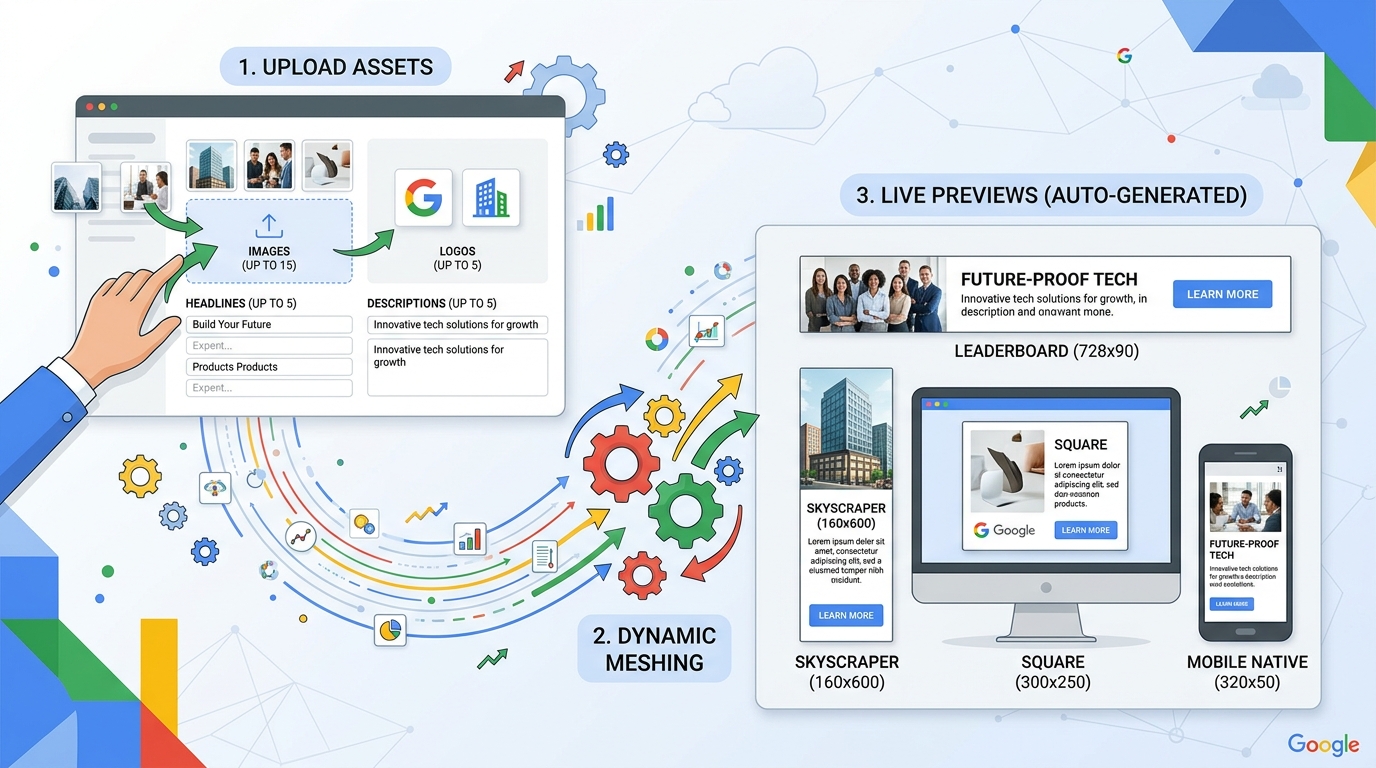
Historically, executing a comprehensive display campaign required graphic designers to produce dozens of static banner files in rigid pixel dimensions — 728x90 leaderboards, 300x250 medium rectangles, 160x600 skyscrapers, 320x50 mobile banners, and numerous regional variations. If a publisher's website featured a custom or responsive dimension, traditional static banners were unable to serve, drastically limiting inventory reach and inflating production expenses.
Google solved this friction by introducing Responsive Display Ads (RDAs), which are now the default ad format for the Google Display Network. Instead of uploading static graphic files, advertisers supply a modular asset pool directly into Google Ads: up to 15 high-resolution marketing images (in both 1.91:1 landscape and 1:1 square ratios), up to 5 brand logos, up to 5 concise headlines (30 characters each), a long headline (90 characters), up to 5 descriptions (90 characters each), and optional short video clips.
When an eligible ad slot opens on any website, app, or Google property, Google's algorithmic layout engine dynamically selects the optimal asset combination and automatically adjusts its size, appearance, and layout to fit the specific space. An RDA can render as a traditional leaderboard on a desktop monitor, a native in-feed card on a mobile publication, or an interactive rich media unit in an app, ensuring virtually 100% placement eligibility across the web.
AdZio manages Responsive Display Ads with strategic precision. Rather than uploading generic assets and hoping for the best, we curate harmonious image pools featuring authentic brand assets, draft modular headlines that make grammatical sense across all possible combinations, and analyze asset-level performance ratings (from “Low” to “Best”) to continuously replace underperforming elements with stronger creative variants.
Up to 15 professional landscape (1.91:1) and square (1:1) photos accompanied by vector brand logos with transparent backgrounds.
Up to 5 short headlines, 1 long headline, and 5 detailed descriptions crafted for standalone clarity and modular combination.
Instantaneous dynamic compilation into standard IAB banner slots, responsive sidebar blocks, and native in-feed publisher formats.
Bridging the gap between passive visual interest and tangible business inquiries through strict message match, rapid mobile performance, and focused conversion paths.
The most common reason display advertising campaigns fail to generate profitable returns is an abrupt disconnect between the banner ad creative and the destination web page. A display ad operates as an explicit visual contract with the user: if the banner showcases a specific discount on diagnostic health checkups, highlights an industrial machinery specification, or promotes a residential property project, the user expects to land on a page dedicated exclusively to that exact subject.
Directing display ad clicks to a generic corporate homepage violates this user expectation. The visitor is forced to navigate menus, hunt for relevant details, and guess where the advertised offer resides. Because display traffic originates from passive browsing rather than active search intent, these visitors have zero patience for friction; they will bounce within three seconds if their curiosity is not immediately validated.
At AdZio, we enforce strict Visual and Verbal Message Match. The primary headline of the destination landing page mirrors the headline of the display banner, utilizing consistent typography, color schemes, and imagery. This immediate continuity provides cognitive reassurance, confirming to the visitor that they have arrived at the authentic, intended destination.
Additionally, technical landing page speed is paramount for display traffic. When a user taps a banner ad on a mobile phone while reading an article, any delay in page loading prompts immediate abandonment. We optimize all campaign landing pages for sub-2.0 second load speeds on mobile networks, eliminating bloated scripts, heavy animations, and redundant form fields to maximize the conversion rate of incoming display clicks.
Landing page headlines, imagery, and color palettes directly reflect the display banner, ensuring unbroken visual continuity.
Engineered for lightweight performance and Core Web Vitals compliance to capture mobile visitors before bounce impulses trigger.
Clear, uncluttered contact forms, tap-to-call buttons, and direct WhatsApp integrations designed for seamless inquiry submission.
Aligning bidding models, audience targeting parameters, and creative messaging with distinct phases of the business marketing funnel.
In Google Ads, a display campaign must never be launched without a clear, singular commercial objective. Attempting to force a single display campaign to simultaneously generate broad brand fame, high website traffic volume, immediate direct-response sales, and remarketing conversions creates conflicting bidding signals that confuse Google's machine learning algorithms and dilute performance outcomes.
Google Display campaigns are structured across three primary stages of the customer journey: Brand Awareness (reaching broad demographic cohorts to establish visual recognition), Consideration & Intent (engaging In-Market and Custom Intent audiences who are actively researching competing solutions), and Action & Conversions (driving qualified inquiries, phone calls, or transactions from highly qualified prospects and remarketing lists).
Each objective requires dedicated bidding strategies and creative approaches. Awareness campaigns prioritize viewable impressions (vCPM bidding), ensuring you pay only when your ad is measurably visible on screen. Consideration campaigns focus on engaged visits through cost-per-click (CPC) bidding. Conversion-focused campaigns leverage Smart Bidding strategies — such as Target CPA (Cost Per Acquisition) or Maximize Conversions — allowing Google's algorithms to evaluate thousands of auction signals and bid aggressively only when a user exhibits a high statistical likelihood of converting.
At AdZio, we architect multi-tiered display campaign funnels that cleanly separate prospecting from retargeting. This structural segregation prevents awareness ad spend from cannibalizing high-converting remarketing budgets, enabling transparent performance attribution and precise budget allocation across each stage of your sales pipeline.
How visual display advertising creates widespread market presence, fosters familiarity, and elevates brand equity across targeted geographic territories.
Brand recognition is an essential prerequisite for commercial growth. When prospective clients in India are ready to choose an architect, schedule a medical procedure, purchase an automobile, or engage an industrial equipment vendor, they naturally gravitate toward brands with which they have established familiarity. An organization that exists solely on search results pages without visual market presence starts every customer interaction from a position of cold skepticism.
Google Display Ads provide a highly cost-efficient channel for building sustained visual brand awareness across targeted regions. Rather than incurring the prohibitive production and media expenses associated with print publications, billboards, or television broadcasts, a business can deploy display advertising across specific cities, states, or nationwide territories at a fraction of the cost. Through viewable impression bidding, you ensure marketing capital is deployed only when your ad actually renders in a viewable browser viewport.
Furthermore, display brand campaigns produce a profound compounding effect across other marketing channels — a phenomenon known as multi-channel lift. When target audiences repeatedly encounter professional, tasteful banner ads highlighting your brand's authority, their likelihood of clicking your organic search listings or typing your brand name directly into Google Search increases substantially. Brand awareness advertising on the Display Network effectively seeds the market, driving down acquisition costs across your bottom-of-funnel channels over time.
While brand awareness campaigns do not focus exclusively on immediate direct clicks, AdZio measures their impact through concrete analytical metrics: Total Reach (unique individuals exposed), Average Frequency, View-Through Conversions (users who saw the ad, did not click, but later visited and converted), and Brand Search Volume lift in Google Search Console.
Utilize vCPM bidding to pay exclusively for ads that meet Google's strict viewability standard — at least 50% on screen for one second or longer.
Drive measurable increases in branded organic search queries and direct website visits through sustained visual market presence.
Track and evaluate users who viewed your display branding and subsequently returned via organic or direct channels to complete conversions.
Transforming visual impressions into verified commercial inquiries through precise in-market targeting, high-value lead magnets, and conversion-optimized funnels.
A widespread misconception among digital marketers is that Google Display Ads are exclusively useful for brand awareness and completely ineffective for lead generation. While generating direct-response leads from passive display traffic is undeniably more challenging than capturing high-intent search queries, disciplined lead-generation display campaigns can produce substantial volumes of qualified inquiries at attractive acquisition costs when executed with strategic rigor.
The key to successful display lead generation lies in Targeting Specificity and Offer Alignment. Display campaigns attempting to generate leads through broad affinity audiences inevitably burn capital. Instead, lead-generation display campaigns must be tightly anchored to In-Market segments, Custom Intent keyword clusters, and competitor audience signals where users have already demonstrated verifiable purchase consideration.
Furthermore, the creative offer must deliver compelling immediate value. Asking a passive display visitor to “Hire Us Today” or “Buy Our Enterprise Solution” demands too large a commitment from someone who was reading an article moments earlier. High-performing display lead generation deploys low-friction, high-value lead magnets: an architectural project cost estimator, an industrial equipment buyer's guide, a free clinical consultation slot, or a transparent dealership EMI breakdown.
Once the click occurs, the destination landing page must feature a streamlined inquiry form requiring only essential qualification fields. By integrating server-side conversion tracking, Google Tag Manager, and Enhanced Conversions, AdZio feeds real-time conversion data back into Google's Smart Bidding engine, training automated Target CPA algorithms to systematically identify and convert similar high-value prospects across the Display Network.
Direct ad impressions exclusively to individuals actively evaluating vendors, comparing quotes, and researching solutions in your industry.
Deploy high-value hooks — customized quotes, pricing guides, consultation bookings — that justify immediate inquiry submission.
Leverage algorithmic machine learning to bid aggressively only when user context indicates a high probability of completed lead conversion.
How visual display advertising, audience targeting signals, and creative messaging adapt across key commercial sectors in the Indian marketplace.
The commercial efficacy of Google Display advertising depends entirely on adapting campaigns to the specific consumer psychology, purchase horizons, and regulatory environments of individual business sectors. A luxury residential real estate development targeting high-net-worth investors across Indian metropolitan centers requires a completely different visual creative strategy, audience layer, and landing page architecture than an automobile dealership promoting test-drive days or a private healthcare hospital highlighting advanced laparoscopic surgical infrastructure.
In high-ticket, extended-consideration industries such as real estate, jewellery, and automobile retail, display campaigns excel at keeping visual representations of product aesthetics, architectural renderings, and pricing promotions in front of prospective buyers who previously browsed inventory online. By displaying responsive banners across news websites, financial portals, and lifestyle publications, brands nurture consideration during the weeks or months leading up to a showroom visit or site appointment.
In educational, hospitality, and travel verticals, seasonality dictates display execution. Education campaigns ramp up visual awareness weeks prior to board result announcements and annual entrance exam schedules, serving responsive banners to students and parents researching higher education options. Similarly, boutique resorts and travel agencies deploy geographic interest targeting to capture families in major feeder metros researching upcoming festival holidays and summer vacations.
Furthermore, specific sectors require strict adherence to Google Ads policy compliance. Healthcare providers must observe sensitive category advertising rules and avoid clinical claims that violate policy; financial institutions must present mandatory disclosure disclaimers; and educational academies must maintain verified accreditation transparency. Below is how AdZio tailors Google Display advertising across ten primary industries we serve.
In the healthcare sector, trust, clinical credentials, and institutional reputation dictate patient choice. While search ads capture emergency medical queries, display advertising allows hospitals, diagnostic chains, and specialized clinics to build enduring visual awareness for specialized departments — such as advanced cardiology, robotic joint replacement, and comprehensive preventive health screening packages.
Preventive Health Screening Camp Promotions & Departmental Authority.
Automobile purchasing is an intensely visual and emotionally driven process. Car buyers spend weeks reviewing model specifications, fuel efficiency figures, and road presence before stepping into a showroom. Display Ads allow authorized dealerships to present sleek vehicle photography and time-sensitive financing offers directly to active automotive researchers.
Test-Drive Scheduling & Festive Showroom Footfall.
Property buyers and commercial real estate investors require substantial visual proof of construction quality, master plan layouts, and lifestyle amenities. Display advertising provides developers with the canvas needed to showcase 3D architectural renders, clubhouse amenities, and strategic location connectivity to qualified investor cohorts.
High-Net-Worth Lead Generation & Site Visit Bookings.
In online retail, visual presentation directly impacts product desire. Display advertising enables D2C brands to introduce lifestyle imagery, new seasonal collections, and promotional discounts across shopping websites, lifestyle blogs, and entertainment portals.
Dynamic Product Retargeting & Cart Recovery.
Resorts, boutique hotels, and luxury banquet properties leverage visual display advertising to convey ambiance, scenic surroundings, and event spaces to travelers and event planners across key feeder markets.
Direct Room Bookings & Banquet Inquiries.
Bridal jewelry, hallmarked gold ornaments, and certified diamond jewelry require exquisite visual presentation to inspire emotional desire and consumer trust. Display ads allow heritage and contemporary jewellers to showcase intricate craftsmanship to bridal families and festive shoppers.
Bridal Appointment Scheduling & Showroom Visits.
Higher education universities, competitive exam coaching academies, and executive upskilling institutes rely on display campaigns to generate widespread admission awareness and prospectus downloads during critical annual decision windows.
Prospectus Downloads & Admission Inquiries.
Tour operators, wildlife safari organizers, and holiday planners utilize scenic display banners to inspire wanderlust and capture vacationers in the exploratory phases of holiday planning.
Customized Itinerary Inquiries & WhatsApp Quotes.
Chartered accountancy firms, corporate legal advisors, architectural design studios, and management consultancies build firm prestige and nurture long-cycle corporate relationships through strategic visual display placements.
Corporate Retainer Consultations & Institutional Authority.
Independent retail showrooms, diagnostic labs, fitness centers, and specialized repair facilities build top-of-mind neighborhood prominence, ensuring local residents immediately think of their business when service needs arise.
Neighborhood Footfall & Local Phone Inquiries.
Building logical account hierarchies that isolate marketing objectives, segregate audience tiers, control geographic budgets, and enable transparent performance attribution.
A disciplined account structure is the foundation of predictable display advertising performance. When an account dumps multiple disparate audience segments — such as cold demographic cohorts, In-Market research pools, and past website remarketing lists — into a single unsegmented campaign, it becomes impossible to control budget allocation or identify which audience generates profitable business outcomes.
At AdZio, our Google Display campaign architecture adheres to strict Funnel-Stage Segregation. We separate upper-funnel Prospecting campaigns from lower-funnel Remarketing campaigns into completely distinct containers with independent daily budgets. This structural separation prevents high-volume cold audiences from monopolizing budget intended for high-converting past visitors, ensuring remarketing lists receive full impression share coverage.
Within each campaign, ad groups are organized around tightly focused Single-Theme Audience Clusters. For example, rather than blending In-Market auto buyers with custom search query audiences, each targeting group resides in its own ad group. This enables our creative team to pair specific responsive display ad copy directly with that audience's mindset, resulting in higher engagement and superior algorithmic relevance ratings from Google.
Furthermore, geographic and device segmentation is applied where auction economics differ significantly. For national Indian campaigns, we frequently separate metropolitan centers (Mumbai, Delhi NCR, Bengaluru) from Tier-2/Tier-3 growth markets, preventing high-cost metro placements from draining budget allocated to cost-efficient regional expansion.
Separate cold audience expansion from warm retargeting campaigns to guarantee dedicated budget allocation for high-converting past visitors.
Cluster tightly related audience signals within individual ad groups, pairing tailored visual creatives with specific buyer mindsets.
Segment campaigns across metropolitan and regional Indian territories to maintain granular control over auction bids and regional spend.
Understanding the dynamic auction mechanics, bidding models, and market factors that influence display advertising expenses across the Indian digital ecosystem.
A frequent question from business leaders is: “How much do Google Display Ads cost in India?” In reality, Google Display Ads do not carry a fixed price or standardized tariff. Costs are determined dynamically through competitive programmatic auctions based on industry vertical, audience targeting precision, geographic territory, creative quality, and selected bidding strategies.
Display advertising offers multiple financial bidding models to match commercial goals: vCPM (Viewable Cost Per Mille), where you bid for every 1,000 viewable impressions — ideal for brand awareness; CPC (Cost Per Click), where you pay only when an interested user clicks your banner; and Smart Bidding (Target CPA or Target ROAS), where Google's machine learning dynamically adjusts bids in real-time to capture verified lead or revenue conversions within your target financial constraints.
Compared to Google Search Ads — where intense keyword competition on commercial terms can drive CPCs to substantial levels — the Google Display Network generally provides significantly lower costs per click and exceptionally affordable cost-per-thousand impressions. This economic advantage makes display advertising ideal for businesses seeking wide brand reach and high-frequency remarketing without exponential media spend.
AdZio assists Indian businesses in establishing realistic, return-driven display budgets. We reject arbitrary spending recommendations; instead, budget allocation is calculated backward from your business capacity, customer lifetime value (LTV), target cost per lead (CPL), and historical conversion rates. Furthermore, clients retain 100% control over daily spending limits, ensuring complete fiscal predictability.
Pay only when at least 50% of your visual banner ad is visible on screen for one continuous second or longer. Ideal for cost-efficient brand reach.
Pay strictly when an interested user clicks your ad. Enables tight control over maximum click costs during data-accumulation and testing phases.
Machine learning algorithms calibrate real-time auction bids to deliver qualified lead inquiries or e-commerce purchases within your target acquisition cost.
Moving beyond surface-level clicks to evaluate view-through conversions, assisted attribution, engagement depth, and verified commercial return on investment.
Evaluating a Google Display campaign using the identical metrics applied to Search Ads is a fundamental analytical error. While search campaigns are assessed almost exclusively on direct click-through conversion rates, display advertising influences consumer purchase decisions across multiple subtle, cumulative touchpoints that traditional “last-click” attribution models fail to capture.
A vital metric in display analytics is View-Through Conversions (VTC). A view-through conversion occurs when a prospective customer sees your visual display ad on a website, does not click it at that moment, but later visits your website via organic search, direct URL, or brand search and completes an inquiry. Google Ads measures these view-through events, providing empirical proof of how visual exposure drives subsequent buying behavior.
For direct-response display campaigns, AdZio tracks comprehensive commercial KPIs: Cost Per Acquisition (CPA), Conversion Rate, Click-Through Rate (CTR), and Average Frequency. We integrate Google Tag Manager with GA4 and Enhanced Conversions, establishing closed-loop tracking for form submissions, phone calls, and direct WhatsApp chats generated by display traffic.
Furthermore, we continuously audit Placement Performance Reports to monitor where your ads physically appear across the web. Placements that generate accidental clicks or exhibit high bounce rates are immediately identified and added to negative placement lists, ensuring that your ad budget is directed exclusively toward high-quality, reputable publisher environments.
Tracking unique individuals reached and average daily exposure frequency to prevent banner wear-out while ensuring recall.
Monitoring audience resonance across creative variants, identifying which headlines and visual hooks prompt active consideration.
Measuring prospects who were exposed to visual ads and subsequently converted via organic search or direct site visits.
Evaluating commercial bottom-line efficiency by tracking exact cost per verified form inquiry, phone call, or purchase.
A structured, data-driven 14-stage management lifecycle engineered to plan, design, deploy, measure, and continuously refine visual advertising campaigns.
At AdZio, we do not view Google Display Ads as an automated “set-it-and-forget-it” software utility, nor do we rely on generic campaign templates. Successful display advertising is an ongoing operational discipline combining data science, behavioral copywriting, technical tracking engineering, and rigorous weekly account governance. Every client engagement follows an institutional 14-stage lifecycle engineered to maximize capital efficiency and eliminate speculative ad spend.
The engagement begins with deep Business Understanding and Goal Quantification. We examine your profit margins, target customer lifetime value, geographic service boundaries, and current sales pipeline capacity. From this foundation, we conduct exhaustive Audience Research, identifying high-commercial-intent In-Market segments and building Custom Intent keyword clusters while constructing account-level negative placement fortifications to preemptively block non-converting traffic.
Next, our technical and creative teams build the operational foundation: architecting a logical Campaign Hierarchy, producing compelling Responsive Display Ad Assets with full format coverage, developing high-speed message-matched Landing Pages, and configuring airtight Conversion Telemetry through Google Tag Manager and Enhanced Conversions. Following a comprehensive quality audit, campaigns are pushed live.
Post-launch is where true agency value compounds. We execute weekly Placement Audits to prune low-quality mobile apps and MFA domains; perform systematic Creative Testing across image themes and headline copy; calibrate Audience Refinement based on engagement signals; and deliver transparent, plain-English Performance Reporting linking every rupee of ad spend directly to verified business inquiries and revenue outcomes.
Deep-dive discovery analyzing your service margins, sales cycle length, and target customer economics.
Establishing concrete KPIs: reach targets, target Cost Per Acquisition (CPA), and conversion goals.
Identifying In-Market cohorts, Custom Intent search clusters, and demographic parameters for your sector.
Structuring separate prospecting and remarketing campaigns with dedicated geographic and daily budgets.
Developing modular Responsive Display Ad assets: high-res photography, vector logos, and high-impact copy.
Implementing layered audience rules alongside aggressive placement exclusion lists to block junk traffic.
Ensuring 1:1 visual message match, sub-2.0s mobile speed, and frictionless conversion inquiry pathways.
Deploying GTM, GA4, Enhanced Conversions, and call tracking to ensure full attribution integrity.
Executing pre-launch audits before initializing campaigns directly within 100% client-owned accounts.
Weekly scrubbing of publisher placement reports to exclude low-performing mobile games and spam websites.
Reallocating budget toward top-converting demographic tiers, high-performing topics, and in-market signals.
Routinely swapping underperforming images and headlines for fresh variants to combat banner fatigue.
Calibrating automated Target CPA thresholds to drive down cost per lead as conversion volume accumulates.
Monthly performance reviews detailing view-through conversions, assisted pipelines, and true commercial ROI.
An objective evaluation of which business models, customer purchase cycles, and marketing goals derive the strongest returns from visual display advertising.
Google Display Ads is a versatile marketing vehicle, but it is not universally appropriate for every business situation. Because display advertising engages passive audiences who are consuming content rather than actively searching for solutions, profitability depends heavily on whether your offering aligns with visual storytelling and multi-touch consideration cycles.
First, businesses with extended consideration cycles and high customer lifetime value (LTV) benefit exceptionally. Real estate developers, automotive dealerships, higher education institutions, B2B enterprise software providers, and healthcare facilities operate in markets where buyers research extensively across weeks or months. For these organizations, display advertising maintains continuous top-of-mind brand presence and re-engages prospects who previously explored services online.
Second, businesses with visually distinctive products or strong brand narratives — including jewellery showrooms, boutique resorts, lifestyle consumer brands, and architectural firms — find that display banners convey aesthetic elegance and craftsmanship in ways text search ads simply cannot match. Similarly, organizations seeking to build regional brand prominence across specific Indian states or metropolitan centers leverage display advertising to establish broad visual familiarity at a fraction of the cost of traditional outdoor billboards or print media.
Conversely, there are scenarios where Display Ads may not represent the primary recommended investment. If a business operates on a very limited daily budget and requires immediate, urgent lead generation — such as an emergency plumber, breakdown towing service, or urgent locksmith — allocating budget to display ads is counterproductive. In such emergency-driven contexts, 100% of advertising capital should be concentrated on Google Search Ads to capture customers in immediate distress.
Real estate, B2B industrial equipment, automotive, and healthcare practices where buyers take weeks to compare vendors.
Jewellery showrooms, luxury resorts, architectural design, and D2C brands that benefit from high-resolution visual allure.
Established businesses with existing organic or paid traffic ready to implement high-converting display remarketing funnels.
Analyzing the structural misconfigurations, placement traps, and creative errors that cause display campaigns to bleed ad capital without commercial returns.
Because the Google Display Network offers virtually limitless impression inventory, setting up display campaigns without rigorous technical controls is the fastest way to deplete marketing budgets on low-quality traffic. Many business owners who conclude that “Display Ads don't work for our industry” have unknowingly fallen victim to basic setup misconfigurations that funnel ad spend into automated click fraud, accidental mobile taps, and irrelevant publisher environments.
The most notorious pitfall is Unrestricted Mobile App Placements. By default, Google serves display ads inside mobile gaming apps, flashlight tools, and children's games. Users (often young children or gamers attempting to close popups) generate thousands of accidental clicks. These accidental clicks produce high bounce rates, zero inquiries, and complete budget exhaustion within days. Hardcoding comprehensive app placement exclusions is an essential pre-launch requirement for all serious commercial campaigns.
A second major failure is Omitting Frequency Capping. When frequency is unrestricted, Google's algorithms may display your banner ad thirty times a day to the same user. Rather than reinforcing consideration, this excessive repetition causes severe banner fatigue, triggers brand annoyance, and wastes ad impressions on individuals who have clearly decided not to engage with your offer.
Finally, businesses often err by Optimizing Solely for Clicks without Conversion Tracking. Display clicks are inexpensive, but clicks alone do not pay commercial salaries or generate profit. Without verified conversion tracking (via GTM and Enhanced Conversions) and message-matched landing pages, automated bidding algorithms optimize toward users who casually click banners rather than prospects who complete business inquiries.
Allowing ads to run inside casual smartphone games and flashlight apps, generating thousands of accidental clicks with zero commercial intent.
Failing to limit daily impressions per user, causing ad fatigue, negative brand perception, and wasted media spend on disengaged audiences.
Operating campaigns without verified GTM conversion tags, leaving Google's Smart Bidding algorithms with zero data signal to optimize toward.
Directing display traffic to generic corporate homepages rather than dedicated, message-matched landing pages tailored to the ad's hook.
Broadcasting ads to generic affinity categories rather than high-intent In-Market buyers and Custom Intent search query clusters.
Lumping cold awareness audiences together with warm past-visitor remarketing lists, causing cold traffic to cannibalize remarketing budget.
Using tiny fonts, cluttered layouts, and low contrast that become unreadable when rendered on smartphone display banner slots.
Failing to review publisher placement reports weekly to prune low-quality MFA (made-for-ads) websites and click-bait domains.
Enabling Target CPA algorithms on brand-new campaigns with zero historical conversion data, triggering erratic bidding fluctuations.
An objective, strategic comparison evaluating how Google Display Ads compare with Google Search Ads, Meta Social Advertising, Organic SEO, and YouTube Advertising.
Building an effective digital marketing architecture requires understanding how different channels interact across the buyer journey. Rather than viewing advertising channels as rivals competing for budget, sophisticated businesses deploy each medium according to its unique operational strengths: intent capture, visual storytelling, organic sustainability, or video immersion.
When compared to Google Search Ads, Display Ads provide exponentially greater visual reach and substantially lower cost-per-click, but operate on passive attention rather than immediate active intent. Compared to Meta (Facebook & Instagram) Ads, Google Display Ads offer superior contextual placement across millions of external news portals and industry websites, while Meta excels at in-feed social interaction and algorithmic lookalike discovery.
Against Search Engine Optimization (SEO), Display Ads deliver instant market visibility within hours of launch, whereas SEO requires several months of technical and content development to compound organic rankings. Compared to YouTube Advertising, Display Ads require significantly lower creative production overhead — requiring high-quality still imagery and copywriting rather than full-scale video production.
Below is AdZio's comprehensive 6-dimension evaluation matrix detailing how Google Display Ads compare across the digital marketing spectrum.
| Strategic Dimension | Google Display Ads | Google Search Ads | Meta (FB/Insta) Ads | YouTube Ads | Organic SEO |
|---|---|---|---|---|---|
| User Intent Profile | Passive Browsing / Contextual | Active High Commercial Intent | Passive Social Browsing | Video Entertainment / Learning | Inbound Information / Search |
| Primary Creative Asset | Responsive Images, Logos, Copy | Text Headlines & Descriptions | Short Video, Carousels, Photos | 15s - 60s Video Ads | Long-form Content & Web Pages |
| Placement Environment | 3M+ Websites, Apps, News Portals | Google SERP (Top & Bottom) | Social Feeds, Reels, Stories | YouTube Pre-Roll & In-Feed | Organic Search Results |
| Cost Structure | vCPM / Low CPC | Medium to High CPC | CPM / Cost Per Engagement | CPV (Cost Per View) | Fixed Production / Retainer |
| Time to Market | Immediate (24 Hours) | Immediate (Hours) | Fast (24-48 Hours) | Moderate (Video Production) | Long-Term (4-12 Months) |
| Primary Marketing Role | Visual Awareness & Remarketing | Direct Inbound Lead Capture | Social Demand Generation | Video Brand Storytelling | Compounding Organic Equity |
Practical, in-depth answers to common questions business decision-makers ask about the Google Display Network, audience targeting, creative specs, and AdZio's management.
Google Display Ads are visual advertisements — consisting of graphic banners, responsive combinations of images and text, or interactive rich media — that appear across Google's partner network of millions of third-party websites, news publications, blogs, mobile apps, Gmail, and YouTube. Unlike search ads that display exclusively on search results pages when users type specific queries, display ads engage audiences visually while they browse content across the broader internet.
Display ads are powered by audience targeting intelligence: connecting with prospective customers based on recent search intent, in-market buying signals, topic categories, or past website visits through remarketing.
Google Display Ads operate via real-time programmatic auctions. Participating website publishers and app developers allocate advertising slots on their web pages through Google AdSense or Google Ad Manager. When a user loads a page, Google's ad exchange evaluates eligible advertisers targeting that audience segment, geographic location, and contextual content topic.
Google conducts an automated auction in milliseconds, dynamically assembling the winning advertiser's Responsive Display Ad assets (images, headlines, logos) to perfectly fit the available slot. When a user clicks the ad, they are directed to a dedicated landing page where conversion tracking measures inquiries, phone calls, or sales.
The Google Display Network (GDN) is Google's global network of publisher websites, digital news media, video platforms, and mobile applications that partner with Google to display programmatic advertisements. The GDN reaches over 90% of global internet users across desktop, tablet, and mobile devices.
In India, the GDN encompasses leading national news websites, regional language news dailies, technology and business forums, lifestyle portals, and millions of popular smartphone applications, providing advertisers with unprecedented visual reach across tier-1, tier-2, and tier-3 commercial markets.
Google Display Ads do not have a fixed universal cost in India. Expenses are determined dynamically in programmatic auctions based on industry competition, audience specificity, geographic region, and bidding strategy. Display advertising typically operates on either a Cost Per Click (CPC) or Viewable Cost Per Mille (vCPM — cost per 1,000 viewable impressions) model.
Compared to Google Search Ads, Display Ads feature substantially lower CPCs and exceptionally affordable CPMs, allowing businesses to achieve widespread brand awareness and robust remarketing frequency at manageable budgets. Advertisers retain 100% control over daily spending caps.
Yes, Google Display Ads are highly valuable for small and local businesses when targeted properly. Local businesses — such as healthcare clinics, automobile dealerships, jewellery showrooms, and fitness centers — can restrict display campaigns to a specific 5km to 25km radius around their facility.
By combining local radius targeting with In-Market audience signals, a local business can build massive neighborhood brand prominence, ensuring local residents repeatedly see professional visual ads while reading local news or browsing the web.
The core distinction lies in user intent and format. Google Search Ads are text-based listings that appear when users actively type explicit search queries into Google. They capture immediate demand from people looking for solutions right now. Display Ads, in contrast, are visual graphic banners that reach users passively while they are browsing third-party websites or using mobile apps.
Search Ads excel at immediate bottom-of-funnel lead capture, while Display Ads excel at upper-funnel visual awareness, mid-funnel brand consideration, and retargeting past website visitors.
Google Display Remarketing (or retargeting) is a targeting mechanism that displays tailored visual banner ads specifically to individuals who previously visited your website or mobile app but did not complete an inquiry or purchase.
Through privacy-safe tracking tags managed via Google Tag Manager, past visitors are added to remarketing audience lists. When they browse other websites across the web, your display ads remind them of your brand and guide them back to dedicated landing pages, significantly increasing overall conversion rates.
Google Display Network offers diverse audience targeting layers: Demographics (age, gender, parental status, household income); Affinity Audiences (lifestyle habits and passions); In-Market Audiences (users actively researching and comparing products in your industry); Custom Segments (built using specific search queries and competitor URLs); Remarketing Lists (past site visitors); and Customer Match (first-party customer email/phone lists).
These audience layers can be combined with contextual placement targeting to ensure ads appear on relevant web pages.
For Responsive Display Ads, advertisers supply modular assets: up to 15 high-resolution marketing images (both landscape 1.91:1 and square 1:1 ratios), up to 5 brand logos (square and landscape with transparent backgrounds), up to 5 short headlines (30 characters), 1 long headline (90 characters), up to 5 descriptions (90 characters), business name, and destination landing page URL.
Google automatically combines and renders these assets into responsive formats that fit thousands of ad slot dimensions across the web.
Yes. When structured with strategic precision, Google Display Ads can produce substantial volumes of qualified inquiries. The key is avoiding broad untargeted broadcasts and instead anchoring campaigns to In-Market buyers, Custom Intent search signals, and past-visitor remarketing lists.
Pairing these high-intent audiences with compelling, low-friction lead offers (such as cost estimators, clinical consultation slots, or pricing guides) and fast mobile landing pages drives reliable lead generation at attractive acquisition costs.
Display performance measurement depends on campaign objectives. Awareness campaigns evaluate Total Reach, Average Frequency, and Viewable Impressions (vCPM). Consideration and direct-response campaigns evaluate Clicks, Click-Through Rate (CTR), Cost Per Acquisition (CPA), and View-Through Conversions (VTC).
AdZio implements closed-loop tracking via Google Tag Manager and GA4, measuring verified inquiries, phone calls, and revenue outcomes to provide clear commercial attribution.
Yes. AdZio provides comprehensive, end-to-end Google Display Ads management for businesses across India. Our services encompass audience research, custom segment architecture, responsive creative design, copywriting, landing page development, conversion tracking setup, weekly placement scrubbing, and transparent performance reporting.
All campaigns operate directly inside your own Google Ads account, ensuring 100% data ownership, billing transparency, and zero proprietary lock-in.
Google Display Ads is an essential component of a comprehensive customer acquisition strategy. Explore related advertising channels and services that integrate with display campaigns.
Whether you are seeking to build widespread visual brand awareness across targeted regions, engage active in-market buyers, or deploy an airtight remarketing campaign to recover lost website visitors, AdZio is prepared to engineer a display advertising strategy tailored to your commercial objectives.
Our display campaigns combine high-impact responsive creative design, precision audience segmentation, strict placement filtering, and transparent attribution reporting. Partner with an agency that views display advertising as an accountable driver of business pipeline growth.
Fill out the brief form below to discuss campaign architecture, audience targeting, or account audit options with AdZio.