 ISO Certified Company
+91-9233973156
ISO Certified Company
+91-9233973156
ISO Certified Company
+91-9233973156
ISO Certified Company
+91-9233973156
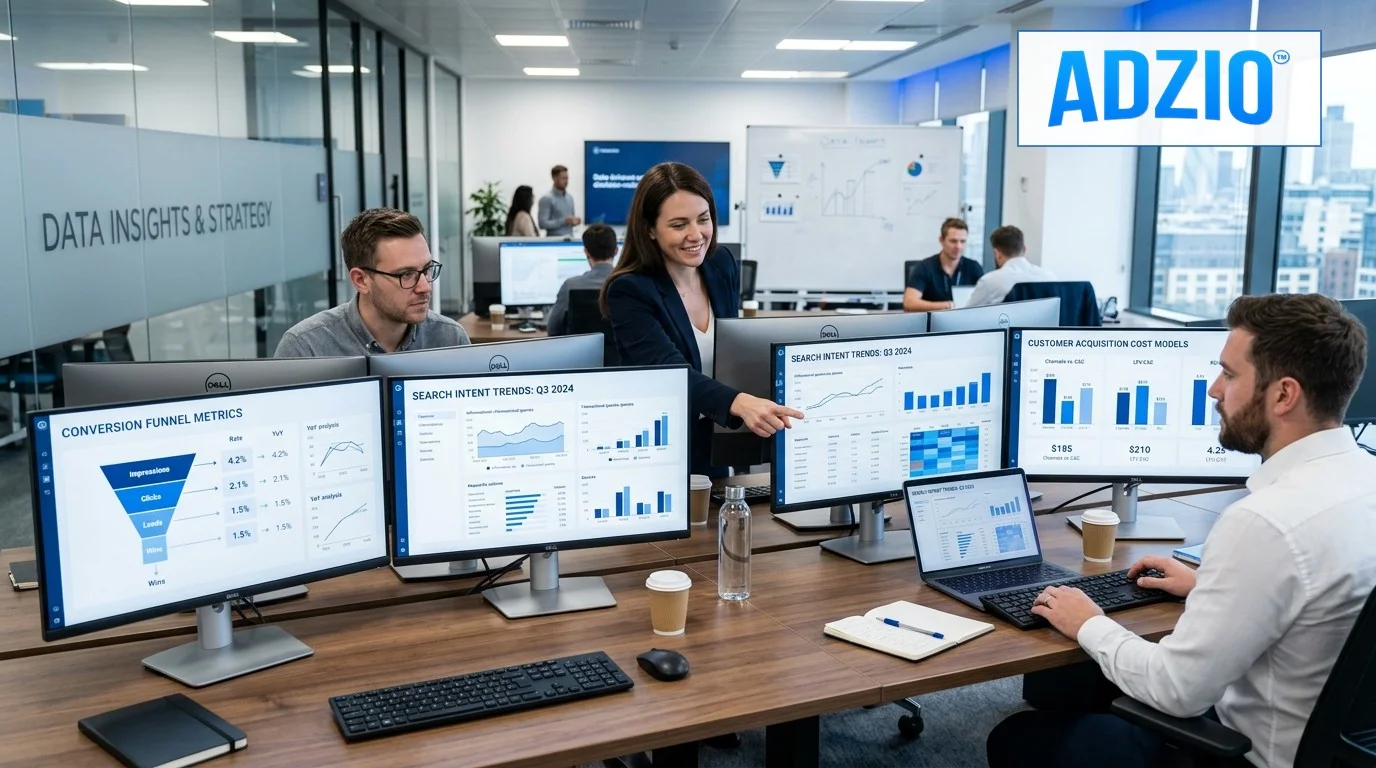
AdZio studies the critical journey between real estate website traffic and meaningful commercial action. We analyze visitor drop-offs, optimize mobile user experiences, streamline enquiry forms, align ad-to-page messaging, and deploy rigorous A/B testing to help property developers, builders, and brokers convert a higher proportion of visitors into qualified site visits and commercial inquiries.
Understanding how evidence-based user experience enhancements transform casual property searchers into motivated buyers.
Real estate conversion rate optimization (CRO) is the disciplined process of studying how prospective property buyers interact with your website or landing pages, identifying friction points that cause hesitation, and systematically enhancing the experience so that a higher percentage take a meaningful commercial next step.
In property marketing, a conversion is fundamentally different from a transactional e-commerce checkout. Property buyers are contemplating high-ticket commitments involving lifetime savings or institutional capital. They do not click a button to buy an apartment online; they convert by requesting dimensioned floor layouts, scheduling on-site sales lounge appointments, initiating WhatsApp consultations, or calling a sales consultant directly.
CRO is not simply "making a website look prettier" or arbitrarily changing button colors. It is the scientific alignment of buyer psychology, architectural information clarity, statutory transparency, and mobile ergonomics to remove doubt and make taking the next step effortless.
The definition of a conversion varies by business model, but always represents high commercial intent:
CRO works horizontally across all digital touchpoints to amplify the commercial value of your existing traffic.
The analytical science of studying visitor behavior, eliminating usability barriers, refining messaging, and improving the conversion efficiency of existing traffic.
Creating dedicated single-purpose web destinations for specific campaigns. CRO evaluates how visitors interact with those pages and optimizes them based on data.
The complete end-to-end commercial system that acquires traffic, captures leads, validates data, and coordinates sales follow-ups. CRO maximizes the capture phase.
Driving high-intent search traffic to your pages. CRO ensures that expensive paid clicks convert into genuine sales leads rather than immediate bounces.
Generating visual discovery on social feeds. CRO provides mobile-first landing continuity that turns social interest into verified inquiries.
Attracting organic search traffic over time. CRO ensures that organic searchers exploring your project pages find clear answers and intuitive next steps.

Acquiring traffic without optimizing conversion is the fastest way to inflate customer acquisition costs.
Most real estate businesses focus exclusively on traffic generation: spending more budget on Google Ads, increasing social ad impressions, or investing in SEO. Yet, when enquiry numbers stall, the immediate reaction is usually to spend even more on advertising.
In reality, the underlying problem is rarely traffic volume; it is conversion friction. Prospective buyers are visiting your web properties, but they encounter slow mobile load speeds, buried floor plans, opaque pricing parameters, lengthy intrusive forms, or confusing navigation menus.
By diagnosing and resolving these barriers through conversion rate optimization, property brands dramatically lower their cost-per-lead (CPL), increase sales team productivity, and extract maximum commercial value from their existing marketing investments.
Structuring the progressive transition from an anonymous visitor to an on-site commercial discussion.
A common mistake in conversion optimization is treating all form submissions equally. Maximizing form completions by removing all qualifying questions generates hundreds of casual, uninterested leads that overwhelm your sales team. AdZio’s real estate CRO methodology optimizes for qualified commercial opportunities, balancing form ease with buyer intent to deliver prospects who actually attend site visits and purchase properties.
Arrives via Google Search, Meta Ads, SEO, or direct links.
Evaluates headline clarity, speed, and visual relevance.
Inspects floor layouts, location connectivity, and specs.
Checks RERA registration, developer credentials, and timelines.
Submits qualifying form or calls sales desk directly.
Sales team validates budget match and purchase timeline.
Attends on-site sales gallery and sample unit viewing.
Aligning calls-to-action with the exact buyer mindset across different stages of property research.
Conversion goals must mirror your actual commercial sales model:
Visitors arrive with different degrees of readiness to transact:
Optimizing multi-page corporate architectures and focused campaign destinations for maximum clarity.
A multi-page corporate website serves varied audiences and requires structured, intuitive navigation:
Dedicated campaign landing pages demand clinical message match and zero navigational distractions:
Replacing generic submission buttons with context-aware triggers and frictionless qualification fields.
A call-to-action button that simply says "Submit" creates hesitation because it fails to set expectations. Does submitting mean a sales agent will call immediately? Does it download a PDF? Does it book an appointment?
AdZio optimizes CTA copy to reflect the genuine next commercial step: "Download Verified Floor Plans," "Schedule an Experience Center Visit," or "Request Detailed Price Sheet." This clarity reassures prospects and increases click-through rates.
Simultaneously, we balance form field ergonomics. We request essential contact parameters (name, verified mobile, email) alongside high-value qualifying selectors—such as unit configuration (2 BHK, 3 BHK, Penthouse) and intended purchase timeline. This eliminates low-relevance casual submissions while providing sales teams with actionable context.
Answering critical buyer questions before asking for personal contact information.
Real estate buyers seek validation that the developer is financially sound, legally compliant, and operationally reliable:
More content is not automatically better; content must systematically resolve buyer uncertainties:
Preserving the advertising promise and engineering seamless touch navigation for smartphone searchers.
When an advertisement makes a specific commercial claim—such as "3 BHK Garden Homes in Sarjapur from ₹95 Lakhs"—the destination page must validate that exact claim within two seconds of arrival. If the user lands on a page featuring an entirely different project or requiring them to search for Sarjapur, trust breaks immediately.
Furthermore, because more than 75% of paid traffic from Google Ads and Meta campaigns originates on mobile devices, mobile usability is the single biggest determinant of conversion success.
AdZio designs mobile conversion experiences featuring tap-friendly CTA buttons, sticky contact ribbons, rapid touch-based floor plan carousels, and minimal typing requirements—ensuring visitors on mobile networks convert effortlessly.

Identifying exactly where property searchers hesitate, drop off, or abandon the enquiry journey.
Effective CRO replaces subjective opinions with empirical user interaction data. AdZio deploys comprehensive behavioral analytics frameworks to analyze how real property buyers navigate your digital assets.
We monitor scroll depth across floor plan sections, examine form field abandonment rates, analyze session interaction heatmaps, and track micro-conversion drop-offs between brochure requests and physical site visit bookings.
This granular diagnostic work reveals specific structural friction points: identifying whether users drop off because a form asks too many questions, whether floor plan images fail to expand on mobile, or whether pricing guidance is positioned too far down the page.
Systematically testing hypotheses to incrementally improve conversion rates without risking baseline performance.
We construct data-backed hypotheses: e.g., "Displaying transparent starting pricing and carpet areas directly in the hero section will reduce immediate bounce rates and increase qualified form starts."
We route incoming campaign traffic evenly between the baseline control page (A) and the variant page (B), testing one meaningful structural or messaging variable at a time.
We analyze conversion rates, statistical confidence levels, and downstream lead qualification rates before rolling out winning variants permanently across your campaign portfolio.
Tailoring conversion pathways to developers, builders, agents, and distinct property asset classes.
Optimizing single-project launch pages, interactive master plans, tower-by-tower inventory filters, and automated site visit appointment booking systems.
Highlighting structural specifications, material brands, clear land titles, and immediate neighborhood conveniences with quick callback forms.
Streamlining property detail clarity, verified listing photos, instant WhatsApp consultation triggers, and personalized broker advisory credentials.
Engaging prospective families through interactive amenity tours, dimensioned floor layouts, nearby school listings, and transparent pricing sheets.
Emphasizing floor plate efficiency, power redundancy, LEED green building certifications, parking ratios, and institutional leasing yield sheets.
Tailoring conversion pathways for micro-market buyers in specific employment corridors, featuring realistic commute times and local infrastructure.
How conversion optimization amplifies paid ad ROI and transforms organic search traffic into qualified pipeline.
Conversion optimization acts as the performance multiplier across your entire digital marketing ecosystem. When CRO improves landing page relevance and user engagement, your Google Ads Quality Scores increase, directly reducing cost-per-click.
Similarly, when Facebook & Meta Ads drive mobile social traffic to a friction-free destination, bounce rates plummet. For organic visitors entering via Real Estate SEO, CRO ensures that visitors discovering your content find clear, compelling pathways to register interest.
Crucially, our conversion framework coordinates directly with our Property Lead Generation Services architecture, ensuring that conversion optimization delivers verified, high-intent prospects to your sales desk.

Critical operational and analytical errors that lead to false conclusions and damaged conversion rates.
Focusing on surface-level visual redesigns without analyzing actual user interaction data, scroll behavior, or form abandonment points.
Overwhelming visitors with multiple conflicting buttons (Call, WhatsApp, Download, Tour, Enquire), causing cognitive paralysis and hesitation.
Hiding location landmarks, floor layouts, or RERA numbers behind mandatory lead gates, which frustrates buyers and triggers immediate bounce.
Eliminating all form friction to inflate raw lead counts, flooding sales executives with unverified numbers and non-viable prospects.
Testing new headlines, different hero images, and altered form fields simultaneously, making it impossible to determine which variable drove the outcome.
Optimizing the digital form perfectly but allowing days to elapse before a sales executive contacts the prospect, nullifying the conversion effort.
AdZio improves conversion rates through clarity, usability, and buyer trust—never through deceptive dark patterns.
We reject deceptive UX tricks such as fake countdown timers, pre-checked consent checkboxes, or hidden exit traps that manipulate users.
All pricing parameters, carpet areas, and amenity descriptions presented during the conversion journey must strictly mirror verified RERA filings.
We strictly avoid false urgency notices such as "only 2 units remaining" unless independently verified by real-time inventory systems.
Prospect contact details are gathered transparently with clear privacy disclosures and handled in compliance with consumer protection standards.
A systematic engineering framework designed to diagnose, test, and continuously enhance property conversion performance.
We define commercial objectives—whether launch registrations, brochure downloads, or on-site experience lounge site visits.
We establish clear tracking parameters for macro-conversions (forms, calls) and micro-conversions (floor plan views, scroll depth).
We evaluate your current website and landing pages across desktop, tablet, and mobile devices to map the prospect path.
We audit Google Tag Manager, GA4 custom events, and Meta Pixel/CAPI tracking to ensure data accuracy before testing.
We examine Core Web Vitals, mobile load speeds, layout stability (CLS), and touch navigation responsiveness.
We analyze drop-off heatmaps, form field abandonment rates, and bounce patterns to identify specific conversion barriers.
We formulate clear testing hypotheses addressing message match, floor plan presentation, and form field qualification.
We design and develop clean test variants modifying specific variables (headlines, CTAs, layout order) for controlled A/B testing.
We deploy live split tests routing inbound campaign traffic evenly, monitoring performance across statistical significance thresholds.
We measure not only digital conversion rate improvements but also downstream lead qualification and site visit attendance.
We permanently deploy validated, winning variations into your core production website or campaign landing page assets.
We cycle back to formulate new hypotheses, progressively lowering acquisition costs and enhancing commercial conversion yield.
Domain-specific property expertise, empirical performance rigor, and an unwavering focus on qualified commercial sales outcomes.
We understand the reality of property decisions—configuration mix, RERA compliance, carpet areas, and the multi-month buyer evaluation journey.
We never artificially inflate form counts with low-intent autofill. We optimize for verified, qualified prospects who actually attend site visits.
We engineer lightning-fast mobile experiences with sub-3-second load times, thumb-friendly navigation, and clear visual information hierarchies.
We replace subjective design debates with empirical data, testing hypotheses rigorously to identify genuine conversion catalysts.
We implement server-side Meta Conversions API and GTM tracking, connecting digital campaign clicks directly to sales CRM milestones.
We improve conversion performance through clarity, trust, and speed—strictly rejecting manipulative dark patterns or fake urgency.
Practical insights into real estate conversion rate optimization, user experience testing, and enquiry qualification.
Real estate conversion optimization (CRO) is the systematic, data-driven discipline of improving the proportion of website and landing page visitors who take a meaningful commercial action—such as submitting an enquiry form, requesting a project brochure, scheduling an on-site visit, or initiating a phone call with your sales team.
Unlike e-commerce where conversion means an immediate online purchase, a real estate conversion represents a high-intent expression of interest in a multi-lakh or multi-crore property investment. Key conversion actions include verified brochure downloads, floor plan requests, callback bookings, WhatsApp consultations, and physical site visit reservations.
CRO improves property enquiries by eliminating user friction: ensuring sub-3-second mobile load speeds, aligning landing page content with incoming advertising promises, presenting verified architectural floor plans clearly, removing unnecessary form fields, and displaying transparent trust signals like RERA registration details.
Lead generation refers to the overarching commercial activity of attracting traffic and gathering prospect contacts across advertising channels. Conversion rate optimization focuses specifically on the user journey and conversion efficiency—ensuring that the traffic you already acquire converts at a higher percentage into qualified commercial inquiries.
Landing page design creates the initial visual layout and content architecture. Conversion optimization is the ongoing empirical process of studying user behavior on that page—analyzing heatmaps, scroll depth, form field abandonment, and A/B test results—to iteratively improve conversion rates over time.
Common causes of non-conversion include mismatched ad messaging, slow mobile loading speeds, buried or missing floor plans, opaque pricing parameters, overly intrusive lead forms asking for unnecessary personal data, weak trust credentials, and confusing call-to-action buttons.
Lead forms should be optimized by balancing friction with qualification. Requesting essential parameters—such as verified phone number, email, and preferred unit configuration (2 BHK, 3 BHK)—ensures sales teams receive actionable commercial context without intimidating prospects with lengthy financial questionnaires.
Responsible A/B testing examines one meaningful variable at a time, such as headline value propositions, primary visual format (architectural elevation render vs 3D walkthrough video), call-to-action button copy, form placement, floor plan preview depth, and the presentation of statutory trust credentials.
Yes. Higher landing page conversion rates and stronger message matching improve Google Ads Quality Scores, which lowers cost per click (CPC) and reduces your effective cost per qualified property enquiry.
Yes. When social media users arrive on a fast, mobile-optimized landing page with visual continuity mirroring the ad creative, bounce rates decrease dramatically, and a higher percentage of social clicks translate into verified leads.
Measurement tracks macro-conversions (enquiry submissions, phone calls, WhatsApp starts) alongside micro-conversions (brochure downloads, floor plan views, video completions). Crucially, AdZio also measures lead qualification rates and site visit completions to ensure commercial quality.
No reputable agency can guarantee specific conversion increases or lead volumes. Conversion outcomes depend on property pricing, location appeal, macroeconomic interest rates, and on-site sales responsiveness. AdZio guarantees rigorous conversion auditing, scientific A/B testing, and user experience enhancements.
Initial friction audits and high-impact structural fixes are typically implemented within 2 to 3 weeks. Statistically rigorous A/B testing and iterative optimization cycles typically run over 60 to 90 days depending on inbound traffic volume.
Yes. AdZio audits existing property websites, project microsites, and campaign landing pages, identifying technical bottlenecks, mobile usability flaws, and conversion barriers, followed by prioritized optimization roadmaps.
Connect with AdZio's conversion rate optimization strategists to audit your existing property website, diagnose conversion friction, streamline lead forms, and build a testing roadmap that lowers your cost-per-qualified-enquiry.