

Conversion Rate Optimization Services to Turn More Website Visitors Into Customers
Driving web traffic is only half the battle. If 97% of your visitors leave without inquiring, booking, or buying, increasing your ad spend simply accelerates your budget waste. AdZio delivers evidence-based Conversion Rate Optimization (CRO)—uniting behavioral heuristics, funnel telemetry, UX design, and controlled A/B experimentation to maximize revenue from the traffic you already have.
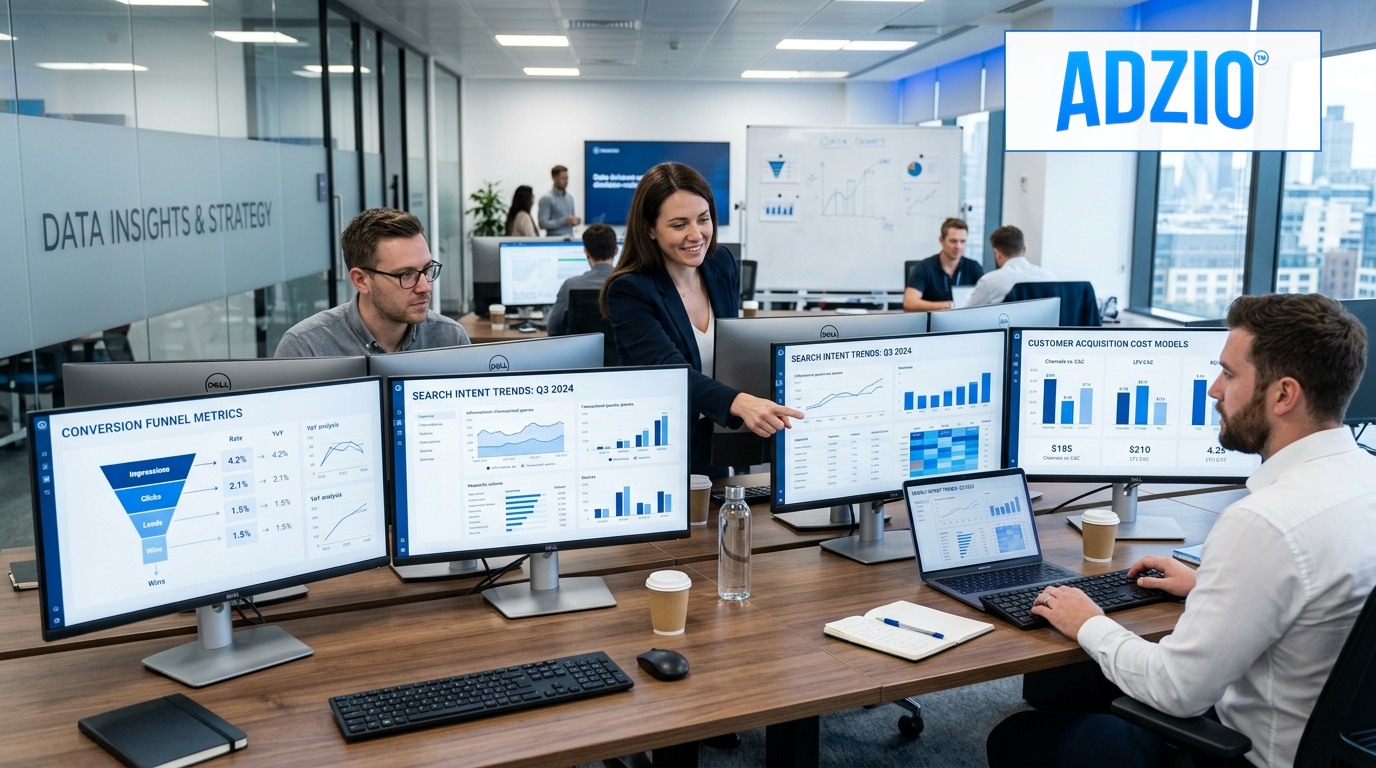
What Is Conversion Rate Optimization & Why Does It Matter?
Conversion Rate Optimization is neither artistic redesign nor manipulative "growth hacking." It is a disciplined scientific framework combining behavioral psychology, web analytics, and technical user experience design.
The Conversion Rate Metric
Calculated as (Total Conversions ÷ Total Visitors) × 100. If 10,000 visitors arrive at your site each month and 200 submit an inquiry, your conversion rate is 2.0%. A scientific lift from 2.0% to 3.5% increases inquiries by 75% without requiring a single rupee in extra advertising spend.
Lower Customer Acquisition Cost
As ad auction costs rise across Google and Meta, bidding higher is unsustainable. CRO drives down your blended Customer Acquisition Cost (CAC) by extracting more commercial value from existing search impressions, paid clicks, and organic visitors.
Friction Elimination Science
Visitors abandon websites because of cognitive friction: vague value propositions, slow mobile loading, confusing navigation, intimidating 10-field forms, or hidden pricing. CRO systematically identifies and dissolves these bottlenecks.
How CRO Differs From Adjacent Marketing & Design Disciplines
Understanding how Conversion Rate Optimization intersects with and complements your broader growth ecosystem:
| Marketing Discipline | Primary Objective | Typical Core Metrics | Where CRO Integrates |
|---|---|---|---|
| Search Engine Optimization (SEO) | Attract relevant organic search traffic | Keyword rankings, organic clicks, impressions | SEO brings visitors to the door; CRO ensures those visitors understand your value and convert. Learn more on our SEO Service Page. |
| Lead Generation | Attract and qualify potential customer inquiries | Lead volume, MQL/SQL counts, Cost Per Lead | CRO optimizes lead capture forms, call-to-action triggers, and page speed to maximize lead capture efficiency. Review our Lead Generation Services. |
| General Digital Marketing | Build multi-channel market awareness | Reach, brand impressions, engagement rate | Digital marketing fills top-of-funnel channels; CRO maximizes bottom-of-funnel cash flow and return on marketing investment. |
| UX Design | Create intuitive, pleasant interfaces | Task completion time, usability score, satisfaction | UX design focuses on user comfort; CRO pairs UX aesthetics with rigorous business metrics, testing whether changes actually drive sales. |
| Landing Page Optimization (LPO) | Maximize conversions on single campaign pages | Single-page conversion rate, ad message match | LPO is a vital component of CRO, focusing specifically on dedicated campaign landing pages. Discover our Landing Page Development. |
18 Conversion Types: Defining Commercial vs. Preparatory Goals
A website that fails to define its conversion goals cannot optimize them. At AdZio, we categorize user actions into Macro Conversions (direct commercial impact) and Micro Conversions (intent signals along the journey).
Direct Commercial Milestones
These are the decisive bottom-of-funnel actions that directly initiate commercial relationships or produce revenue: completed online transactions, paid contract requests, booked doctor appointments, test drive reservations, and formal RFQ submissions.
Intent & Progression Milestones
These are the preparatory engagement actions that signal high intent before the final conversion: viewing pricing tables, starting to type in a contact form, downloading technical whitepapers, watching 75% of an explainer video, or copying a phone number.
1. Lead Form Submissions
Comprehensive business inquiries capturing company name, project scope, budget, and contact info.
2. Commercial Quote Requests
Detailed RFQs with technical file uploads for fabrication, architectural plans, or bulk wholesale pricing.
3. Instant Callback Requests
High-urgency mobile submissions requesting an immediate phone consultation within 15 minutes.
4. Calendar Appointments
Self-scheduled slots synced with executive calendars for legal, CA, or corporate consulting discovery.
5. Clinical Diagnostic Bookings
Patient appointment scheduling for medical specialists, dental checkups, and diagnostic blood tests.
6. Direct WhatsApp Chats
Click-to-chat triggers initiating live conversational commerce on WhatsApp.
7. Dynamic Click-to-Call Dials
Mobile phone link taps connecting urgent callers directly to showroom or emergency service desks.
8. Interactive Software Demos
Registrations for enterprise software walk-throughs and pilot environment evaluations.
9. Free Trial Signups
Zero-friction account creation for SaaS platforms to experience core platform utility.
10. E-Commerce Purchases
Completed checkout transactions on E-Commerce Websites with verified payment gateway capture.
11. Add to Cart Actions
Crucial micro-conversion signaling intent to buy specific inventory items or catalog configurations.
12. Checkout Initiation
Transition from cart review to shipping/billing entry; the most critical funnel abandonment juncture.
13. Test Drive Reservations
Automotive showroom test drive bookings specifying vehicle model, transmission, and local dealership.
14. Real Estate Site Visits
Physical apartment or commercial space inspection bookings with verified buyer budget parameters.
15. Educational Downloads
Gated research papers, compliance checklists, and ROI calculators that capture MQL email credentials.
16. Student Admission Counseling
Prospectus requests and academic counseling bookings for competitive coaching and private colleges.
17. Banquet Date Inquiries
Hotel venue availability checks for weddings, corporate retreats, and multi-day conferences.
18. Account Registrations
Member signups for B2B supplier portals, loyalty programs, and investor newsletters.
The 6-Stage Conversion Funnel: Diagnosing Where Prospects Drop Off
A high bounce rate or an abandoned cart is a symptom, not the root disease. By breaking down the user journey into 6 distinct behavioral transitions, AdZio pinpoints the exact cognitive friction points leaking potential revenue.
The Anatomy of Digital Drop-Off: Finding the Leaky Bucket
Every stage in your conversion funnel requires a specific psychological bridge. When visitors transition from ad click to landing page, they demand immediate message match. When reading service descriptions, they demand trust signals. When entering credit card or phone details, they demand data security and zero friction.
When any of these bridges break, prospects bounce. Rather than guessing, AdZio measures the drop-off gradient across each stage to focus experimentation where the economic leverage is highest.
Fixing friction at the bottom of the funnel (e.g. checkout errors or mobile form glitches) delivers immediate revenue lift because these visitors have already demonstrated peak purchasing intent.

Stage 1: Traffic & Channel Acquisition
Top of FunnelChannels: Google Search, Paid Meta Ads, LinkedIn, Organic SEO, Local Maps, Referral, Direct.
Stage 2: Landing & First Impressions (0–5 Seconds)
Relevance TestPages: Dedicated Landing Page, Category Page, Product Detail Page (PDP), Service Sheet.
Stage 3: Engagement & Value Consumption
Cognitive BridgeActions: Scrolling, reading feature lists, reviewing specifications, inspecting imagery, evaluating pricing.
Stage 4: Commercial Intent Initiation
Micro-CommitmentActions: Clicking primary CTA button, focusing on first form field, clicking WhatsApp chat icon, tapping phone number.
Stage 5: Conversion Completion
Macro VictoryActions: Successful form submission, verified payment gateway charge, calendar booking confirmation.
Stage 6: Post-Conversion & Follow-Up Velocity
Retention & LTVActions: Thank you page reassurance, order receipt, instant sales coordinator contact, automated onboarding.
The 20-Point Website CRO Audit: Interactive Scorecard
Before changing a single button color or writing new copy, we conduct an exhaustive heuristic audit. Use our interactive tool below to evaluate your current digital assets against 20 industry-standard conversion benchmarks.
Conversion Heuristic Audit Checklist
Check each item that your current website or landing page satisfies:
Select the benchmarks above that your current website satisfies to see your conversion readiness diagnosis.
Request Professional Audit ReviewLanding Page Optimization: The Science of Message Match & Single Focus
A standard website homepage serves dozens of competing audiences. A dedicated lead-generation landing page has only one job: convincing a specific visitor to take one specific commercial action.
Why Message Match Dictates 50% of Landing Page Success
When a user searches for "commercial solar installer in Agartala" or clicks a LinkedIn ad offering a "B2B CRM integration checklist", their brain has formed an immediate expectation. If your landing page presents a generic headline like "Welcome to Our Company", cognitive dissonance triggers an immediate exit.
AdZio aligns ad creative copy, imagery, and landing page headlines with 1:1 precision. This instant confirmation reassures the visitor they are in the exact right place, slashing bounce rates and establishing immediate trust.
Call-to-Action (CTA) Optimization: Wording, Contrast & Visual Hierarchy
Your Call to Action is the tipping point where passive attention converts into active commitment. Subtle improvements in button positioning, language, and contrast produce measurable conversion changes.
Solid High-Contrast Button
Reserved exclusively for the single highest-value macro conversion on the page (e.g. "Request Free Quote" or "Book Consultation").
Ghost / Outline Button
For visitors who are interested but need more evidence before committing (e.g. "View Case Studies" or "Download Specs").
Direct-to-Chat Button
Essential for high-speed regional and mobile consumers who prefer immediate live text dialogue over formal web forms.
CTA Copywriting: Passive Friction vs. Value-Add Motivation
The words on your button must complete the user's mental sentence: "I want to...". Compare the psychological impact:
| Weak / Friction-Inducing Copy | Why It Fails | High-Performing Value-Driven Copy | Why It Motivates Action |
|---|---|---|---|
| Submit | Imposes psychological labor; sounds like submitting to authority or homework. | Claim Your Consultation → | Articulates the exact benefit the prospect receives upon clicking. |
| Contact Us | Vague and uninspired; provides zero motivation or reason to communicate. | Speak with a CRO Strategist | Identifies who the prospect will speak with and sets clear expectations. |
| Buy Now (for ₹50k+ items) | Demands immediate financial surrender on high-ticket consultative items. | Request Custom Pricing / Spec | Lowers commitment barrier to initiate dialogue on high-value products. |
| Download | Generic; lacks urgency or exclusivity. | Get 2026 Audit Checklist (PDF) | Specifies format, freshness, and immediate utility. |
Form Optimization: Balancing Friction Against Lead Qualification
Every additional field on a web form increases abandonment, but forms with too few fields flood your sales team with low-intent inquiries. CRO is the science of calibrating that friction balance.
8 Best Practices for High-Converting Lead Forms
- Top-Aligned Persistent Labels: Never rely exclusively on placeholder text that vanishes once typing begins.
- Single-Column Visual Flow: Multi-column forms confuse eye-tracking paths, causing 30%+ higher abandonment.
- In-Line Instant Validation: Green checkmarks reassure users immediately; red tooltips explain errors before submission.
-
Native Mobile Keyboards: Appropriate input types (
type="tel",type="email") open correct keypad layouts. - Honeypot Anti-Spam: Eliminate bot submissions without forcing human prospects through distorted image puzzles.
- Multi-Step Stepper Wizards: For forms requiring 6+ fields, multi-step progress bars reduce initial cognitive intimidation.
- Data Privacy Micro-Copy: Explicit assurance stating that phone numbers and emails are never shared or sold.
-
Browser Autofill Optimization: Proper
autocompleteattributes allow 1-tap completion on Chrome and Safari.
Interactive Form Friction & Lead Qualification Simulator
Select the fields included in your current or proposed contact form to analyze its Cognitive Friction Score, estimated completion rate range, and lead qualification balance.
Toggle Active Form Fields:
Friction & Qualification Telemetry
Real-time algorithmic estimate based on empirical B2B and consumer field interaction benchmarks.
Architecture Analysis: Single-Step vs. Multi-Step Form Psychology
The decision between a single-step capture form and a progressive multi-step stepper is one of the most critical structural choices in conversion engineering. Neither is universally superior; each solves for a distinct cognitive barrier.
Single-Step Forms (Instant Visibility)
All fields are visible immediately on page load. The user sees the entire scope of the request before committing their first keystroke.
- ✓ Optimal When: Forms have 1 to 4 total fields (e.g., Quick Callback, Newsletter, Consultation Request).
- ✓ Cognitive Advantage: Total transparency removes anticipation anxiety; users feel in complete control.
- ✕ Critical Vulnerability: When field count exceeds 5, the visual block triggers "effort shock" and immediate abandonment.
Multi-Step Stepper Forms (Commitment Escalation)
Fields are organized into 2 to 4 progressive screens with a visual progress bar, starting with zero-friction micro-commitments.
- ✓ Optimal When: Complex qualification required (Real estate preferences, medical history, bespoke software scopes).
- ✓ Cognitive Advantage: Employs the Foot-in-the-Door principle and Endowed Progress effect; users complete Step 1 effortlessly and feel compelled to finish.
- ✕ Critical Vulnerability: Hiding sensitive asks (phone/email) until Step 3 can cause user frustration if not signaled upfront.
Conversion Copywriting: Aligning Message Match to Customer Awareness
Design creates visual trust, but copy does the closing. High-converting pages do not use generic slogans; they meet prospects at their exact psychological stage of problem comprehension.
The 5 Levels of Customer Awareness & Landing Page Copy Alignment
Originally formulated by legendary copywriter Eugene Schwartz, this framework is the backbone of modern CRO message-matching. Pitching a direct product purchase to a problem-unaware visitor yields near-zero conversions.
Completely Unaware
Prospect does not recognize they have a problem or that an alternative exists.
Problem Aware
Prospect feels pain acutely (e.g. ad costs escalating) but doesn't know CRO is the answer.
Solution Aware
Prospect knows CRO or A/B testing solves their issue, but has not selected a provider.
Product Aware
Prospect knows AdZio specifically, but is hesitating over pricing, terms, or timeline.
Most Aware
Prospect is ready to transact immediately; they just need frictionless access to the deal.
4 Proven Persuasion Frameworks Applied to Landing Page Wireframes
| Framework | Core Psychological Flow | Practical Landing Page Section Execution | Best-Fit Conversion Model |
|---|---|---|---|
| PAS Problem - Agitation - Solution |
Identifies acute pain, articulates the downstream operational cost of inaction, then presents your service as the structured antidote. | Hero introduces the rising cost per acquisition; Section 2 calculates the revenue lost to leaky checkout funnels; Section 3 unveils the comprehensive CRO Audit. | High-consideration B2B services, SaaS trials, medical and clinical consultations. |
| AIDA Attention - Interest - Desire - Action |
Captures cognitive focus with a bold claim, deepens curiosity with proprietary mechanisms, sparks desire with transformation proof, then demands immediate action. | Hero headline hooks with non-consensus insight; interactive simulator drives engagement; deliverables matrix builds desire; prominent sticky CTA closes the loop. | Long-form sales pages, e-commerce product detail pages, paid ad landing pages. |
| BAB Before - After - Bridge |
Paints the current frustrating reality ("Before"), visualizes the streamlined ideal future ("After"), and positions your process as the definitive pathway ("Bridge"). | Split-screen visualization showing chaotic unmeasured ad spending vs an automated data-driven CRO testing engine, bridged by AdZio's 16-stage methodology. | Website redesigns, digital marketing agency switch campaigns, local business upgrades. |
| FAB Features - Advantages - Benefits |
Translates technical attributes into competitive advantages, and maps each advantage to visceral business or emotional benefits. | Tabular matrix connecting technical features (e.g., GA4 custom funnel tagging) to business advantages (clear attribution) and bottom-line benefits (higher marketing ROI). | B2B SaaS feature pages, enterprise technical consulting, IT and software development. |
Cognitive Ergonomics: 6 Psychological Laws Applied to Conversion UX
Human decision-making is governed by predictable cognitive patterns. Applying established psychological and usability laws to website interface design removes mental friction before users are consciously aware of it.
1. Hick's Law
"The time it takes to make a decision increases logarithmically with the number and complexity of choices." When a landing page presents 15 options or a cluttered navigation bar with 50 menu items, cognitive overload triggers decision paralysis. We streamline options down to the single most relevant path.
2. Fitts's Law
"The time required to move to a target area is a function of the distance to the target and the width of the target." Critical conversion buttons must be large, high-contrast, and positioned within easy reach—especially on mobile screens where bottom thumb zones dominate.
3. Miller's Law (7±2)
"The average human working memory can hold only 7 (plus or minus 2) chunks of information at once." We break complex service specifications, multi-field forms, and pricing matrices into bite-sized, digestible modules so prospects absorb value effortlessly.
4. Cognitive Load Theory
Distinguishing between intrinsic load (the necessary complexity of understanding the product) and extraneous load (poor font legibility, jumping layouts, confusing icons). CRO aggressively eliminates extraneous load so all mental energy is focused on the offer.
5. Visual Scanning Paths
Eye-tracking studies demonstrate that web users scan pages in distinct Z-patterns (on landing pages) or F-patterns (on text-dense pages). We position primary headlines, value badges, and conversion buttons along these natural fixation points.
6. Loss Aversion & Safety
Psychologically, the pain of losing is twice as powerful as the pleasure of gaining. We incorporate risk-reversal guarantees, authentic certifications, and verified client badges directly adjacent to conversion inputs to alleviate buying hesitation.
A/B Testing & Controlled Experimentation: Replacing Opinions with Evidence
Everyone has an opinion on web design, from the CEO to the intern. A/B testing silences subjective debate by allowing real user behavior to crown the winning variation.
The Anatomy of a Scientific CRO Hypothesis
Testing random changes produces random results. At AdZio, every A/B experiment is rooted in a structured three-part hypothesis:
"Based on [Observed User Data / Analytics Feedback],
we believe that changing [Specific Element / Experience]
for [Target Audience Segment]
will achieve [Specific Measurable Lift in Primary Metric],
because [Psychological or Behavioral Rationale]."
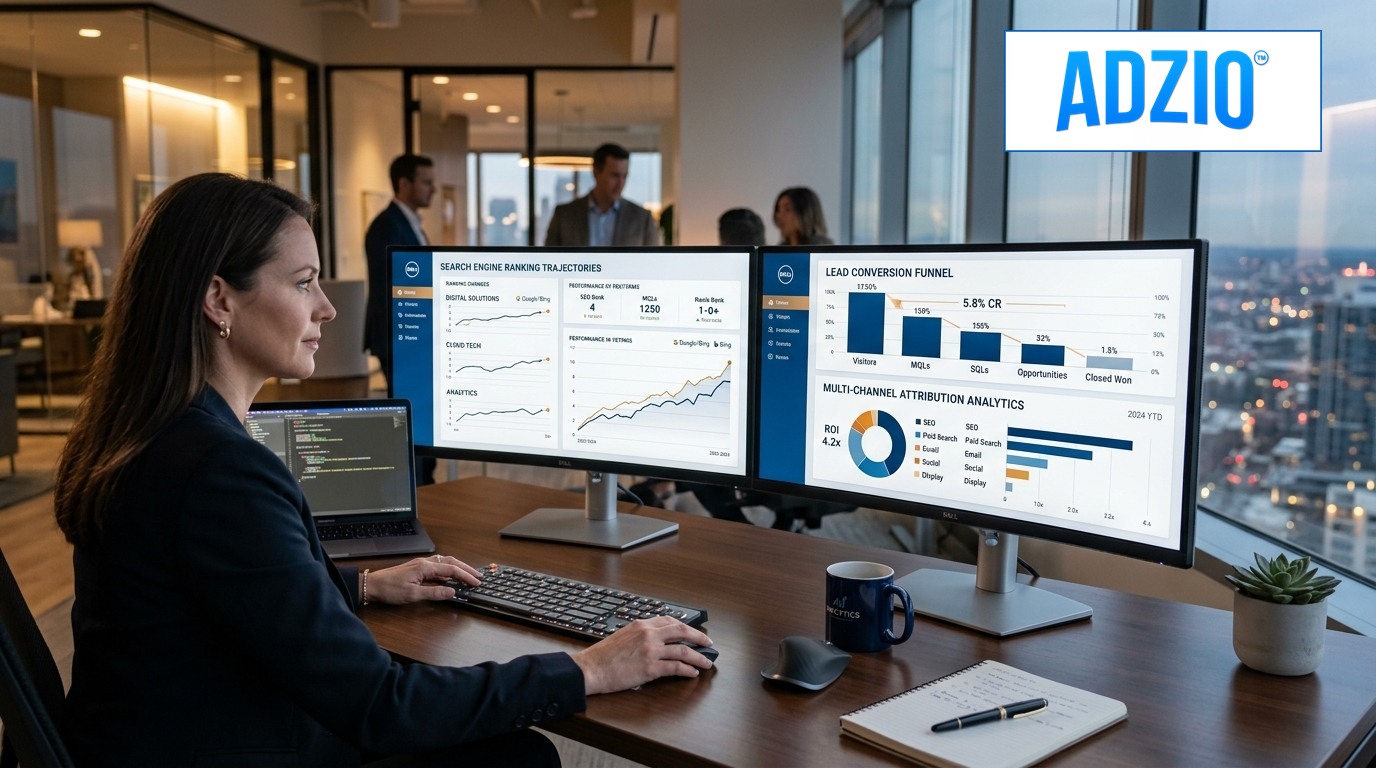
Interactive A/B Experiment Simulator (Illustrative Demo)
Educational SimulationExplore how traffic distribution, conversion rates, and statistical confidence interact across a sample split-run test:
Standard Page Layout
• Conversions: 125
• Conversion Rate: 2.50%
• Status: Baseline Reference
Benefit Headline + Sticky CTA
• Conversions: 165
• Conversion Rate: 3.30% (+32%)
• Confidence: 96.4% (Winner)
Short Form + Video Hook
• Conversions: 140
• Conversion Rate: 2.80% (+12%)
• Confidence: 81.2% (Inconclusive)
Mathematical Rigor: Sample Size Estimation & Statistical Significance
One of the most frequent reasons internal marketing experiments fail is premature stopping ("peeking") before statistical power is achieved. A test stopped after 3 days with a 50% lift is almost always a false positive driven by random noise.
4 Critical Experimentation Parameters
- 1. Statistical Significance (α = 0.05 / 95% Confidence): The probability that the measured lift is not due to random sample variance. We require p < 0.05 before declaring a winner.
- 2. Statistical Power (1 - β = 0.80 / 80% Power): The probability of detecting a real effect if one actually exists. Underpowered tests risk discarding winning ideas as inconclusive.
- 3. Minimum Detectable Effect (MDE): The smallest relative lift your sample size is mathematically equipped to detect. Smaller MDEs require exponentially larger visitor volumes.
- 4. Full Business Cycle (Minimum 14 Days): Tests must run for at least 2 full business cycles (14 consecutive days) to capture weekday vs. weekend consumer behavioral differences.
Frequentist vs. Bayesian Testing Frameworks
AdZio employs both paradigms depending on client traffic volume and testing velocities:
• Frequentist Paradigm: Best for high-traffic enterprise sites. Treats the conversion rate as fixed and calculates the p-value. Requires strict fixed-horizon sample sizes without continuous peeking.
• Bayesian Paradigm: Best for high-velocity and mid-market growth testing. Calculates the continuous "Probability to be Best" and "Expected Loss," enabling agile decision-making while mitigating risk.
Sample Size Requirements Matrix (Per Variation)
Calculated at 95% Statistical Confidence (α = 0.05) and 80% Power (β = 0.20) for a two-tailed hypothesis test:
| Baseline Conversion Rate | +5% Relative Lift | +10% Relative Lift | +15% Relative Lift | +20% Relative Lift | +30% Relative Lift |
|---|---|---|---|---|---|
| 1.00% Baseline | 1,240,000 visitors | 310,000 visitors | 138,000 visitors | 78,000 visitors | 35,000 visitors |
| 2.00% Baseline | 615,000 visitors | 155,000 visitors | 69,000 visitors | 39,000 visitors | 17,500 visitors |
| 3.00% Baseline | 405,000 visitors | 102,000 visitors | 45,500 visitors | 25,700 visitors | 11,500 visitors |
| 5.00% Baseline | 240,000 visitors | 60,500 visitors | 27,000 visitors | 15,200 visitors | 6,800 visitors |
| 10.00% Baseline | 114,000 visitors | 28,800 visitors | 12,900 visitors | 7,300 visitors | 3,300 visitors |
7 Statistical Traps That Invalidate A/B Test Results
Checking daily dashboards and declaring victory on Day 3 inflates your false positive rate from 5% to over 30%. Tests must run to their pre-calculated horizon.
A variation appears to win overall, but loses when broken down across individual device segments (Desktop vs Mobile) due to unequal traffic allocation.
Returning customers click new redesigns out of curiosity rather than genuine intent, creating an artificial initial lift that evaporates after 2 weeks.
Lifting conversions on a secondary CTA (e.g., brochure download) at the direct expense of primary quote inquiries, reducing overall business revenue.
Stopping a test on Friday evening misses weekend purchasing dynamics, leading to inaccurate models of real customer decision velocity.
"Any figure that looks interesting or different is usually wrong." An A/B test reporting a 300% lift is almost always a tracking script double-fire bug.
CRO Research Methods: Blending Hard Telemetry with Qualitative Voice
Web analytics tell you where users drop off, but qualitative research reveals why. AdZio combines quantitative metrics with qualitative human feedback to formulate high-impact hypotheses.
1. GA4 Funnel Telemetry
Auditing user journey drop-offs, device-specific bounce rates, landing page performance, and custom conversion events to map traffic patterns.
2. Heatmaps & Scroll Maps
Visualizing where users click, where they hover, and how far down the page they scroll before interest flags, highlighting blind spots.
3. Session Recordings
Observing anonymized real visitor sessions to detect rage-clicks, broken form fields, mobile rendering glitches, and hesitation loops.
4. Voice of Customer (VoC)
Mining customer service tickets, sales call objections, on-site micro-surveys, and chat transcripts to uncover the exact vocabulary buyers use.
Mobile CRO: Engineering for Touch, Speed & Thumbs
Over 70% of digital traffic in India originates on mobile devices, yet mobile conversion rates routinely trail desktop by 50%. Closing this gap is the single greatest growth lever for modern businesses.
The "Thumb Zone" & Mobile Ergonomics
Smartphone users operate their devices with one thumb while walking, commuting, or multitasking. Forcing a mobile user to pinch-to-zoom, reach across a 6.7-inch screen for a navigation link, or fill a microscopic form guarantees immediate abandonment.
- • 48x48 Pixel Touch Targets: All buttons and interactive links are sized to prevent accidental mis-taps.
- • Sticky Mobile Footer Bars: High-intent CTAs (Call Now, WhatsApp, Book) remain accessible at the bottom of the screen regardless of scroll depth.
- • Core Web Vitals Speed: CSS/JS minification and next-gen WebP imagery keep mobile LCP under 1.5 seconds.
- • Zero Layout Shift: Strict aspect-ratio containers prevent elements from jumping as mobile ads and images load.
E-Commerce CRO: Maximizing Add-to-Cart Velocity & Checkout Completion
For online retail brands, a fractional lift in checkout completion compounds directly into substantial bottom-line profit. We optimize every critical juncture from Product Detail Page (PDP) down to final payment authorization.
1. High-Converting PDPs
High-resolution zoomable galleries, transparent inventory status, verified customer review filters, clear delivery date estimates, and sticky add-to-cart drawers.
2. Friction-Free Cart Drawers
Slide-out mini carts that keep users on the browsing path, free-shipping threshold progress bars ("Add ₹300 for Free Delivery"), and 1-click quantity adjustments.
3. 1-Page Checkout Streamlining
Eliminating mandatory account registration friction with guest checkout, auto-detecting city/state via PIN code, and integrating fast UPI 1-tap payment methods.
Catalog Navigation Architecture: Search, Faceted Filtering & Discovery UX
Shoppers who use on-site search convert at nearly double the rate of passive browsers because they arrive with active purchase intent. If your catalog navigation fails them, you leak your highest-value prospects.
Predictive Typeahead & Search Intelligence
Modern e-commerce search cannot be a static text query. It must function as an intelligent shopping concierge:
- • Visual Product Suggestions: Show thumbnail image, active price, and rating directly inside the dropdown as the user types.
- • Typo-Tolerant Fuzzy Matching: Handle phonetic misspellings, plurals, and brand variations without returning zero results.
- • Category Quick-Jumps: Route broad queries (e.g., "shoes") to curated category landing pages rather than unranked product lists.
- • Zero-Results Recovery: Never show a dead-end "No items found" screen; suggest related popular items, trending searches, and a direct inquiry link.
Faceted Filtering Ergonomics & Mobile Drawers
Filtering large inventories should be effortless, instantaneous, and completely responsive:
- • Dynamic Result Counts: Display live counts next to each filter option (e.g.,
[ ] Leather (42)) so users never filter into an empty set. - • Instant AJAX Updates: Update product grids asynchronously without full page reloads that trigger white screen flashes.
- • Mobile Bottom-Sheet Drawer: Open full-screen filter panels with large touchable checkboxes and a sticky footer button showing "View 38 Results".
- • Prominent Active Badges: Display removable filter chips at the top of the grid with a single-tap "Clear All Filters" button.
Cart Abandonment Deconstructed: 6 Primary Leaks & Engineering Fixes
| Abandonment Cause | Psychological Friction Trigger | AdZio CRO Architecture Remedy | Impact Area |
|---|---|---|---|
| Unexpected Shipping Fees | Surprise cost inflation at final step triggers feelings of deception and checkout abandonment. | Implement dynamic "Free Shipping Threshold" progress bars across PDPs and slide-out carts so totals are transparent early. | Cart Drawer / Step 1 |
| Forced Account Creation | Demanding password setup and email verification interrupts impulse momentum. | Make Guest Checkout the default path; offer optional 1-click password creation on the post-order confirmation screen. | Checkout Initiation |
| Coupon Code Anxiety | Prominent blank coupon input boxes prompt users to leave the checkout to hunt for promo codes on external coupon sites. | Collapse the promo box into a subtle text link ("Have a voucher code?") or auto-apply the best valid offer directly at cart view. | Order Summary Review |
| Payment Security Hesitation | Unfamiliar payment gateways or missing trust seals trigger fear of credit card data compromise. | Prominently display RBI-compliant payment gateway logos, UPI instant QR codes, SSL encryption badges, and COD availability. | Payment Selection |
| Excessive Form Fields | Asking for separate billing address, fax numbers, or repeated telephone fields on mobile. | Use single-line address lookup, auto-populate City/State from PIN code, and set "Billing same as Shipping" checked by default. | Shipping Address |
| Unclear Return Policy | Buyer fears being stuck with an ill-fitting or defective item with no recourse. | Place micro-reassurance badges directly below the "Place Order" button (e.g., "7-Day Hassle-Free Returns & Dedicated Support"). | Final Confirmation CTA |
Lead Generation CRO: Connecting Conversion Science to Sales Qualified Leads
Generating contact form submissions is useless if the inquiries are uncontactable or have zero commercial intent. AdZio connects conversion rate optimization directly to sales pipeline velocity and closed revenue.
Beyond Vanity Form Fills: Engineering for Intent
In B2B and professional services, a 50% increase in cheap, unqualified leads only burns out your sales team. Our lead generation CRO methodology introduces strategic qualification filters—such as project timeline dropdowns, budget parameters, and corporate email verification—ensuring that higher conversion rates produce higher revenue, not higher noise.
Explore our comprehensive Lead Generation Services and specialized Landing Page Development solutions to see how campaign architecture synchronizes with conversion design.
Harvard Business Review research proves that contacting a digital inquiry within 5 minutes increases the odds of qualification by 21 times compared to waiting 30 minutes. We configure instant webhook notifications to ensure immediate sales response.
Local Business CRO: Turning Hyper-Local Searches into Showroom Visits & Calls
When a customer in Agartala or Guwahati searches for a local specialist, clinic, or contractor, proximity is the primary deciding factor. Local CRO aligns your digital landing pages with immediate geographical intent.
1. Tap-to-Call Dominance
For urgent services (breakdown repairs, clinics, contractors), mobile visitors demand immediate phone dialogue. Prominent sticky tap-to-call buttons eliminate form-filling friction entirely.
2. Localized WhatsApp Triggers
In Northeast India and regional business hubs, WhatsApp is the default business communications channel. Pre-filled chat links allow users to initiate price inquiries in their preferred language.
3. Verified Proximity Signals
Displaying authentic physical addresses, parking instructions, landmark guidance, and verified Google Business Profile reviews reassures local prospects of your legitimacy.
The PIE Prioritization Framework: Scoring Optimization Hypotheses
Every website has dozens of potential optimization ideas, but engineering resources are finite. We use the structured PIE model (Potential, Importance, Ease) to determine which tests generate the highest return on effort.
Interactive PIE Score Calculator (Try Your Idea)
Score any potential website optimization change on a 1-to-10 scale to calculate its prioritized execution score:
This optimization hypothesis combines strong potential upside with high traffic importance and manageable implementation effort. It should be scheduled in your immediate testing sprint.
Illustrative CRO Experiment Prioritization Backlog
Demonstration of how an enterprise optimization backlog is mathematically structured:
| Optimization Hypothesis | Page / Location | Potential | Importance | Ease | PIE Score | Priority Status |
|---|---|---|---|---|---|---|
| Sticky Tap-to-Call & WhatsApp Bar | Mobile Service Pages | 9 / 10 | 9 / 10 | 8 / 10 | 8.7 / 10 | Sprint 1 (Now) |
| Guest Checkout with Auto-PIN Lookup | E-Commerce Checkout | 9 / 10 | 10 / 10 | 6 / 10 | 8.3 / 10 | Sprint 1 (Now) |
| Headline Message Match Alignment | Google Ads Landing Page | 8 / 10 | 9 / 10 | 8 / 10 | 8.3 / 10 | Sprint 2 |
| Pruning 8 Non-Essential Form Fields | B2B Quote Request Page | 8 / 10 | 8 / 10 | 8 / 10 | 8.0 / 10 | Sprint 2 |
| RERA & Cashless Insurance Trust Badges | Hospitality / Real Estate Hero | 7 / 10 | 8 / 10 | 9 / 10 | 8.0 / 10 | Sprint 3 |
| Custom Dynamic Product Configurator | Catalog Pages | 6 / 10 | 7 / 10 | 3 / 10 | 5.3 / 10 | Backlog (Later) |
15 Core Conversion Metrics & Downstream Attribution Models
Measuring only raw pageviews or vanity button clicks produces misleading optimizations. AdZio tracks 15 rigorous conversion metrics linked to financial unit economics.
1. Macro Conversion Rate (%)
Percentage of total sessions that complete a commercial transaction or verified inquiry.
2. Micro Conversion Rate (%)
Ratio of sessions completing intermediate steps: price views, video plays, whitepaper downloads.
3. Form Completion Rate (%)
Percentage of users who successfully submit a form after focusing on the first input field.
4. Form Abandonment Rate (%)
The drop-off percentage of visitors who begin typing into a form but exit prior to completion.
5. CTA Click-Through Rate (%)
The ratio of impressions of a specific call-to-action button against total unique clicks received.
6. Landing Page Conversion Rate
Standalone conversion performance of specific paid ad landing pages isolated by traffic source.
7. Shopping Cart Abandonment (%)
Percentage of e-commerce shoppers who place items in the cart but fail to start checkout.
8. Checkout Completion Rate (%)
The percentage of users who initiate the checkout process and complete final payment authorization.
9. Average Order Value (AOV)
Average monetary amount spent per completed purchase; lifted through smart cross-sells.
10. Revenue Per Visitor (RPV)
Total revenue divided by total visitor sessions. The ultimate single benchmark of site monetization.
11. Cost Per Acquisition (CPA)
Total advertising spend divided by total completed conversions; reduced directly through CRO.
12. Customer Acquisition Cost (CAC)
Blended marketing and sales expense required to onboard a paying commercial client.
13. Lead-to-Customer Velocity
Average elapsed business days between initial web form submission and final contract closing.
14. Bounce Rate vs. Engagement Rate
GA4 sessions lasting over 10 seconds, viewing 2+ pages, or triggering a conversion event.
15. Return on Ad Spend (ROAS)
Gross revenue generated per rupee invested in paid advertising channels.
20 Industry Blueprints: Tailoring CRO to Specific Commercial Friction
Conversion hurdles are unique to each sector. The anxieties of an IVF clinical patient are fundamentally different from a procurement officer purchasing industrial machinery or a homeowner booking interior painting.
1. Healthcare Systems & Regional Networks
Decision Trigger: Patients or family members seeking specialized treatment protocols, second opinions for critical diagnoses, or tertiary care facilities.
2. Multi-Specialty Hospitals
Decision Trigger: Urgent inpatient admissions, scheduled elective procedures, emergency care, or maternity package planning.
3. Clinics & Dental Centers
Decision Trigger: Tooth pain relief, orthodontic aligner evaluations, smile makeovers, or preventive pediatric dental care.
4. Diagnostic & Pathology Laboratories
Decision Trigger: Doctor-prescribed blood tests, comprehensive annual health checkups, or specialized genetic screening.
5. Automobile Manufacturers & OEMs
Decision Trigger: New vehicle research, variant comparisons, festive seasonal launches, or finding regional dealer networks.
6. Car Dealerships & Regional Showrooms
Decision Trigger: In-stock car availability, festival discount quotes, trade-in valuations, and rapid delivery timelines.
7. Bike Showrooms & Electric 2-Wheeler Centers
Decision Trigger: Daily fuel savings calculation, college commute purchases, or sports motorcycle upgrades.
8. Real Estate Developers & Builders
Decision Trigger: High-ticket residential property investments, luxury villa acquisitions, or first-time home purchases.
9. Consultative High-Ticket E-Commerce
Decision Trigger: High-ticket custom furniture, specialized home electronics, luxury decor, or bespoke artisan apparel.
10. Jewellery & Luxury Boutiques
Decision Trigger: Bridal jewellery sets, anniversary diamond rings, gold bullion investments, or designer couture.
11. Hotels, Luxury Resorts & Banquet Venues
Decision Trigger: Leisure getaways, destination wedding hosting, corporate conventions, or banquet bookings.
12. Tour Operators & Destination Travel Agencies
Decision Trigger: Family holiday packages, customized international itineraries, or spiritual pilgrimages.
13. Education & Coaching Institutes
Decision Trigger: Parents and students evaluating competitive exam coaching (JEE/NEET), digital skills bootcamps, or school admissions.
14. Corporate Legal, CA & Financial Advisory
Decision Trigger: Corporate tax restructuring, statutory audits, regulatory compliance, or high-stakes commercial disputes.
15. Fine Dining & Event Catering Services
Decision Trigger: Weekend romantic reservations, corporate banquet dinners, anniversary celebrations, or wedding catering.
16. Luxury Salons, Spas & Aesthetic Studios
Decision Trigger: Bridal makeup trials, hair botox/keratin packages, anti-aging aesthetic therapies, or relaxation spa days.
17. Gyms, CrossFit & Fitness Centers
Decision Trigger: New Year fitness resolutions, weight transformation programs, personal training, or group HIIT workouts.
18. Local Contractors (Roofing, HVAC, Solar)
Decision Trigger: Emergency AC breakdown during summer, rooftop solar subsidy evaluation, or monsoon roof leakage repairs.
19. B2B Manufacturing & Industrial Fabrication
Decision Trigger: OEM parts sourcing, precision CNC machining contracts, chemical raw material bulk orders, or custom packaging.
20. B2B Enterprise SaaS & Technology Startups
Decision Trigger: IT directors, revenue operations leaders, and founders seeking software to automate workflows and accelerate revenue.
The 16-Stage End-to-End CRO Process Architecture
High-converting websites are not born from sudden inspiration. They are engineered through a continuous 16-stage operational cycle linking quantitative measurement with iterative design refinements.
1. Business & Unit Economic Discovery
Uncovering gross margins, customer lifetime value (LTV), target CAC, and minimum viable deal size.
2. Conversion Goal & Event Architecture
Formally defining primary macro conversions and secondary micro milestones across web properties.
3. Web Analytics Health Audit
Verifying GA4 tracking tags, GTM containers, Meta Conversions API (CAPI), and eliminating duplicate hits.
4. Full-Funnel Telemetry Mapping
Building exploration funnels in analytics to calculate conversion drop-off percentages at every step.
5. User Journey & Pathing Analysis
Examining top navigation loops, internal search queries, and unintended exit pathways.
6. 20-Point Heuristic CRO Audit
Evaluating clarity, friction, distraction, urgency, and trust across mobile and desktop viewports.
7. Friction & Hesitation Identification
Isolating high-drop form fields, confusing technical jargon, hidden costs, or slow page scripts.
8. Scientific Hypothesis Formulation
Structuring testable claims linking observed data to behavioral design changes and expected lift.
9. PIE / ICE Opportunity Prioritization
Scoring hypotheses by Potential, Impact, and Ease to prioritize the highest ROI experiments first.
10. Wireframing & UX Recommendations
Producing high-fidelity design prototypes of test variants featuring optimized copy and layout.
11. Technical Front-End Implementation
Coding lightweight HTML/CSS/JS test variations with zero flicker and flawless responsiveness.
12. Controlled A/B Split Testing
Running experiments across representative traffic samples until statistical significance is achieved.
13. Downstream Sales Verification
Confirming that conversion lifts translate into qualified opportunities rather than junk form fills.
14. Statistical Evaluation & Learning
Documenting learnings from both winning and losing tests to refine mental models of customer behavior.
15. Production Hardening & Rollout
Hard-coding confirmed winning variants directly into permanent production web templates.
16. Executive Reporting & Iterative Cycle
Delivering bi-weekly executive briefings and queueing the next prioritized test from the backlog.
CRO Governance & The 5-Stage Experimentation Maturity Model
World-class conversion optimization is not an isolated one-time project; it is an organizational capability. Discover where your company currently sits on the experimentation maturity curve and what is required to advance.
Ad-Hoc & Reactive
Design changes are driven by executive HiPPO (Highest Paid Person's Opinion). No formal hypothesis or controlled split testing.
Structured Testing
Marketing team runs periodic A/B tests on high-traffic landing pages. Basic heatmaps deployed, but tests are often stopped prematurely.
Data-Driven Engine
Formal hypothesis creation using quantitative GA4 funnels and qualitative session recordings. PIE prioritization framework governs testing queues.
Strategic Optimization
CRO is integrated across product, marketing, and sales operations. Multi-touch attribution links on-page test winners to closed CRM revenue.
Experimentation Culture
Continuous experimentation across website, mobile apps, pricing models, and checkout workflows. Every product feature begins as an experiment.
The 5 Specialist Disciplines in an AdZio CRO Engagement Pod
True conversion engineering requires a synthesis of disparate skill sets. A graphic designer lacks statistical modeling, while a data analyst rarely understands persuasive behavioral copywriting. AdZio deploys a balanced multidisciplinary unit:
1. Lead CRO Strategist
Orchestrates testing backlogs, conducts heuristic walkthroughs, formulates core hypotheses, and manages executive stakeholder communications.
2. Quantitative Data Analyst
Audits GA4 telemetry, configures custom exploration funnels, calculates sample size power horizons, and validates statistical significance models.
3. Conversion Copywriter
Translates user voice-of-customer insights into high-converting headlines, friction-reducing microcopy, value propositions, and CTA labels.
4. UI/UX Conversion Designer
Crafts high-fidelity Figma prototypes adhering to cognitive ergonomic laws, visual scanning hierarchies, thumb zones, and accessibility standards.
5. Full-Stack Optimization Engineer
Builds lightweight, flicker-free A/B test variations with zero Core Web Vitals degradation, and permanently merges confirmed winning code.
6. Experiment Knowledge Archivist
Documents post-test retrospectives for both wins and losses into a searchable knowledge base so your company never re-tests failed ideas.
Conversion Lift & Revenue Impact Simulator
Experiment with user-entered values to see how incremental percentage improvements in conversion rate compound into substantial revenue gains without increasing your advertising media budget.
18 Costly CRO Mistakes That Waste Time & Budget
Failed optimization projects usually fail because of methodological errors rather than bad intentions. Avoiding these 18 common pitfalls will save your team months of wasted experimentation.
1. Testing Without a Hypothesis
Changing random button colors without any behavioral rationale or observed user friction.
2. Ending Tests Prematurely
Calling a winner after 4 days before gathering enough sample size or testing across weekend cycles.
3. Blindly Copying Competitors
Assuming your competitors know what they are doing; they may be leaking conversions just as badly.
4. Optimizing Only Desktop
Designing beautiful desktop viewports while ignoring that 75%+ of traffic browses on smartphones.
5. Too Many Competing CTAs
Offering 5 different actions on one page, creating choice paralysis (Hick's Law) and zero clicks.
6. Intimidating Long Forms
Demanding 12 fields (fax, full address, annual budget) on a top-of-funnel inquiry, causing 80% exits.
7. Hidden Pricing & Fees
Concealing shipping fees or minimum prices until the final step, triggering angry cart abandonment.
8. Cluttered Header Menus
Sending paid ad traffic to pages with 40 navigation links that distract visitors away from the offer.
9. Slow Core Web Vitals
Every 1 second of loading latency cuts conversion probability by up to 20% on mobile devices.
10. Inaccurate Tracking Setup
Optimizing against distorted analytics where thank-you pixels fire on page refreshes.
11. Misleading Clickbait Ads
Driving cheap clicks with exaggerated claims that the landing page and sales team cannot honor.
12. Confusing Micro for Macro
Celebrating an increase in button clicks that ultimately resulted in zero additional paying clients.
13. Testing on Low Traffic Sites
Trying to run 5-variant A/B tests on a site with only 500 monthly visitors (requires qualitative CRO).
14. Ignoring Post-Click Lag
Generating high-intent inquiries but waiting 2 days to follow up, by which time the lead has cooled.
15. Ineffective Error Tooltips
Showing vague errors like "Submission failed" without highlighting which specific field had a typo.
16. Invasive Intrusive Popups
Blasting mobile users with full-screen popups within 2 seconds of arrival, violating Google policies.
17. Testing During Holidays
Treating Diwali or Black Friday shopping spikes as normal baseline behavior for permanent changes.
18. Stopping After One Test
Treating CRO as a one-time project rather than an ongoing scientific practice that compounds over time.
Transparent Monthly CRO Retainers & Inclusions
Whether you need an intensive one-time heuristic audit or an ongoing monthly experimentation team, AdZio provides clear, scope-backed retainers with zero hidden markups.
Comprehensive heuristic audit and prioritized friction remediation blueprint for high-intent pages.
- 20-Point Heuristic Review
- GA4 Funnel Telemetry Check
- Mobile Viewport & Touch Audit
- Speed & Core Web Vitals Report
- 10 Prioritized UX Wireframes
- Executive Video Findings Review
Continuous monthly experimentation and landing page optimization for scaling commercial brands.
- Everything in Diagnostic Audit
- 2 A/B Experiments per Month
- Landing Page Copy Refinements
- Form Friction Engineering
- Session Recording Analysis
- Bi-Weekly Executive Briefings
Full-funnel optimization for high-traffic e-commerce brands, hospitals, and enterprise B2B portals.
- Everything in Growth Engine
- 4 A/B Experiments per Month
- Multi-Step Checkout Streamlining
- Heatmap & Scrollmap Surveillance
- Voice of Customer Survey Analysis
- Weekly Dedicated Strategy Calls
Bespoke CRO architecture for major consumer conglomerates, fintech apps, and national retail chains.
- Full-Stack Development Support
- Multi-Arm Bandit Algorithm Testing
- Custom Server-Side Personalization
- Predictive Churn Mitigation
- SLA-Backed Response Times
- Dedicated Analytics Director
25-Point Service Deliverables Comparison Matrix
Examine the detailed scope across every CRO engagement model:
| Deliverable Feature | Diagnostic Audit | Growth Engine | Dominance | Enterprise |
|---|---|---|---|---|
| 1. Research & Quantitative Analytics | ||||
| GA4 Event Tracking & Funnel Audit | Included | Included | Included | Enterprise Matrix |
| Heatmap & Scroll Map Data Mining | Static Sample | Included | Included | Continuous Real-Time |
| Session Recording Review (Drop-offs) | 25 Sessions | 100 Sessions/mo | 250 Sessions/mo | Unlimited Enterprise |
| Voice-of-Customer Survey Synthesis | Basic Review | Bi-Monthly | Monthly Active | Live VoC Pipeline |
| Core Web Vitals & Speed Diagnostics | Included | Included | Included | Edge CDN Speed Eng. |
| 2. Experimentation & Testing Cadence | ||||
| Controlled A/B Experiments | Audit Only | 2 Tests / mo | 4 Tests / mo | Custom Parallel Tests |
| Hypothesis Formulation & Backlog | Initial 10 | Continuous Active | Continuous Active | Dynamic Prioritized |
| Statistical Significance Validation | N/A | 95% Confidence | 95% Confidence | Bayesian / Multi-Arm |
| Post-Test Learning Documentation | Summary Report | Included | Included | Full Enterprise Wiki |
| 3. UX, Wireframing & Design Engineering | ||||
| Friction-Calibrated Form Wireframes | Included | Included | Included | Bespoke Form Logic |
| CTA Copywriting & Button Redesigns | Recommendations | Active Production | Active Production | Full Creative Studio |
| Mobile Viewport Touch Target Layouts | Included | Included | Included | Native App + PWA |
| Front-End Test Code Implementation | Guidance Only | Included | Included | Full-Stack Dev |
| Production Hardening of Winners | Client Implements | Included | Included | Git Direct Push |
| 4. Strategy, Reporting & Account Support | ||||
| Dedicated CRO Strategist | Senior Auditor | Assigned Lead | Senior Director | Dedicated Pod |
| Executive Strategy Review Call | 1 Video Review | Bi-Weekly | Weekly | On-Demand Daily |
| Downstream Sales Lead Quality Audit | Basic Review | Monthly Audited | Bi-Weekly Audited | Live CRM Sync |
Frequently Asked Questions About Conversion Rate Optimization
Direct, transparent answers regarding CRO economics, statistical requirements, research methodologies, and our strategic execution approach.
What is Conversion Rate Optimization (CRO)?
Conversion Rate Optimization (CRO) is the systematic, data-driven discipline of improving website user experience, layout, copywriting, and technical performance so that a higher percentage of visitors take meaningful commercial actions. Rather than spending more money to acquire new traffic, CRO maximizes the revenue and leads generated from your existing visitor base.
What are professional CRO services?
Professional CRO services encompass end-to-end conversion engineering: quantitative web analytics auditing, user journey mapping, qualitative heatmap analysis, friction identification, hypothesis formulation, UX wireframing, A/B split testing, form optimization, and server-side conversion tracking.
Why is CRO important for growing businesses?
Digital advertising costs (CPC) on Google and Meta rise each year due to competition. If your website converts at only 1%, acquiring customers becomes unsustainably expensive. By lifting your conversion rate to 2% or 3%, you double or triple your customer acquisition volume while cutting your blended Customer Acquisition Cost (CAC) in half.
What is the mathematical formula for conversion rate?
The conversion rate formula is: (Total Conversions ÷ Total Visitors) × 100. For example, if your e-commerce store receives 50,000 visitors in a month and logs 1,250 completed orders, your conversion rate is (1,250 ÷ 50,000) × 100 = 2.5%.
What is the difference between CRO and SEO?
SEO (Search Engine Optimization) focuses on driving qualified organic search traffic to your website through technical infrastructure, keyword relevance, and backlinks. CRO focuses on what happens after visitors arrive—guiding them through friction-free pathways to complete inquiries or purchases.
What is the difference between CRO and Lead Generation?
Lead Generation represents the entire multi-channel initiative responsible for attracting prospects and capturing contact details. CRO is the specialized optimization discipline that improves the conversion efficiency of the landing pages, forms, and CTAs used within those lead generation campaigns.
What is the difference between CRO and Landing Page Optimization (LPO)?
Landing Page Optimization is a targeted subset of CRO focused specifically on single standalone advertising landing pages. CRO encompasses the entire website ecosystem, including site-wide navigation, category pages, product pages, multi-step checkouts, and customer retention pathways.
When does a business need a dedicated CRO strategy?
A business needs CRO when: ad spend is increasing but lead volume is stagnant; website traffic is growing but revenue remains flat; mobile bounce rates are significantly higher than desktop; checkout abandonment exceeds 70%; or sales reps complain that web inquiries are low-quality tire-kickers.
Does CRO guarantee higher conversions or more sales?
No ethical marketing or optimization agency can guarantee specific percentage lifts, fixed lead volumes, or sales figures. External economic factors, competitor promotions, product pricing, and sales team closing skills directly influence final revenue. AdZio guarantees disciplined, evidence-based experimentation, rigorous statistical testing, and full transparency.
What is A/B testing and how does it work?
A/B testing (split testing) is an experimental method where two versions of a webpage—Version A (the original Control) and Version B (the Variant with a specific change)—are served simultaneously to randomized segments of live website visitors. By comparing the conversion rates between the two groups over a statistically significant sample size, we determine with mathematical certainty which variation performs better.
What is a scientific CRO hypothesis?
A hypothesis is a structured, testable statement linking observed user friction to an intentional design modification and predicted behavioral outcome. At AdZio, hypotheses follow the formula: "Because we observed [data], changing [element] will result in [metric lift] because [behavioral reason]."
How long should an A/B test run?
An A/B test should typically run between 2 to 4 weeks. Tests must run through full business week cycles (including weekends) to account for daily behavioral variations, and must accumulate enough conversion events to reach at least 95% statistical significance.
Can you do CRO if your website has low traffic?
Yes, but the methodology shifts. Websites with under 10,000 monthly visitors cannot run high-velocity A/B tests because achieving statistical significance takes too long. Instead, we perform qualitative CRO: heuristic friction audits, session recording reviews, customer interviews, and radical high-impact page redesigns rather than micro-variant tests.
What data and tracking tools are required for CRO?
CRO requires accurate event tracking in Google Analytics 4 (GA4), tag management via Google Tag Manager (GTM), session recording and heatmap tools (such as Microsoft Clarity or Hotjar), and where appropriate, server-side conversion tracking like the Meta Conversions API (CAPI).
What are micro conversions vs. macro conversions?
Macro conversions are primary commercial objectives (orders, booked consultations, RFQ submissions). Micro conversions are intent indicators along the journey (viewing pricing tables, adding an item to cart, scrolling 75% of a service page, starting a form). Tracking micro conversions reveals where user momentum stalls.
What is statistical significance in CRO?
Statistical significance (measured via p-value) is the probability that a difference in conversion rates between Control and Variant is real, rather than a fluke of random chance. A 95% significance level means there is only a 5% chance the observed lift occurred accidentally.
What is a CRO audit?
A CRO audit is an exhaustive technical and behavioral evaluation of your website. It inspects 20 core heuristic vectors including mobile viewport speed, value proposition clarity, message match, CTA visibility, form friction, trust signals, and funnel analytics to produce a prioritized roadmap of optimization opportunities.
What makes a high-converting landing page headline?
A high-converting headline immediately answers three questions within 5 seconds: What is this? What benefit does it deliver to me? What makes it credible? It must match the terminology of the ad or search query that brought the visitor.
How does form length affect conversion rates?
Generally, shorter forms generate higher raw submission volume because they minimize psychological friction. However, for high-ticket B2B or medical consulting, ultra-short forms often attract tire-kickers. CRO calibrates form length to collect the minimum fields necessary for sales qualification without causing abandonment.
What is CTA optimization?
CTA optimization is the testing and refinement of Call to Action buttons: button copy (action + value vs passive words), visual contrast against background colors, sizing for mobile touch targets (48x48px minimum), and positioning across the user's scroll path.
How does page speed impact conversion rates?
Page speed directly dictates conversion probability. Google studies indicate that mobile conversion rates drop by up to 20% for every additional second a page takes to load. Fast sites (LCP < 1.5s) keep visitors in an uninterrupted cognitive flow.
What is cognitive load and how does it hurt conversions?
Cognitive load refers to the amount of mental effort required to process information. Dense text blocks, ambiguous navigation labels, low contrast, and competing visual elements overwhelm the user's working memory, causing them to leave for an easier competitor site.
Why is mobile CRO different from desktop CRO?
Mobile users have smaller screens, lower patience, variable network speeds, and interact via touch thumbs rather than precise mouse cursors. Mobile CRO focuses on sticky bottom action bars, single-column forms, native keypad inputs, and eliminating layout shifts.
Can CRO improve lead generation for local businesses in Agartala and Tripura?
Yes. For local businesses across Agartala, Tripura, and Northeast India, CRO focuses on high-intent mobile triggers: prominent click-to-call buttons, localized WhatsApp direct chat, verified physical location signals, and fast mobile loading on regional telecom networks.
Can CRO help e-commerce stores reduce cart abandonment?
Yes. We optimize e-commerce checkout flows by implementing guest checkout, auto-detecting address fields from PIN codes, offering transparent shipping terms before the cart, displaying trust badges, and integrating 1-tap UPI payment flows.
How does AdZio approach healthcare and patient inquiry CRO?
Healthcare CRO requires strict ethical compliance. We focus on transparent doctor credentials, department overviews, cashless insurance empanelment clarity, and seamless appointment booking, strictly avoiding exaggerated clinical claims or fear-based messaging.
Can CRO be combined with Google Ads and Meta Ads campaigns?
Yes, combining CRO with paid advertising is the ultimate growth catalyst. While Google Ads and Meta Ads acquire traffic, CRO ensures those paid visitors convert at the highest possible percentage, lowering your Cost Per Acquisition (CPA).
How does AdZio get started with a new CRO client?
We begin with a commercial discovery call to understand your business economics and margins, followed by a technical analytics audit and a 20-point heuristic review of your key conversion pages. We then deliver a prioritized backlog of high-impact opportunities.
Request a Free Preliminary Website Conversion Audit
Connect directly with an AdZio conversion strategist. We will evaluate your user journey, identify top drop-off points, and outline actionable optimization opportunities.
Stop Leaking Budget on Unoptimized Traffic
Partner with AdZio to engineer a disciplined conversion system linking behavioral insights, frictionless landing pages, and evidence-based A/B testing. Maximize your return on existing traffic today.