 ISO Certified Company
+91-9233973156
ISO Certified Company
+91-9233973156
ISO Certified Company
+91-9233973156
ISO Certified Company
+91-9233973156

Your Google Business Profile is the digital storefront of your real-world business across Google Search and Google Maps. At AdZio, we engineer, optimize, and manage verified local profiles for healthcare providers, retailers, showrooms, professional firms, and service-area businesses across India, Tripura, Agartala, and national markets — ensuring accurate information, authentic review governance, and maximum local discovery without policy violations or keyword-stuffing risks.
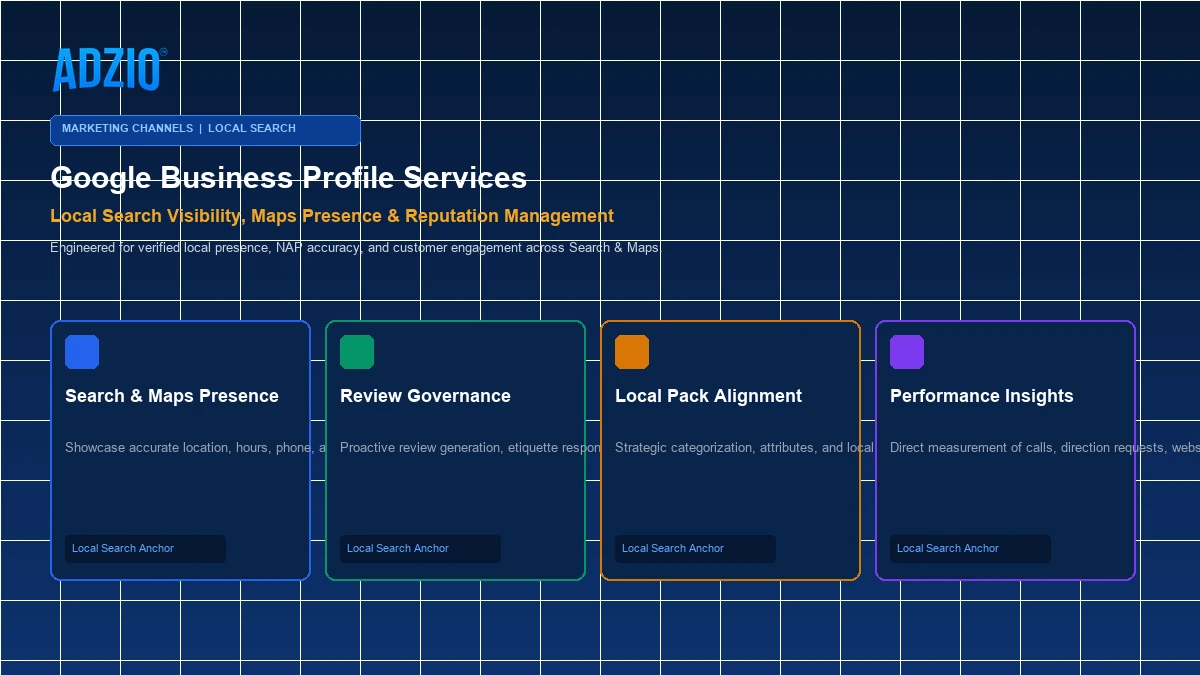
A clear, factual breakdown of Google's flagship local listing tool, its operational reality, and why it forms the bedrock of local customer discovery.
Google Business Profile (formerly known as Google My Business, and prior to that as Google Places and Google+ Local) is an official business listing utility provided by Google. It enables eligible businesses with a physical storefront or a defined in-person service area to create, verify, and maintain their corporate presence across Google Search and Google Maps. When a prospective customer searches for your brand name or queries a relevant commercial category combined with local intent (such as "pediatric clinic in Agartala" or "car showroom near me"), your Google Business Profile serves as the structured knowledge card that displays your verified business name, physical street address, operational phone number, current business hours, website address, customer ratings, customer reviews, photo galleries, and service lists.
However, understanding what Google Business Profile is requires recognizing its boundaries. Google Business Profile is not an isolated magic switch that automatically catapults a business to the top of Google Maps simply because a listing has been verified. Google's local search algorithms operate autonomously, calculating visibility based on a combination of Relevance, Distance, and Prominence. A business profile represents a structured representation of real-world business data. If that data is inaccurate, inconsistent with the company's website, or populated with spammy, keyword-stuffed titles, the profile risks being demoted or suspended entirely.
At AdZio, our approach to Local SEO and Google Business Profile management is grounded in technical accuracy, strict compliance with Google's representation guidelines, and seamless synergy with your broader digital marketing infrastructure. We treat your profile as an authoritative local entity that must reflect the truth of your physical operations, building lasting prominence through legitimate customer reviews, structured category alignment, authentic photography, and synchronized website data.
Acts as Google's official canonical record of your real-world business name, physical location, operational phone number, and website address.
Directly powers your location pin, turn-by-turn driving directions, and local business information on the Google Maps mobile app and desktop navigation.
Serves as the primary public repository for authentic customer reviews, star ratings, merchant responses, and customer photos influencing buyer trust.
How Google reconciles physical reality, user search context, and local entity signals to present local information.
To understand how Google Business Profile operates, consider what happens when a consumer conducts a local search. The searcher might query a specific brand name ("AdZio Digital Agartala") or a generic commercial category ("best jewellery showroom near me"). Google's search algorithms immediately detect the geographic intent behind the query — either derived from explicit location terms typed into the search box or inferred from the user's current GPS coordinates, IP address, and mobile network triangulation.
In response, Google triggers the **Local Pack** (also known as the "Map Pack" or "3-Pack") — a prominent visual module positioned directly beneath sponsored ads and above standard organic website links. The Local Pack displays three relevant local business profiles alongside an interactive Google Map featuring location pins, customer ratings, operational hours, address snippets, and one-tap action buttons for "Website," "Directions," and "Call."
The ranking and inclusion of profiles within this module are determined by Google's proprietary local search algorithm, which evaluates three fundamental criteria established in Google's official documentation:
How closely your profile's categories, business description, service menus, product inventory, and website content correspond to the exact search phrase entered by the consumer.
The physical distance between each potential business location and the location term used in the query, or the user's verified real-time geographical coordinates when searching on a mobile device.
How well-established and trusted the business is in the real world, reflected through authentic review volume and velocity, high average star ratings, directory citations, and organic website SEO authority.
Critical Reality for Business Owners: Neither AdZio nor any other agency can manually manipulate distance or guarantee a permanent #1 position in the Local Pack. Distance is determined by where the user stands; prominence is earned over time through legitimate customer satisfaction and consistent local SEO; relevance is achieved through meticulous profile configuration. Our role is to ensure your business maximizes every variable within its control.
How verified local profiles capture high-intent buyers, reduce consumer friction, and build local competitive advantage.
In modern consumer behavior, local search represents the highest-commercial-intent moment in the buying journey. When someone searches for "emergency plumber near me," "orthopedic doctor in city center," or "automobile service center open now," they are not conducting casual academic research. They possess an immediate, urgent need and are actively deciding where to spend money, book an appointment, or travel within the next few hours.
For local businesses, an unmanaged, unclaimed, or outdated Google Business Profile introduces catastrophic friction. If your profile displays outdated operating hours, a disconnected telephone number, an incorrect address, or unaddressed negative customer reviews, prospective buyers will instantly bypass your listing in favor of a competitor whose profile communicates active reliability. Furthermore, Google frequently relies on user-suggested edits and automated scrapers to update unverified profiles; without active management, third parties can inadvertently change your phone number, alter your business categories, or report your business as permanently closed.
Actively maintaining your Google Business Profile ensures that you control your local brand narrative. It allows you to publish real-time announcements, showcase fresh high-resolution photos of your facility and team, answer customer inquiries via Q&A, and provide direct booking or consultation links. When synchronized with a fast, mobile-friendly website developed through professional Website Development, your profile becomes a reliable inbound customer engine.
Understanding how Google Business Profile relates to, differs from, and complements your broader marketing channels.
Many business owners use these terms interchangeably, but they represent distinct concepts. Google Maps is the public consumer-facing mapping, routing, and navigation software. Google Business Profile is the administrative management tool through which business owners create, edit, verify, and monitor the business data that appears on Google Maps. Optimizing your profile directly influences how your business is presented on the Maps surface, integrating closely with our specialized Google Maps Marketing services.
Google Business Profile is a critical component of Local SEO, but it is not the entirety of Local SEO. Local SEO encompasses an expansive holistic strategy that includes optimizing your website's location landing pages, embedding LocalBusiness structured schema markup, building consistent citations across Indian directories (JustDial, IndiaMART, Sulekha), earning local editorial backlinks, and maintaining localized on-page content. Your profile relies on strong website local SEO to reinforce its prominence.
While Google Search Ads operate on a pay-per-click model where advertisers bid on specific keywords to appear immediately at the top of search results, Google Business Profile is an organic, unpaid listing asset. Search ads deliver immediate, paid visibility that ceases the moment ad spend stops; your profile provides continuous, organic local visibility that compounds over time through earned reviews and historical prominence. Running both in tandem allows businesses to dominate both paid and organic real estate.
Traditional Search Engine Optimization focuses on ranking your website's organic pages (such as blog posts, service guides, and homepages) for broad informational and commercial queries across national or global audiences. Google Business Profile focuses strictly on localized geographic discovery within proximity of your physical operations. A business requires both: your website answers deep technical and commercial questions, while your profile provides instant contact information, reviews, and navigation.
Platforms like Facebook, Instagram, and LinkedIn through Social Media Marketing excel at audience engagement, community building, and lifestyle brand storytelling. However, consumers do not typically open Instagram when their air conditioner breaks down or when they need immediate clinical care; they search Google. Social media creates brand affinity during leisure browsing; Google Business Profile captures high-intent customers at the exact moment of decision.
Any eligible business that meets clients face-to-face — either at a physical storefront (hospitals, retail stores, restaurants, showrooms, clinics) or by traveling to the client's premises within a designated service radius (plumbers, home tutors, electricians, caterers) — must maintain an optimized profile. Purely virtual e-commerce businesses or online-only brands without physical interaction are ineligible under Google's policies and should focus on national SEO and performance ads instead.
| Channel Attribute | Google Business Profile | Local SEO (Website) | Google Search Ads | Social Media Marketing |
|---|---|---|---|---|
| Primary Surface | Google Maps & Local 3-Pack | Google Organic Search Results | Sponsored Search Placements | Meta / LinkedIn Feeds |
| Cost Model | Free Organic Listing Asset | Organic (Investment in Optimization) | Paid (Cost Per Click - CPC) | Paid Ads & Organic Content |
| Primary User Intent | High Urgent Local Intent | Commercial & Informational Search | Commercial & Transactional Search | Passive Discovery & Social Browsing |
| Physical Location Required? | Yes (Storefront or Service Area) | No (Can target any geography) | No (Can target any geography) | No |
| Core Ranking Factor | Relevance, Distance, Prominence | Content, Backlinks, Technical SEO | Bid Amount & Ad Quality Score | Algorithmic Engagement & Reach |
How to configure the essential identity fields of your profile in strict accordance with Google's guidelines to prevent suspensions.
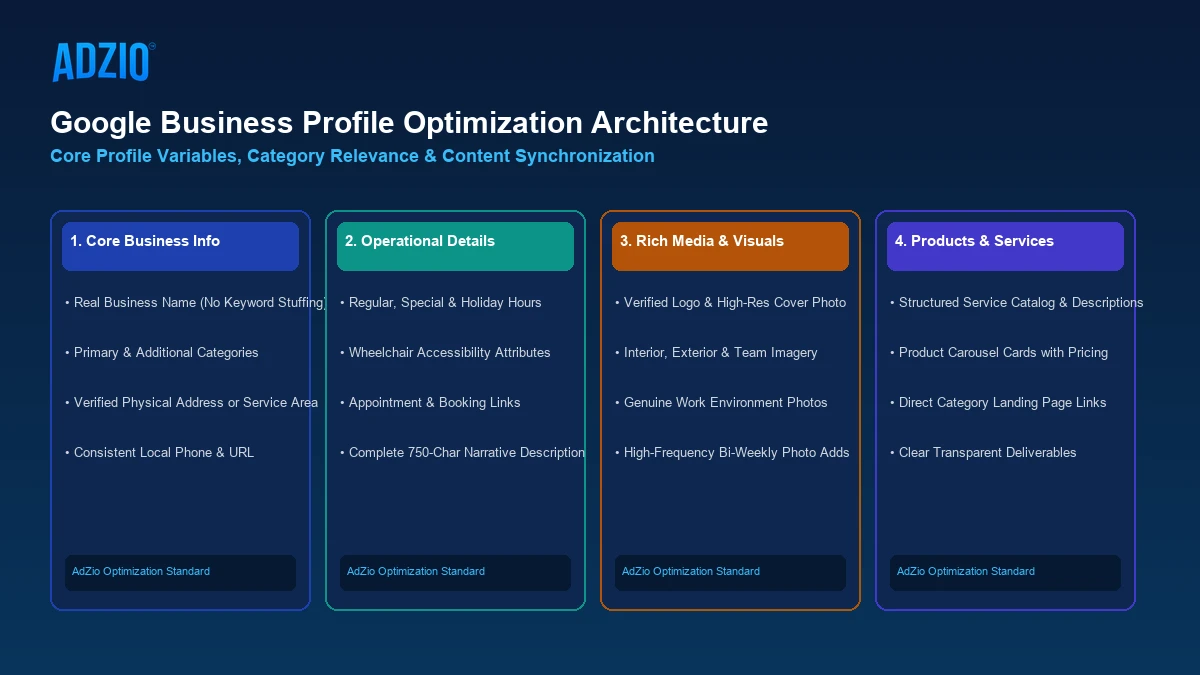
The cornerstone of profile optimization is complete, unyielding accuracy across your core business variables. Every piece of data entered into your Google Business Profile must mirror real-world physical reality. Google verifies this data by cross-referencing street-view imagery, physical signage, official corporate registrar filings, tax documents (GSTIN in India), and prominent third-party directories.
A widespread and dangerous practice among amateur marketers is "name spamming" — tacking keywords, city names, or service offerings onto the official business name (e.g., changing "Sharma Dental Clinic" to "Sharma Dental Clinic - Best Dentist Implants Agartala"). While this black-hat tactic may temporarily manipulate relevance algorithms, it is an explicit violation of Google's Guidelines for Representing Your Business. It exposes the profile to immediate suspension, competitor redressal reporting, and permanent listing deletion.
AdZio enforces a zero-tolerance policy against keyword stuffing. We ensure your business name matches your legal registration and physical signage exactly, while relying on legitimate category selection, detailed service menus, structured attributes, and on-page website SEO to signal commercial relevance safely.
Choosing the right primary and additional categories is the single most powerful technical lever in Google Business Profile optimization.
Google maintains a fixed, standardized taxonomy of thousands of business categories. Unlike business descriptions, you cannot write your own custom categories; you must select from Google's official pre-defined database. The **Primary Category** carries overwhelming algorithmic weight. It informs Google what your business *is*, not merely what it *sells* or *does*. For instance, if you operate an eye hospital, selecting "Eye Care Center" or "Ophthalmology Clinic" as your primary category connects you with clinical intent far more effectively than selecting a generic "Doctor" category.
In addition to the primary category, Google permits up to nine **Additional Categories**. These secondary categories allow you to capture related commercial searches without diluting your primary focus. For example, a dental hospital might set "Dental Clinic" as primary, while adding "Cosmetic Dentist," "Pediatric Dentist," "Orthodontist," and "Teeth Whitening Service" as secondary categories. However, adding irrelevant categories (e.g., a dental clinic adding "Pharmacy" when it does not operate an independent licensed pharmacy) confuses the algorithm and invites red flags.
Select an industry vertical below to see recommended primary and secondary category configurations based on Google's official taxonomy.
How to communicate your unique value proposition, service capabilities, and history within Google's 750-character limit.
Google permits up to 750 characters for your official business description. While Google's ranking documentation notes that keywords inside the business description do not directly alter local map rankings in the same heavy manner as business categories, the description is critically influential for **human conversion**. When a prospective patient, client, or shopper clicks your profile, the description is where they evaluate your legitimacy, professional credentials, service offerings, and core value proposition.
An effective description answers five fundamental questions within the opening 250 characters (which display above the mobile "Read More" truncation fold):
Google strictly prohibits inserting promotional sales pitch language (e.g., "50% off all items!"), URLs, HTML links, phone numbers, or repetitive keyword strings inside the description field. Violating these content guidelines triggers automated rejection of the description.
How to configure your address correctly based on whether customers visit your facility or you travel to their premises.
Google classifies local businesses into two primary operational models, and selecting the wrong configuration is one of the most common causes of profile suspension. The first model is a **Physical Storefront Business** — an enterprise that operates out of a permanent physical address with permanent exterior signage, dedicated business phone lines, and staff present during stated operational hours to serve walk-in customers (e.g., hospitals, diagnostic centers, dental clinics, restaurants, retail shops, automobile dealerships). These businesses must display their full street address on Google Maps and Google Search.
The second model is a **Service Area Business (SAB)** — a business that meets or delivers directly to customers at their personal or commercial premises, rather than serving them at the business's administrative headquarters (e.g., emergency plumbers, mobile car detailers, pest control technicians, electricians, catering companies). Under Google's guidelines, if a business operates out of a residential home or a private office where customers are not received during business hours, the physical street address **must be hidden** from public view. Instead, the merchant specifies a defined Service Area consisting of specific cities, districts, or postal pin codes within approximately two hours of drive time.
A severe policy violation occurs when businesses attempt to manipulate proximity by creating fake locations at virtual mailboxes, P.O. boxes, remote co-working desks, or friends' residences in cities where they maintain zero physical staff. Google actively identifies and suspends listings utilizing virtual office addresses. AdZio ensures that your location setup reflects legitimate operations, protecting your profile from sudden policy takedowns.
Why maintaining accurate operating hours is essential for customer satisfaction and local search algorithm confidence.
Operational hours might appear to be a mundane administrative detail, but they represent a primary source of customer frustration when neglected. Imagine a parent driving across town to an emergency pediatric clinic at 8:00 PM because Google indicated it was "Open Now," only to find locked gates and dark windows. That consumer will immediately file a complaint, leave a stinging 1-star review, and report the listing as inaccurate.
Furthermore, Google's search algorithms actively factor operational status into real-time local search results. When a user searches for a service with the modifier "open now" (e.g., "pharmacy open now" or "restaurant near me open now"), profiles whose hours indicate they are currently closed are filtered out of the Local Pack. If your hours are incorrect, you forfeit high-urgency commercial footfall.
Google Business Profile provides three distinct hours categories: **Regular Hours** (your standard weekly operating schedule), **Special Hours** (custom hours or closures for national holidays, regional festivals such as Durga Puja or Diwali, and private corporate events), and **More Hours** (department-specific hours, such as delivery hours, drive-through hours, or senior citizen priority slots). AdZio implements proactive calendar governance, scheduling seasonal holiday hours well in advance so your listing always reflects reality.
How high-resolution, legitimate photography of your physical premises, team, and services builds undeniable buyer confidence.
In local digital commerce, visual evidence is the ultimate antidote to customer skepticism. According to Google's internal research, business profiles featuring high-quality photography receive 42% more requests for driving directions on Google Maps and 35% more clicks through to their websites than profiles without visual content. When consumers can visually inspect your clean clinic reception, modern automobile showroom, state-of-the-art diagnostic equipment, or warm dining room ambiance, their anxiety about visiting vanishes.
However, the type of photography matters immensely. Uploading generic stock photos downloaded from royalty-free libraries is counterproductive. Consumers instantly recognize stock images, which undermines authenticity and trust. Even worse, uploading synthetic AI-generated images that depict fictitious storefronts or non-existent staff directly violates Google's misleading content guidelines and invites manual penalties.
AdZio advocates for a structured, ongoing photography protocol comprising five distinct visual categories:
Clear daytime and evening shots showing building entrance, street corner approach, and parking facilities to help customers recognize your location while driving.
Spacious perspectives of the front reception desk, customer waiting lounges, consultation rooms, and showroom display aisles demonstrating cleanliness and comfort.
Professional, friendly portraits of senior doctors, managing partners, service technicians, and front-desk staff putting a relatable, human face to the business.
Behind-the-scenes photography showing doctors utilizing advanced medical scanners, mechanics servicing vehicles on diagnostic lifts, or artisans crafting fine jewellery.
Uploading 3 to 5 fresh, high-resolution original photos every month signals to Google's algorithms that the business is active, operational, and constantly updating its offerings.
How to transform your Google Business Profile into an interactive catalog that showcases specific offerings, prices, and direct website landing pages.
Depending on your primary business category, Google Business Profile enables two powerful commercial showcase features: the **Services Menu** and the **Products Editor**. These tools allow businesses to move beyond broad generalities and present specific, granular commercial offerings directly within Google search results before the user ever navigates to your website.
For service-based companies (such as legal firms, healthcare clinics, consulting agencies, and repair services), the Services Menu organizes offerings under distinct category headings. Each service item includes an official title, an optional price or starting rate, and a descriptive paragraph detailing what the service entails. Crucially, Google uses the text within your Services list as a topical relevance signal; when users search for long-tail service queries (e.g., "root canal treatment with laser" or "trademark registration consultant"), profiles with detailed matching service items enjoy a significant relevance advantage.
For retail stores, showrooms, and equipment suppliers, the Products Editor creates a visual product carousel directly on the profile. Each product card features a high-resolution photo, product name, category classification, fixed price or price range, a 1,000-character description, and a direct action button ("Order Online," "Buy," "Learn More," "Get Offer") linking to the corresponding product landing page on your domain.
Utilizing Google Posts to announce legitimate business updates, educational advice, and seasonal announcements without spamming.
Google Posts function as mini-announcements published directly to your profile, displaying within the "Updates" tab on mobile devices and near the bottom of your knowledge panel on desktop search. Posts remain visible for up to six months (or until the designated event or offer expiration date), providing a direct channel to broadcast timely, actionable information to prospects who are actively researching your company.
Google supports three primary Post types:
AdZio advises against treating Google Posts as a low-quality social media clone. Posting repetitive, robotic keyword snippets three times a day does not improve rankings and annoys prospective customers. Instead, we craft bi-weekly or monthly updates that deliver genuine informational value, highlight real business activities, and direct users to relevant content developed under our Content Marketing programs.
Why authentic customer feedback dictates local prominence, how to generate reviews legitimately, and strict warnings against review manipulation.
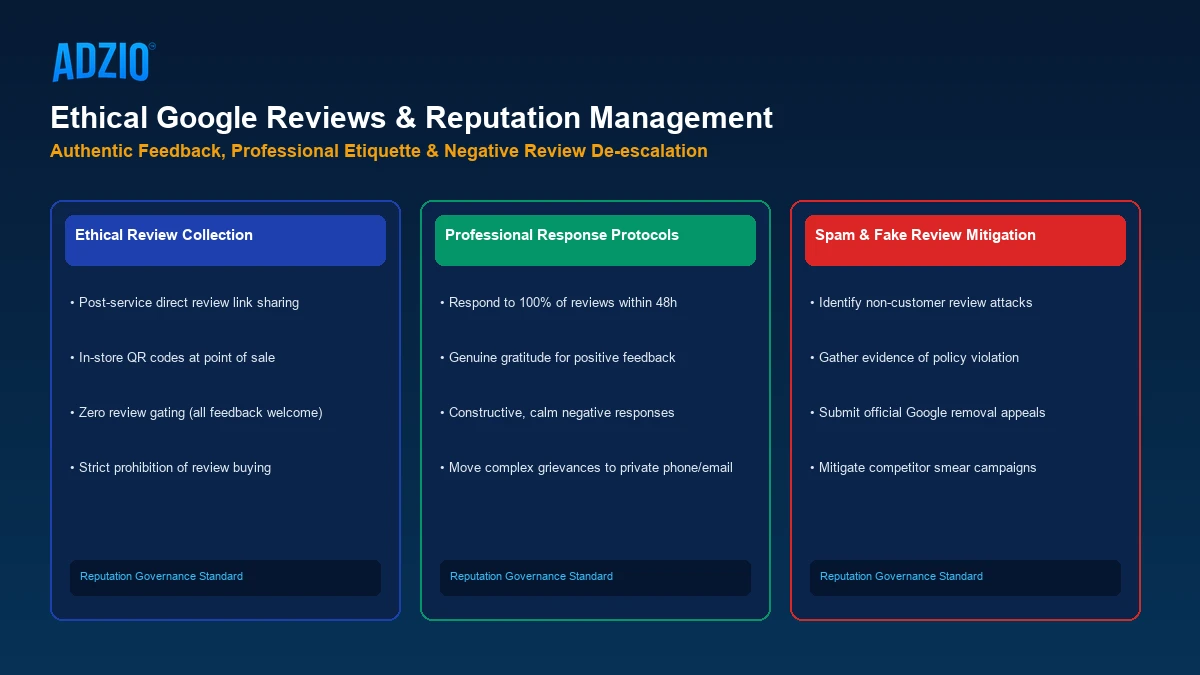
In the local consumer ecosystem, online reviews are the ultimate currency of trust. Studies consistently show that over 88% of consumers consult Google reviews before visiting a local business or booking an appointment, placing nearly as much trust in verified reviews as personal recommendations from friends and family. Furthermore, review volume, star ratings, and the frequency with which new reviews are published are major confirmed ranking signals for Google's Prominence algorithm.
However, the pursuit of positive reviews must be conducted with absolute ethical integrity. A rampant and toxic black-hat practice is purchasing fake 5-star reviews from online brokers or utilizing automated bots to inflate ratings. Google's anti-spam machine learning algorithms actively inspect review velocity, reviewer account history, IP addresses, and natural language patterns. Profiles caught purchasing reviews face severe public penalties — including conspicuous consumer warning badges placed on the listing, complete deletion of all reviews, or total profile termination.
AdZio enforces an uncompromising policy on ethical review acquisition, in harmony with our Online Reputation Management protocols:
Sharing your official Google short link (`g.page/r/.../review`) via post-service SMS or automated WhatsApp Marketing workflows makes leaving honest feedback completely effortless for real clients.
Placing elegant, professionally branded QR code signage at reception desks, payment counters, and customer lounges invites real-world patrons to share their immediate experience.
Strict adherence to Google policies: never pre-screening customers with third-party forms to filter negative reviews privately while only sending happy customers to Google. All authentic feedback is welcomed.
How you respond to reviews signals your professionalism to thousands of prospective future clients. Master the art of constructive customer de-escalation.
Responding to customer reviews is not merely a polite gesture; it is an active public relations exercise observed by thousands of future searchers. When prospective customers read your profile, they pay close attention to how management handles criticism. A dismissive, angry, or defensive retort to a negative review instantly destroys trust, signaling to readers that your business is combative and unaccountable. Conversely, a calm, empathetic, and professional response that acknowledges the customer's frustration and offers an offline resolution path transforms an uncomfortable situation into a powerful demonstration of corporate integrity.
Google also views merchant response activity as an indicator of an engaged, active business. We recommend responding to **100% of reviews** — positive, neutral, and negative — within 24 to 48 hours. When responding to positive reviews, express genuine gratitude and personalize the message without unnaturally forcing keywords. When responding to negative feedback, follow our four-step formula: (1) Thank the reviewer for their feedback, (2) Acknowledge the grievance and apologize for the lapse in service, (3) State your standard of quality, and (4) Provide direct offline contact details (phone and email) for senior management to resolve the matter privately.
Select a customer feedback scenario below to review AdZio's recommended response architecture tailored for professional local businesses.
How Google synthesizes geographic proximity, category intent, and real-time mapping to present local businesses.
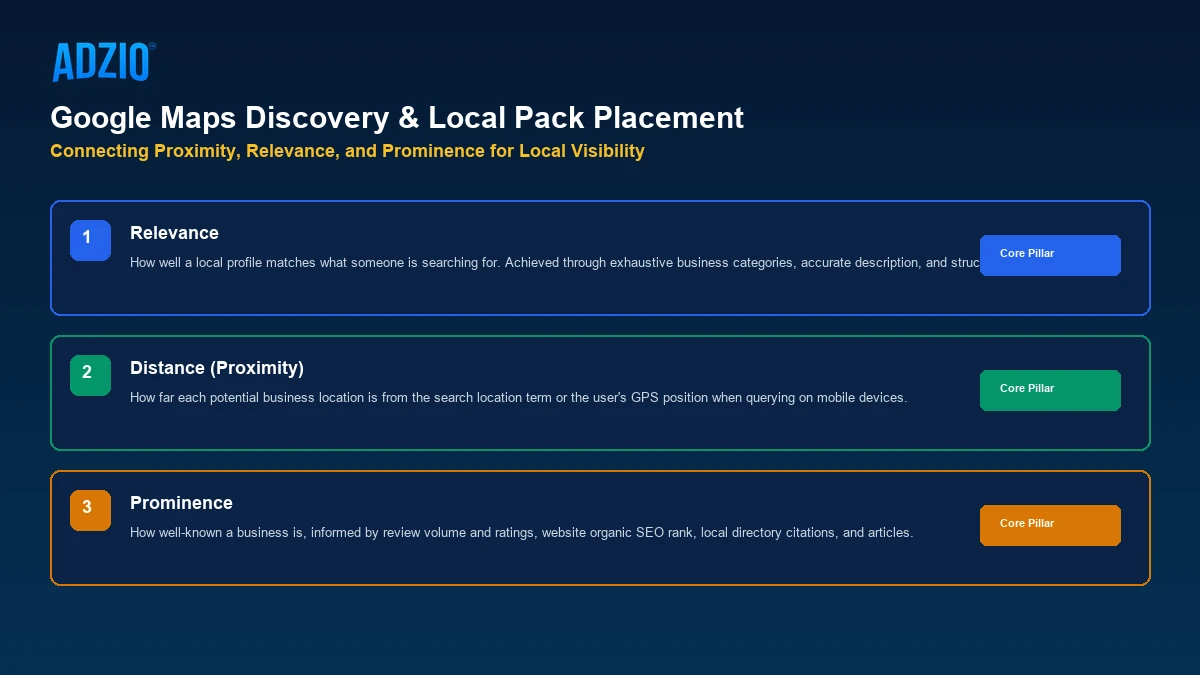
When a consumer searches on mobile with localized intent, the traditional ten blue organic links are pushed well down the page. In their place, Google serves the visual **Local 3-Pack** and an interactive map. For brick-and-mortar storefronts, medical clinics, restaurants, and retail showrooms, appearing within this top three-listing cluster captures the overwhelming majority of phone calls and driving direction requests generated by that query.
However, visibility within the Local Pack is not static or uniform across an entire city. It operates on a geographic grid. A user standing 500 meters from your clinic will likely see your profile in the top three; that same user searching from 10 kilometers away on the opposite side of town will encounter different businesses closer to their immediate physical position. Proximity acts as an algorithmic tether.
AdZio's optimization methodology focuses on expanding your "prominence radius." While we cannot physically move your building closer to distant searchers, we can build the topical authority, review density, citation consistency, and organic website backing that signals to Google that your business is prominent enough to merit inclusion even when searchers are located further away.
Users can call your business, check opening hours, view parking availability, and initiate GPS navigation directly from the Local Pack without loading a website.
When users tap "Directions," Google Maps provides turn-by-turn driving, transit, or walking directions, directly bridging digital interest into physical footfall.
Connecting your profile with Google Ads allows your corporate logo to appear as a prominent sponsored square pin on the map along commuter routes.
Why a Google Business Profile cannot succeed in isolation without the technical backing of your website's local architecture.
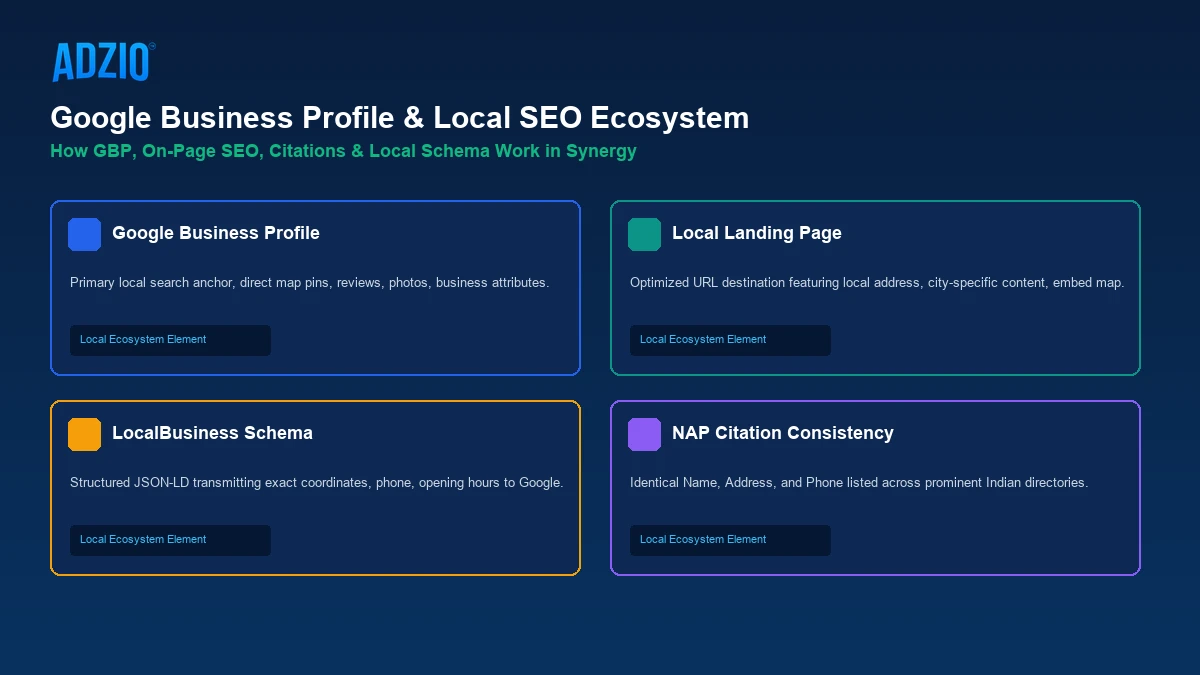
A common misconception among local business owners is that Google Business Profile operates independently from their corporate website. In reality, Google's local search algorithms heavily crawl and evaluate the destination website linked in your profile's "Website" field. The organic SEO authority, content depth, and structured data of your website directly inform Google's confidence in your listing.
AdZio synchronizes your profile with your website across four foundational technical pillars:
First, we enforce **NAP Consistency** (Name, Address, Phone Number). The exact spelling of your company name, physical address format, and telephone number on your profile must match the footer and contact page of your website to the character. Second, we build dedicated **City & Location Landing Pages** that feature local service descriptions, embedded Google Maps, customer testimonials, and localized FAQs.
Third, we implement advanced **LocalBusiness Schema Markup** (JSON-LD) on your website. This machine-readable code transmits your exact GPS latitude and longitude, operational opening hours, accepted currencies, medical specialties, and official social media profiles directly to search engine crawlers. Fourth, we audit and synchronize your business citations across high-authority Indian business directories (JustDial, IndiaMART, TradeIndia, Sulekha), eliminating conflicting phone numbers or outdated addresses that confuse search algorithms.
How to interpret Google's Performance Insights dashboard to measure real-world commercial impact, phone call volume, and footfall trends.
Unlike traditional website analytics that measure bounce rates and session durations, Google Business Profile Performance Insights tracks direct, high-intent real-world consumer actions. Google reports data across two primary categories: **Discovery Metrics** (how people found your profile) and **Action Metrics** (what people did after viewing your profile).
Discovery metrics distinguish between **Direct Searches** (users searching explicitly for your business name or street address), **Discovery Searches** (users searching for a generic category, product, or service that your business offers, such as "diagnostic lab near me"), and **Branded Searches** (users searching for related brand names associated with your business). A healthy, well-optimized profile generates the majority of its visibility from non-branded Discovery queries, exposing your business to new customers who did not previously know your brand.
Action metrics track four critical conversion actions:
Evaluate your profile's operational readiness and identify critical optimization gaps before competitors outrank your listing.
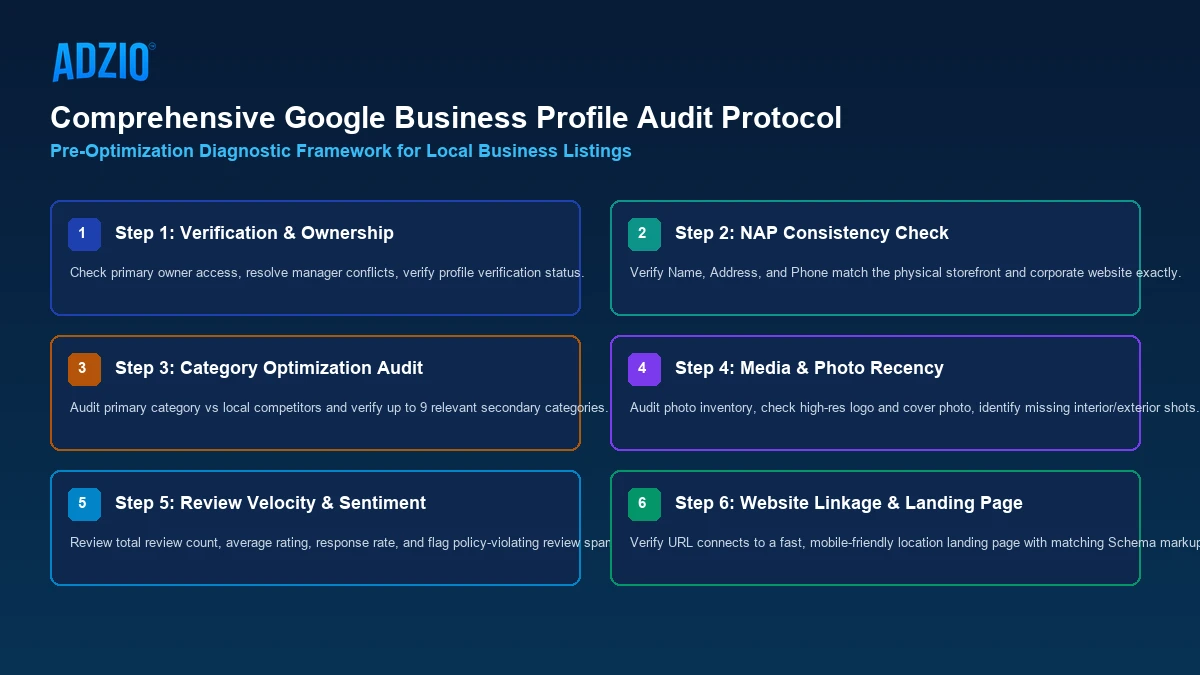
An incomplete Google Business Profile signals to Google's algorithms that the merchant is inactive or unreliable. Listings missing essential fields — such as business hours, high-resolution logos, detailed service menus, or timely review responses — suffer from reduced algorithmic prominence and lower conversion rates.
Our interactive demonstration audit tool simulates the 12 foundational checkpoints AdZio inspects during an initial local health review. Use the checklist below to calculate your estimated profile completeness score and identify immediate areas for remediation.
An interactive demonstration simulating AdZio's monthly performance reporting dashboard for managed Google Business Profiles.
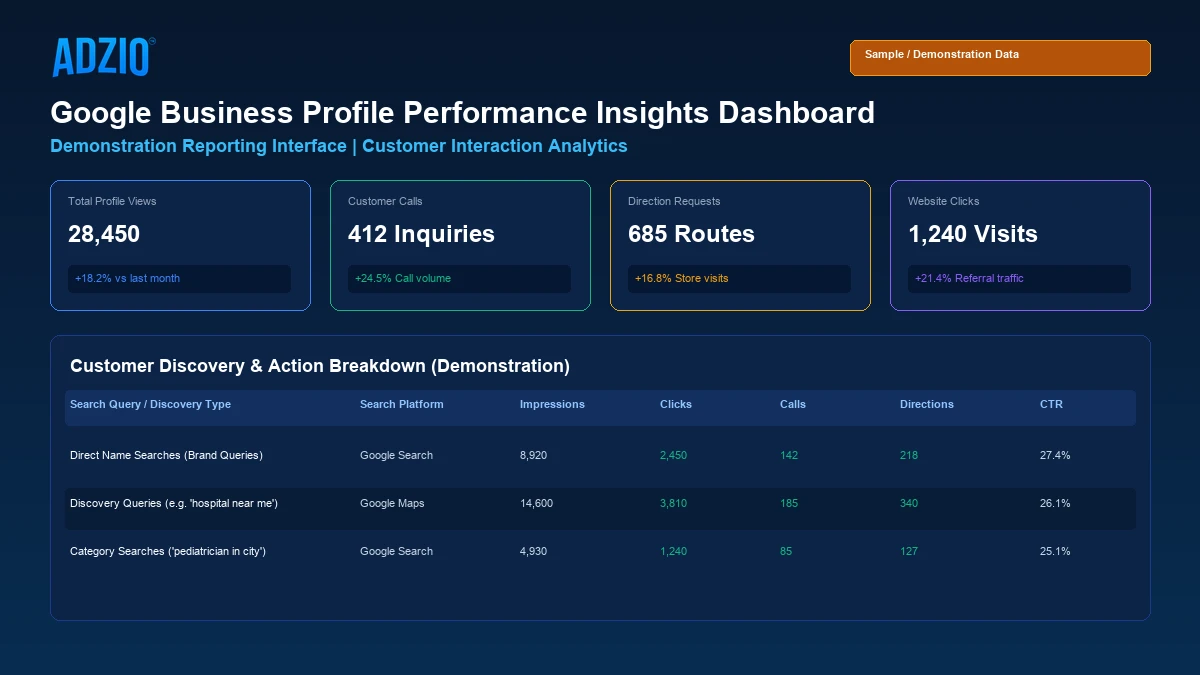
Tracking local search success requires examining verified customer interactions rather than vanity impression counts. Our reporting dashboard aggregates discovery search queries, platform breakdowns (Search vs. Maps), call frequency, driving direction origin points, and customer photo engagement.
Below is an interactive demonstration simulating our reporting dashboard across date intervals (Last 30 Days, Last 90 Days, and Year-to-Date). All figures represent sample benchmarks clearly labeled for demonstration purposes.
| Search Query / Discovery Type | Search Platform | Impressions | Clicks | Phone Calls | Direction Requests | Avg. CTR |
|---|---|---|---|---|---|---|
| Direct Name Searches (Brand Queries) | Google Search | 8,920 | 2,450 | 142 | 218 | 27.4% |
| Discovery Queries ('hospital near me') | Google Maps | 14,600 | 3,810 | 185 | 340 | 26.1% |
| Category Searches ('pediatrician in city') | Google Search | 4,930 | 1,240 | 85 | 127 | 25.1% |
How Google Business Profile operates across commercial sectors. Each industry demands unique category hierarchies, attribute configurations, and customer conversion paths.
Medical establishments operate under heightened regulatory and algorithmic scrutiny. Understand the rules governing clinical local listings.
Healthcare providers — including hospitals, multi-specialty clinics, diagnostic pathology centers, dental clinics, and individual medical practitioners — are classified under Google's strictest **Your Money or Your Life (YMYL)** quality standards. When consumers search for medical care, inaccurate information can directly impact human health and safety. Consequently, Google applies rigorous verification procedures and strict representation rules to all medical profiles.
First, healthcare organizations must avoid making unsupported medical claims or guaranteeing clinical outcomes in their profile descriptions, services, or Google Posts. Claims such as "100% cure guaranteed," "#1 cancer hospital in India," or non-verifiable procedural success rates trigger immediate content rejection or listing suspension. Descriptions must remain strictly descriptive, focusing on established faculty qualifications, clinical infrastructure, accredited diagnostic facilities (such as NABH or NABL certifications), and emergency capabilities.
Second, medical establishments must manage patient reviews with profound sensitivity toward patient privacy and medical confidentiality. Even if a patient publicly details their specific medical condition in a negative review, the clinic's management **must never acknowledge or discuss the patient's private health information in a public response**. Doing so violates patient confidentiality standards. Responses must remain general, empathetic, and professional, directing the individual to contact medical administration privately via phone or secure email.
Third, for institutions housing multiple independent specialists, Google permits the creation of **Practitioner Profiles** (individual profiles for licensed doctors) alongside the primary **Facility Profile** (the hospital or clinic), provided the doctor operates distinct customer-facing hours. AdZio structures these relationships properly to prevent cannibalization and ensure reviews accumulate toward the correct entity.
How hospital networks, retail chains, and dealership franchises govern dozens of physical listings without duplicate listing penalties.
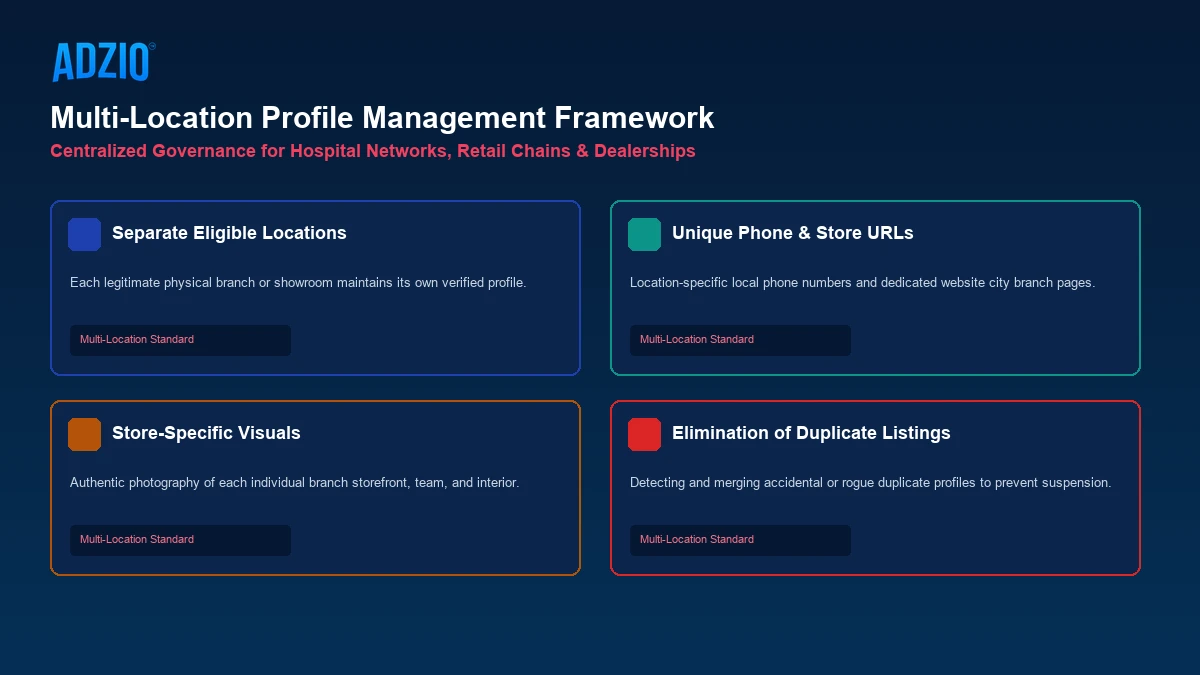
Managing local presence for businesses with multiple physical branches — such as diagnostic lab networks, retail pharmacy chains, car dealerships, or regional restaurant franchises — introduces significant operational complexity. Each physical location must maintain its own independent, verified profile while adhering to corporate brand standards.
A frequent mistake made by multi-location enterprises is linking every individual branch profile to the generic corporate homepage URL (e.g., `company.com`). When Google's crawler checks the linked page and finds a generic national overview without localized address or phone confirmation, the listing's local relevance is severely weakened.
AdZio enforces a multi-location protocol: (1) Each branch profile links to a dedicated, localized city landing page (e.g., `company.com/locations/agartala/`) developed under our Landing Page Development guidelines; (2) Each location features its own local landline number; (3) Store-specific photography depicts that specific branch's exterior and team; and (4) Organizations managing 10+ locations are enrolled in **Bulk Location Verification** within a centralized Business Profile Location Group, preventing individual branch suspension cascades.
Diagnosing hard vs. soft suspensions, understanding common policy triggers, and following official appeal protocols.
Experiencing a Google Business Profile suspension is one of the most alarming events a local business can face. Overnight, your business disappears from Google Maps, phone calls drop precipitously, and customer direction requests evaporate. Understanding how suspensions occur and how to resolve them through official channels is critical for local business survival.
Google enforces two types of suspensions:
When a suspension occurs, panic is the enemy. Submitting an immediate appeal without fixing the root cause will result in a rejected appeal, after which reinstatement becomes exponentially harder. AdZio conducts a thorough forensic audit: reviewing the business name against official GST/tax registration, verifying physical signage via unedited geo-tagged video, auditing category relevance, and ensuring address eligibility. We then prepare an official Reinstatement Appeal accompanied by verifiable legal documentation (utility bills, business registration, lease deeds).
Disclaimer: Neither AdZio nor any agency possesses an automated back-door to Google's internal trust and safety team. Reinstatements are reviewed and granted exclusively by Google based on official policy compliance.
How to protect your local market share against unscrupulous competitors using fraudulent listings, virtual mailboxes, and keyword-stuffed titles.
Local search results in high-ticket industries — such as real estate, legal advisory, automobile repair, and locksmith services — are frequently plagued by rogue competitor spam. Unscrupulous competitors create fake "ghost" listings at nonexistent residential addresses or append aggressive keywords to their business names (e.g., "Premier Legal - Divorce Lawyer Criminal Advocate Property Dispute Solicitor Agartala") to game local search rankings.
This deceptive behavior harms consumers and unfairly robs legitimate businesses of rightful visibility. Fortunately, Google maintains formal channels to police local search integrity. AdZio helps legitimate businesses monitor their local ecosystem and submit evidence-backed complaints through Google's official **Business Redressal Complaint Form**.
We gather verifiable real-world evidence: capturing photographic proof of physical storefronts to demonstrate that a competitor has no permanent signage at a claimed address, submitting corporate registrar records showing their true legal entity name without stuffed keywords, and documenting lead-generation call centers operating under fake local listings. By holding your local market to Google's official standards, we restore fair, merit-based local search competition.
AdZio's exhaustive, end-to-end framework for auditing, optimizing, and maintaining local business prominence.
Auditing legal business name, physical street address, phone number, and website URL against official state tax records and physical signage.
Classifying whether the business qualifies as a Physical Storefront or a Service Area Business (SAB), determining public address visibility.
Benchmarking local competitive landscape to select the highest-impact Primary Category and up to 9 relevant Additional Categories.
Crafting a compelling, policy-compliant 750-character narrative business description articulating history, services, and trust proof points.
Connecting profile to a fast, mobile-friendly location landing page with matching NAP details, embedded map, and LocalBusiness schema.
Configuring exhaustive service menus with descriptions and publishing product carousel cards with pricing and purchase URLs.
Uploading 15+ high-resolution, unedited original photos capturing exterior signage, interior spaces, team members, and real equipment.
Establishing direct review short-link workflows, point-of-sale QR codes, and staff training for systematic post-service feedback collection.
Auditing and harmonizing NAP information across major Indian business directories (JustDial, IndiaMART, Sulekha) to eliminate conflicts.
Publishing bi-weekly Google Posts, updating holiday special hours, auditing user-suggested edits, and monitoring listing security.
Analyzing monthly discovery queries, Search vs. Maps distribution, customer call times, and driving direction origins to guide strategy.
Aligning profile updates with seasonal promotions, newly launched services, and local community events under our Digital Marketing Consulting governance.
The policy blunders, technical oversights, and black-hat shortcuts that result in listing demotion, suspensions, and lost customer revenue.
Adding keywords, cities, or services to your real business name. A direct policy violation risking immediate suspension.
Selecting a generic or tangential category that misleads the search algorithm about your core clinical or commercial specialty.
Failing to set daily opening hours, causing Google to show your business as 'Closed' or filtering you out of 'Open Now' searches.
Not configuring holiday hours during major festivals, leading angry customers to visit a closed storefront.
Using co-working desks, P.O. boxes, or virtual mailboxes to manufacture fake proximity in cities where you have no physical staff.
Displaying residential home addresses publicly for service-area businesses that travel to customers, violating privacy guidelines.
Accidentally creating multiple listings for the same business address, causing algorithmic confusion and suspension.
Uploading generic stock images or AI-generated storefronts that mislead customers and undermine visual credibility.
Leaving descriptions, services, accessibility attributes, and logos empty, achieving a low profile strength rating.
Never replying to reviews, signaling to prospective buyers that management is passive and indifferent to feedback.
Purchasing reviews from brokers. Triggers permanent listing penalties and public fraud warning labels on your profile.
Inconsistencies between your profile address and the contact info listed on your website footer, destroying local algorithm trust.
Directing users to a generic corporate homepage instead of a dedicated, localized city branch page with map embed.
Failing to review Google's automated user-suggested edits, allowing third parties to change your phone number or hours.
Fabricating satellite branch listings where no physical operations exist, leading to entire account suspension.
Stuffing URLs, discount codes, or all-caps sales claims into your business description, triggering automated rejection.
Explore authoritative, practical answers to common questions surrounding Google Business Profile management, local algorithm considerations, profile optimization, compliance standards, and sustainable visibility across Google Search and Google Maps.
Google Business Profile (formerly known as Google My Business or Google Local) is a free platform provided by Google that allows eligible businesses and organizations to manage how their commercial information appears across Google Search and Google Maps. When customers search for businesses, products, or services in their geographic vicinity, Google Business Profile serves as the primary data repository that powers local Knowledge Panels, Google Maps pins, and Local 3-Pack search results. Through an authenticated profile, business owners can verify their address, publish operating hours, list phone numbers, showcase authentic photography, display products or services, post business updates, and interact with customer reviews.
At AdZio, we view Google Business Profile as an indispensable digital storefront that bridges customer discovery with real-world or digital commerce. When structured accurately according to Google's strict guidelines, it ensures that prospective local patrons receive dependable, consistent, and actionable information whenever commercial intent arises.
Google Business Profile services encompass the strategic setup, verification assistance, information auditing, metadata optimization, visual content curation, review governance, and ongoing maintenance of a business's local entity within Google's business ecosystem. Rather than merely filling in standard registration fields, professional GBP management systematically aligns primary and secondary categories with true consumer intent, creates informative and policy-compliant descriptions, configures granular service lists, audits name, address, and phone (NAP) consistency across external citations, and institutes authentic review acquisition workflows.
Additionally, professional GBP services monitor profile health against algorithmic policy shifts, remediate unverified third-party edits, analyze user interaction signals through performance dashboards, and coordinate profile updates with broader local SEO, Google Maps marketing, and website development initiatives.
Google Business Profile functions as an authenticated entity registry within Google's Knowledge Graph. When a business claims and verifies its listing via Google's designated verification pathways (such as postcard, video recording, email, or telephone verification), Google associates the entity's real-world attributes with a unique geographic coordinate and business category index. When a user executes a local or transactional search query—such as "pediatric dentist near me" or "corporate law firm in Agartala"—Google's core local search algorithm evaluates thousands of potential entity records based on three foundational ranking pillars: Relevance, Distance, and Prominence.
Relevance measures how closely the profile's categories, services, and content align with the user's intent. Distance calculates the physical proximity between the searcher and the business location or defined service perimeter. Prominence reflects how well-known, trusted, and reputable the business appears based on review sentiment, external citations, directory consistency, and web authority derived from its linked organic website.
While closely intertwined, Google Business Profile and Google Maps represent distinct layers of Google's local ecosystem. Google Maps is a consumer-facing navigational, cartographic, and discovery application utilized by millions of mobile and desktop users to navigate routes, inspect geographic terrain, and discover nearby points of interest. Google Business Profile, by contrast, is the administrative management portal and backend database where legitimate enterprise representatives curate, verify, and maintain the business data displayed within Google Maps.
An optimized Google Business Profile feeds accurate data directly into Google Maps, powering the business's map pin, photos, operating schedules, and route calculation triggers. For a detailed breakdown of how to maximize your geographic presence, explore our dedicated guide on Google Maps marketing.
A verified and meticulously maintained Google Business Profile is undeniably the single most critical off-page asset within local search engine optimization. Industry benchmark studies consistently demonstrate that profile completeness, primary category selection, review volume and sentiment, and sustained user engagement signals originating from GBP account for over 30% of local pack ranking weights. Without an active and optimized profile, a local brick-and-mortar storefront or service-area provider is practically invisible within high-intent localized search experiences like the Google Local 3-Pack and Google Maps search.
However, GBP does not operate in isolation. Its effectiveness is amplified exponentially when paired with on-page local SEO, including schema-enhanced location pages, mobile-optimized site architecture, authoritative local backlinks, and widespread citation consistency.
Comprehensive profile optimization entails a methodical 12-stage execution plan:
1. Audit and verify the legal business name without prohibited keyword stuffing.
2. Select the single most specific primary category that describes your core commercial enterprise, complemented by carefully curated secondary categories.
3. Craft an informative, professional, 750-character business description outlining services, target clientele, and unique value propositions.
4. Publish exact street addresses for walk-in establishments or configure realistic service radius boundaries for service-area businesses.
5. Maintain pinpoint operational hours, including special holiday hours and split-shift schedules.
6. Upload high-resolution, geo-authentic photography depicting exterior storefronts, interior facilities, personnel, and authentic service delivery.
7. Populate granular product catalogs and service menus with clear descriptions and direct destination URLs.
8. Establish an authentic, ethical review acquisition protocol and respond promptly to all incoming customer feedback.
9. Connect the profile to an authoritative, mobile-responsive local landing page equipped with LocalBusiness JSON-LD markup.
A Google Business Profile category is a standardized classification tag chosen from Google's predefined taxonomy of over 4,000 global business types. Categories help Google's search algorithms understand the exact nature of your business and match your listing with relevant consumer search queries. For example, rather than categorizing your establishment under the generic term "Store," Google provides precise choices such as "Organic Grocery Store," "Supermarket," or "Gourmet Grocery Store."
Category selection determines not only algorithmic relevance for search queries but also unlocks industry-specific profile features. For instance, selecting "Restaurant" enables menu tabs and reservation integrations, while choosing "Hotel" unlocks room amenity attributes, check-in schedules, and direct booking engine links.
Choosing a primary category requires identifying the singular classification that encapsulates the primary economic activity of your establishment as a whole. A fundamental guideline is: "What your business IS, not what it DOES or SELLS." For instance, if an automobile dealership also houses an express oil change bay, its primary category should remain "Car Dealership" rather than "Oil Change Service."
Always select the most specific available option. If you operate an orthopedic surgery hospital, choosing "Orthopedic Clinic" or "Orthopedic Surgeon" will deliver substantially tighter algorithmic relevance for high-intent searches than selecting the overly broad category "Medical Clinic." You can then add subsidiary services under secondary categories.
Yes, Google permits businesses to designate one Primary Category and up to nine Secondary Additional Categories. Secondary categories allow multi-faceted commercial enterprises to accurately communicate supplemental offerings. For example, a dental practice whose primary category is "Dental Clinic" may appropriately designate secondary categories such as "Cosmetic Dentist," "Pediatric Dentist," "Teeth Whitening Service," and "Emergency Dental Service."
However, adding irrelevant or peripheral categories solely to capture extra search impressions dilutes your entity's core semantic focus and can trigger manual policy reviews. Only select secondary categories that represent legitimate, fully staffed, and readily available commercial services provided directly at that location.
Google provides a 750-character allotment for business descriptions. An effective description must be written primarily for human evaluation, communicating who you are, what specialized products or services you provide, who you serve, and your enduring commitments to customer satisfaction or clinical excellence. While the first 250 characters are visible before mobile truncated "Read More" links, the entire text should flow naturally without synthetic keyword stuffing or promotional gimmicks.
Google explicitly forbids promotional language such as "50% off all week," all-caps screaming text, active URLs or hyperlinks, and misleading claims. Instead, focus on historical pedigree, accreditations, geographic service commitment, and transparent summaries of core offerings.
No. Google's official Guidelines for Representing Your Business on Google strictly prohibit appending descriptive keywords, service phrases, or geographic city tags to your business name unless they are legally registered, consistently displayed on physical exterior signage, and reflected on municipal business licenses and corporate registrations. For example, if your legal entity and physical storefront sign read "Apex Logistics," changing your profile title to "Apex Logistics - Best Packers and Movers in Agartala Near Me" constitutes a flagrant policy violation.
While keyword stuffing in business titles historically produced short-term algorithmic gains, Google's automated entity matching and competitor redressal systems now actively issue hard suspensions to offending listings. At AdZio, we strictly advocate for authentic, legally verified business naming to ensure permanent profile stability.
A Service-Area Business (SAB) is a commercial classification for enterprises that travel directly to customer locations to deliver services rather than serving patrons at a dedicated, walk-in commercial storefront. Classic examples include plumbing contractors, electricians, mobile car detailing units, roofing specialists, emergency pest control operators, and home cleaning services.
Under Google's guidelines, if a business operates from a residential home, private apartment, or shared coworking facility without dedicated permanent exterior signage and regular on-site customer service hours, it MUST hide its physical address from public display and configure discrete service areas based on postal pin codes or recognized municipal boundaries.
Yes. In fact, if you operate a home-based business or service-area enterprise where customers cannot physically visit during posted operating hours, you are required by Google's terms to suppress your street address. In the GBP dashboard, selecting "Clear Address" removes the street address from public search results and Maps pins, replacing it with an outline map showing your specified service areas (such as cities, regions, or postal zip codes within a maximum 2-hour driving perimeter).
Hiding your residential address protects your private domicile while ensuring your listing remains fully eligible to surface when prospective clients search for your trade within designated service territories.
High-quality, authentic visual assets are paramount to local conversion performance and engagement algorithms. Internal search metrics show that listings with authentic, updated photography receive over 42% more requests for driving directions on Google Maps and 35% more direct click-throughs to their official websites compared to text-only or photo-deficient profiles.
Authentic exterior imagery helps customers instantly recognize your physical building from the street, preventing navigation abandonment. Interior, team, and operational photos establish credibility and dismantle consumer skepticism. Conversely, relying on generic stock photography or synthetic AI images violates Google's media policy and damages customer trust upon arrival.
Google reviews allow authenticated Google account holders to publish numerical star ratings (from 1 to 5 stars), descriptive feedback, and optional photographic proof regarding their firsthand commercial experience with a verified business. These reviews are publicly visible on the business's Knowledge Panel, Maps card, and localized search snippets, dynamically computing an aggregated average star rating and review count.
Google's automated spam filtration algorithms inspect incoming reviews for behavioral anomalies, device tracking telemetry, network IP consistency, and linguistic patterns to weed out fraudulent entries. Genuine reviews serve as vital social proof that directly influences prospective consumer purchasing choices and contributes heavily to local search prominence signals.
When responding to critical or negative reviews, businesses must maintain complete emotional composure, professionalism, and strategic foresight. Remember that your public response is read not just by the dissatisfied reviewer, but by hundreds of prospective future customers evaluating how your leadership handles operational setbacks.
Follow a structured 4-step framework: First, express sincere appreciation for the feedback and acknowledge the customer's perceived inconvenience without accepting legal culpability. Second, state your organization's established quality or service standards. Third, invite the individual to transition the conversation offline by providing direct contact details (such as a management email address or telephone line). Fourth, investigate the internal root cause to prevent recurrences. Never engage in vitriolic public debates or violate consumer confidentiality.
Absolutely not. Purchasing Google reviews, paying third-party syndicates for favorable ratings, offering customer discounts or gifts in exchange for reviews, or setting up on-premises review capture kiosks ("review gating") constitutes a direct and severe violation of Google's User Contributed Content Policies, as well as consumer protection statutes enforced by regulatory bodies worldwide (including the FTC and national advertising standards councils).
Google actively deploys machine-learning models to detect artificial review rings, wiping illegitimate feedback en masse and placing permanent algorithmic warnings or outright suspensions on participating listings. Authentic, organic customer feedback collected through systematic post-service communication is the only legitimate and lasting pathway to building local prominence.
No. While unscrupulous agencies occasionally promise immediate rating surges via fabricated profiles, the practice is extraordinarily hazardous and counterproductive. Google continually purges bot accounts and retroactively deletes suspicious review histories. Furthermore, when Google detects synthetic review spikes on a profile, it frequently removes the business's ability to receive new reviews entirely or issues an unappealable listing suspension.
Even more damaging is the erosion of consumer confidence. Today's digital consumers readily spot repetitive, hollow, or unverified praise. When real patrons encounter discrepancy between fabricated ratings and substandard real-world experiences, the resulting backlash inflicts catastrophic damage on brand reputation.
Google Business Profile posts are micro-content updates published directly through your profile dashboard that appear within your Knowledge Panel and Maps card. Posts can encompass diverse formats, including What's New announcements, limited-time commercial offers with coupon codes, upcoming community or promotional events with designated start/end dates, and featured product spotlights.
Active posting signals to Google that your enterprise is vibrant, engaged, and operationally healthy. Posts also provide prospective customers with timely context regarding holiday hours, new diagnostic technologies, seasonal menus, or recent service additions, effectively serving as dynamic call-to-action billboards right at the point of search discovery.
Your Google Business Profile and official website form a symbiotic relationship within Google's indexing systems. In the profile settings, you designate an official website URL. For single-location businesses, this links to the homepage; for multi-branch organizations, each listing points to its dedicated, location-specific landing page.
Google's search crawlers actively crawl the linked web page to verify commercial credibility, extracting semantic context, structured data (such as Schema.org LocalBusiness markup), service listings, and exact NAP credentials. The organic search authority, backlink profile, and topical relevance of your website directly fuel your Google Business Profile's local pack ranking strength. You can explore how we build high-converting, search-optimized web platforms on our website development page.
Google Maps marketing refers to the specialized discipline of optimizing and promoting a business entity specifically to achieve prime visibility, navigational direction requests, and consumer conversions within Google Maps search interfaces and location-driven mobile queries. This encompasses optimizing geographic coordinates, configuring service perimeters, refining local categories, generating authentic customer reviews, and running localized Google Maps promoted pins through Google Ads.
While Google Business Profile serves as the data foundation, Maps marketing focuses heavily on mobile customer journeys, turn-by-turn navigation capture, in-store footfall acceleration, and competitive local grid dominance. To learn more about this specialized channel, visit our Google Maps marketing service page.
No. Neither Google Business Profile registration nor professional optimization services can ever guarantee specific positions, #1 ranks, or permanent placement in Google's Local 3-Pack. Google's local ranking algorithms are proprietary, dynamic, and continuously evolving, evaluating real-time proximity between the searcher and the business, competitive density, consumer behavioral signals, and algorithmic updates.
Any agency or marketing consultant claiming to guarantee #1 positions on Google Maps or Search is engaging in deceptive marketing. At AdZio, our philosophy centers on maximizing every verifiable factor within your control—compliance, data richness, review velocity, citation integrity, and technical website synergy—to systematically expand your local visibility radius over time.
Having a verified Google Business Profile guarantees that your commercial entity exists within Google Maps' database and can be located when a user searches for your exact brand name or clicks directly on your map pin. However, it does NOT guarantee that your pin will automatically appear as a prominent landmark icon on general map overviews or that your business will surface in top query results for broad, unbranded transactional keywords like "best coffee shop."
Map icon rendering and unbranded visibility depend heavily on the user's zoom level, search intent, physical GPS position, browsing history, and your entity's comparative prominence score against nearby competitors.
Yes. For service providers, healthcare clinics, automotive emergency services, and dining establishments, direct telephone inquiries initiated via mobile "Call" buttons on Google Business Profile represent one of the most prolific and high-converting lead channels. When mobile searchers encounter an immediate need, the presence of verified operating hours, a dedicated local telephone number, and positive review summaries encourages one-touch calling.
In your profile dashboard, Google tracks these telephone clicks as actionable conversion metrics, allowing businesses to gauge seasonal inquiry volumes, peak calling hours, and geographic lead distribution.
Yes. Google Business Profile functions as a premier top-of-funnel customer acquisition gateway, driving qualified commercial inquiries through multiple interactive touchpoints: direct website visits, telephone calls, driving direction requests, appointment bookings via scheduling integrations, and native direct messaging channels where activated.
Because local search queries carry exceptionally strong purchase intent (with over 75% of local mobile searches resulting in a physical store visit or service inquiry within 24 hours), leads originating from Google Business Profile typically exhibit substantially higher conversion rates than general social media or programmatic display impressions. Discover our dedicated frameworks for full-funnel lead generation on our lead generation page.
Yes, hospitals, multi-specialty clinics, diagnostic pathology centers, dental practices, and individual medical practitioners can maintain verified profiles. However, healthcare institutions must operate under heightened scrutiny and strict adherence to healthcare privacy regulations, medical ethics codes, and Google's specific practitioner guidelines.
For example, healthcare profiles must never disclose protected patient health information (PHI) in review responses, make unsubstantiated therapeutic claims, or fabricate patient testimonials. Furthermore, when both a medical clinic and individual licensed physicians operate within the same facility, Google permits both facility listings and individual practitioner profiles, provided clear department distinctions and phone lines are maintained.
Yes. Multi-location enterprises, regional retail chains, and franchise systems can manage multiple profiles under a unified Business Profile Manager organization account. For chains with 10 or more legitimate physical branches, Google offers Bulk Location Verification, streamlining the verification workflow across all operating locations simultaneously.
Crucially, every individual location profile must represent a distinct, physical establishment with its own local telephone number, specific operational hours, tailored photo gallery, and dedicated local landing page on the corporate website (e.g., example.com/locations/agartala). Centralizing phone numbers or redirecting all listings to a generic homepage harms local relevance and customer trust.
Profile suspensions generally stem from one of two triggers: automated algorithmic filters flagging suspicious metadata changes, or manual penalties resulting from policy complaints submitted by competitors or consumers. The most common infractions include:
• Modifying core business details (such as the business name, primary category, or physical address) after initial verification.
• Keyword stuffing promotional terms or city names into the business title.
• Registering virtual offices, P.O. boxes, remote mail drops, or unmanned coworking desks as physical storefronts.
• Operating a service-area business while displaying a residential home address.
• Creating duplicate listings for the same physical location or overlapping service categories.
• Linking the profile to an unindexed, spammy, or redirected domain.
• Associating the listing with a manager account flagged for widespread policy violations.
At AdZio, our Google Business Profile management strategy is anchored in rigorous data hygiene, strict policy compliance, and deep integration with your wider digital ecosystem. We do not engage in temporary ranking hacks, artificial review schemes, or keyword-stuffed naming gimmicks that place your business entity at risk of catastrophic suspension.
Instead, we execute a continuous, disciplined management program: auditing your entity attributes, structuring categories to align with actual consumer search behavior, refining visual content to mirror your real-world facility, establishing sustainable customer review workflows, and synchronizing your listing with authoritative on-page local SEO and high-intent advertising campaigns. To explore our overarching business philosophy, visit Our Approach and Our Process.
Attributes are granular informational tags that describe specific amenities, accessibility accommodations, payment methods, and operational characteristics of your commercial facility. Examples include "Wheelchair-accessible entrance," "Free Wi-Fi," "Accepts credit cards," "Outdoor seating," "Identifies as women-owned," and "Appointments required."
Complete attribute configuration directly enhances search visibility for voice and conversational queries where consumers filter specifically for accessible or accommodating facilities. Furthermore, during seasonal or health crises, attributes communicate critical logistical expectations (such as curbside pickup or mandatory masking) directly to arriving customers.
Google deploys several verification pathways depending on business industry, risk classification, geographic territory, and account history. Traditional postal mail verification (receiving a physical postcard containing a 5-digit verification PIN) remains common for many regions. Increasingly, Google mandates Video Verification, requiring business operators to record an uninterrupted mobile video showcasing street name signs, permanent exterior storefront branding, unlocked interior facilities, and operational business equipment or software.
High-trust domains and established Google Search Console accounts may occasionally qualify for Instant Verification or Automated SMS/Phone OTP verification. Businesses should note that Google determines the verification pathway dynamically; advertisers cannot arbitrarily request an email code if Google's automated systems dictate a live video audit.
UTM (Urchin Tracking Module) parameters are standardized text query tags appended to your profile's primary website URL—for example, example.com/?utm_source=google&utm_medium=organic&utm_campaign=gbp_listing. Because Google Analytics default channel attribution frequently groups organic local pack clicks into generic organic search or direct traffic pools, utilizing custom UTM tagging allows your marketing analytics suite to isolate exact user sessions, goal completions, appointment bookings, and revenue originating directly from your Google Business Profile.
Implementing UTM parameters does not negatively affect your local SEO rankings, provided your target landing page contains a clean self-referential canonical tag pointing to the root URL.
Whether you are confronting a stubborn profile suspension, planning a multi-location expansion, or looking to elevate your local organic prominence across Google Maps and Search, our senior strategists are ready to assist.
Local search behavior, smartphone adoption, and linguistic patterns vary dramatically across metropolitan hubs and emerging Tier-2 and Tier-3 urban markets. Explore how AdZio tailors Google Business Profile strategies to capture regional commercial intent.
In rapidly urbanizing commercial centers like Agartala and throughout Tripura, local consumers are increasingly bypassing traditional paper directories and billboard promotions in favor of immediate smartphone searches on Google Maps. Transactional queries such as "best diagnostic centre in Agartala," "automobile service near Battala," or "corporate lawyers in Tripura" exhibit soaring month-over-month growth.
Because many regional enterprises have either neglected their digital verification or published fragmented business information, establishing a pristine, verified, and complete Google Business Profile provides an immense first-mover competitive advantage. AdZio helps regional enterprises establish authoritative local footprints that dominate local search results.
Verified physical addresses, regional landmarks in directions, and authentic multilingual review acquisition.
Enterprises serving cross-district markets across Northeast India—including healthcare institutions drawing patients from southern Tripura, Assam, and neighboring border regions—face unique geographic search challenges. When prospective clients travel significant distances for specialized clinical care or industrial equipment, their search intent encompasses transport connectivity, parking facilities, emergency services, and accommodation amenities.
Our strategic profile deployments for regional corridor enterprises integrate comprehensive service area definitions, clear highway landmark references, bilingual service postings, and verified appointment scheduling links, reassuring traveling patrons before they embark on transit.
Service area perimeter optimization, transit landmark guidance, and emergency contact redundancy.
In mature Tier-1 metropolitan markets like Delhi NCR, Mumbai, Bengaluru, and Kolkata, local search competition is exceptionally fierce. Within a single 500-meter radius, dozens of dental clinics, restaurants, or boutique retail outlets often compete for the same Local 3-Pack real estate. In these hyper-competitive environments, basic profile completeness is merely the cost of entry.
Capturing sustainable prominence requires advanced local SEO choreography: geo-specific review velocity campaigns, rich schema-supported local web architecture, automated weekly GBP post cadences, precise attribute coverage, and granular performance tracking via local rank tracking grids. AdZio coordinates multi-tier strategies capable of competing in India's densest commercial zones.
Algorithmic prominence signals, external citation authority, and organic website domain equity.
AdZio adheres strictly to Google's real-world geographic verification guidelines. We never invent fictitious satellite offices, lease temporary residential addresses for rank manipulation, or manipulate pin placements. Every regional deployment is grounded in legitimate, verifiable commercial operations.
Whether your enterprise operates a flagship medical facility in Agartala, a regional automotive dealership network across Tripura, or a multi-location retail brand spanning metropolitan India, local search prominence begins with verifiable data integrity.
Connect directly with AdZio's senior local search strategists to audit your current profile health, assess primary and secondary category relevance, evaluate review acquisition workflows, and design a compliant, high-prominence local visibility roadmap.
Schedule an exploratory strategy session through our Request a Callback desk.
Submit multi-brand or enterprise RFP details via Request a Quote.
Provide verified business details below. We never ask for Google account passwords, SMS verification codes, or confidential client records.
Partner with AdZio to transform customer discovery across Google Search, Google Maps, and Local Pack ecosystems.