

Google Maps Marketing for Local Business Visibility
Transform geographic proximity into high-value customer actions. At AdZio, we engineer advanced Google Maps marketing strategies that maximize your physical storefront discovery, capture turn-by-turn mobile navigation, and drive high-intent phone calls and store visits across India's most competitive local markets.
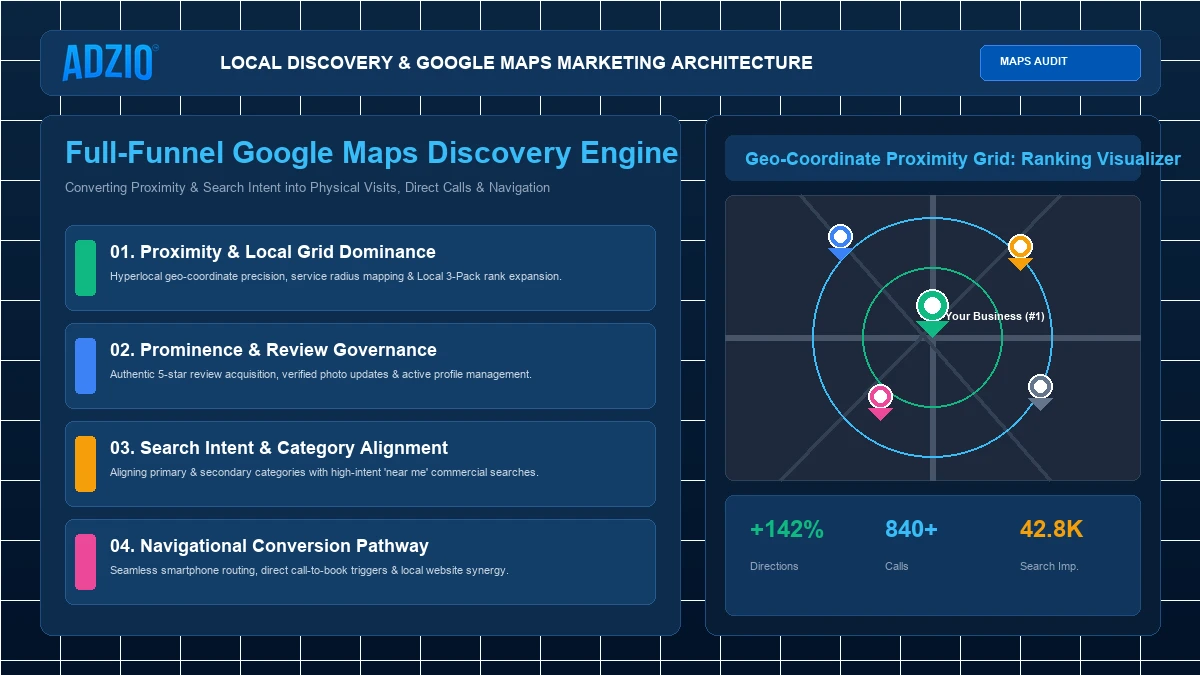
Why Google Maps Governs Real-World Local Commerce
Modern consumer behavior has shifted permanently toward mobile, on-the-go decision-making. When prospective patrons experience an immediate commercial or clinical need, Google Maps is the primary discovery canvas.
In today's digital economy, consumer search behavior has evolved far beyond traditional desktop queries. Whether an individual is searching for an emergency dental hospital in Agartala, an authorized automobile dealership across western Tripura, or a fine jewellery showroom in central Kolkata, the immediate impulse is to unlock a smartphone and search directly within Google Maps or execute a location-sensitive query on Google Search. These search moments represent exceptionally potent commercial intent: the searcher is not conducting leisurely academic research, but actively seeking a verified, reputable physical establishment to visit, call, or navigate to within hours or minutes.
Google Maps is no longer merely a navigational utility for calculating driving routes; it has transformed into a comprehensive local commercial operating system. Prospective customers examine physical proximity, scrutinize unedited interior and exterior photographs, evaluate authentic customer ratings and management responses, verify real-time operating schedules, and inspect available parking or wheelchair accessibility before ever stepping foot outside their door. An inaccurate telephone number, an unverified street address, or an outdated holiday schedule creates immediate consumer friction, causing high-value patrons to abandon their intended visit and navigate directly toward a prepared competitor.
At AdZio, we understand that establishing an authoritative Google Maps presence requires more than simply plotting a pin on a cartographic interface. It demands meticulous geographic data alignment, active review governance, precise category mapping, and deep synchronization with your broader organic web architecture. Our Google Maps marketing methodologies ensure that your enterprise is accurately represented, algorithmically prominent, and operationally compelling whenever nearby consumers express high-intent local need.
Critical Local Search Touchpoints
When prospective buyers interact with your business on Google Maps, their purchase decisions are influenced by five critical verification checkpoints:
- Pin Accuracy & Routing: Flawless GPS coordinate calibration ensuring audio navigation routes directly to your customer entrance.
- Current Operating Status: Real-time "Open Now" or "Closes Soon" indicators preventing customer arrival at locked doors.
- Reputation Velocity: Recent, authentic 5-star customer ratings accompanied by empathetic, professional owner responses.
- Storefront Imagery: High-resolution exterior and interior photos establishing real-world credibility and eliminating skepticism.
- Frictionless Interaction: Instant one-touch mobile calling and direct website links to specialized appointment booking pages.
What Is Google Maps Marketing?
Deconstructing the multidisciplinary marketing engine that bridges cartographic indexing, algorithmic local pack prominence, and physical customer footfall.
Google Maps marketing is the specialized strategic discipline of optimizing and promoting a commercial enterprise within Google Maps and localized Google Search environments to maximize brand discovery, navigational requests, phone inquiries, and in-person footfall. Contrary to common misconception, Google Maps marketing is far more comprehensive than merely "adding a business listing to Google Maps." While verifying an address is an essential prerequisite, a raw listing without optimization will remain buried beneath established competitors across dense local search grids.
In practical business execution, Google Maps marketing represents a synergistic convergence of multiple technical and marketing pillars: rigorous Google Business Profile optimization, on-page local SEO, entity attribute structuring, localized review acquisition workflows, mobile user-experience refinement, and geographic citation synchronization. It focuses deliberately on the customer discovery journey—understanding how consumers formulate local search queries, how Google's algorithms calculate local pack rankings, and what specific trust signals compel a mobile user to tap "Directions" or "Call".
Crucially, professional Google Maps marketing does not rely on artificial ranking tricks, keyword-stuffed titles, or fabricated customer reviews. Such black-hat tactics inevitably trigger algorithmic demotions or hard suspensions. Instead, AdZio's approach focuses on cultivating genuine local prominence: providing comprehensive and authentic business data, earning consistent customer commendations, publishing location-specific photography, and establishing undeniable local topical authority through synchronized website landing pages.
Entity Data Hygiene
Ensuring flawless Name, Address, Phone (NAP) parity, pinpoint latitude/longitude coordinate calibration, and comprehensive service taxonomy across all digital surfaces.
Navigational Conversion
Optimizing mobile touchpoints to transform map pin discovery into turn-by-turn driving directions, immediate click-to-call inquiries, and verified storefront visits.
Prominence & Governance
Proactively cultivating authentic customer sentiment, instituting prompt review response protocols, and shielding the profile from competitor spam or unverified edits.
How Google Maps Marketing Drives Real-World Actions
To optimize your business effectively on Google Maps, one must dissect the micro-moments that define a modern local consumer journey. The progression begins with an immediate, location-sensitive need—such as an automobile driver encountering a flat tire, a family seeking a pediatric specialist, or a couple searching for fine dining. When the user initiates a search on their smartphone, Google's algorithms analyze the user's precise GPS coordinates and search query to retrieve nearby commercial entities matching that intent.
The search results surface either as an integrated Google Local 3-Pack within general search or as a dedicated list of mapped pins inside the Google Maps application. At this critical juncture, your listing's primary category, star rating, total review count, and physical distance determine whether your business appears within the initial viewport. If your profile demonstrates superior prominence and data completeness, the user taps the pin to review your Knowledge Card.
Within seconds, the consumer evaluates your business photos, reads recent customer feedback, verifies operational hours, and selects an immediate action: tapping "Directions" to initiate turn-by-turn navigation, tapping "Call" to speak with a receptionist, or clicking through to a specialized local landing page to schedule an appointment. Google Maps marketing optimizes every micro-element of this journey to eliminate hesitation and maximize customer conversion.
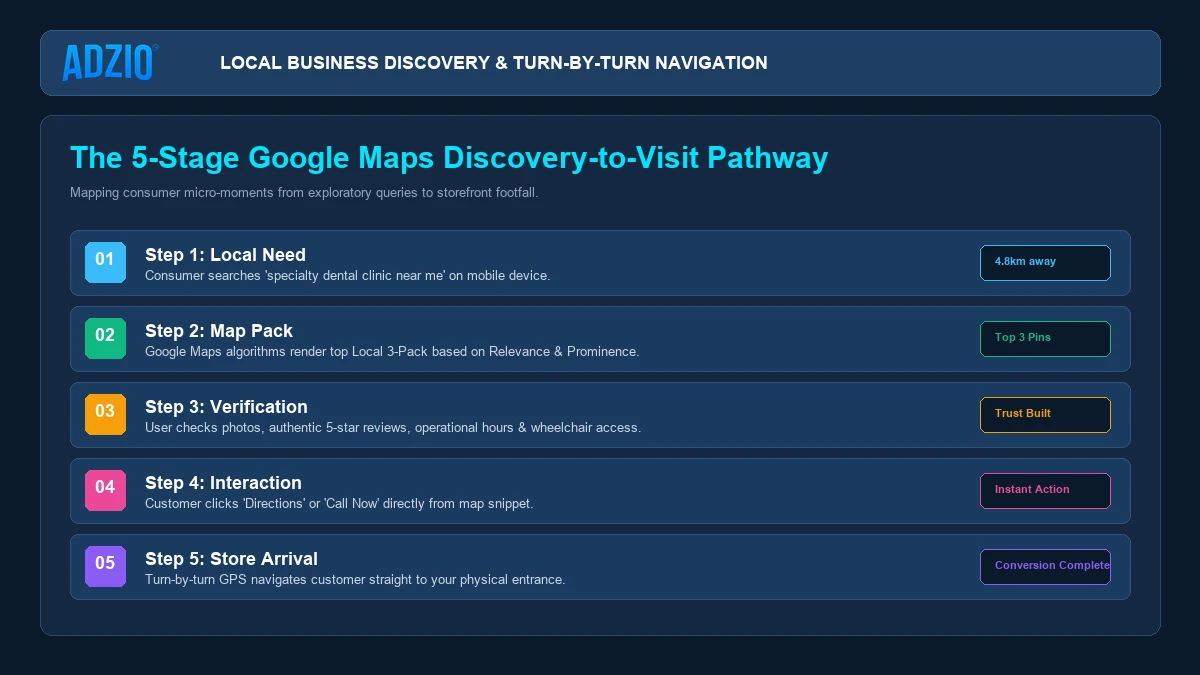
Local Need Formulation
Consumer searches for nearby products, clinical treatments, or professional services using conversational or 'near me' keywords.
Local 3-Pack Rendering
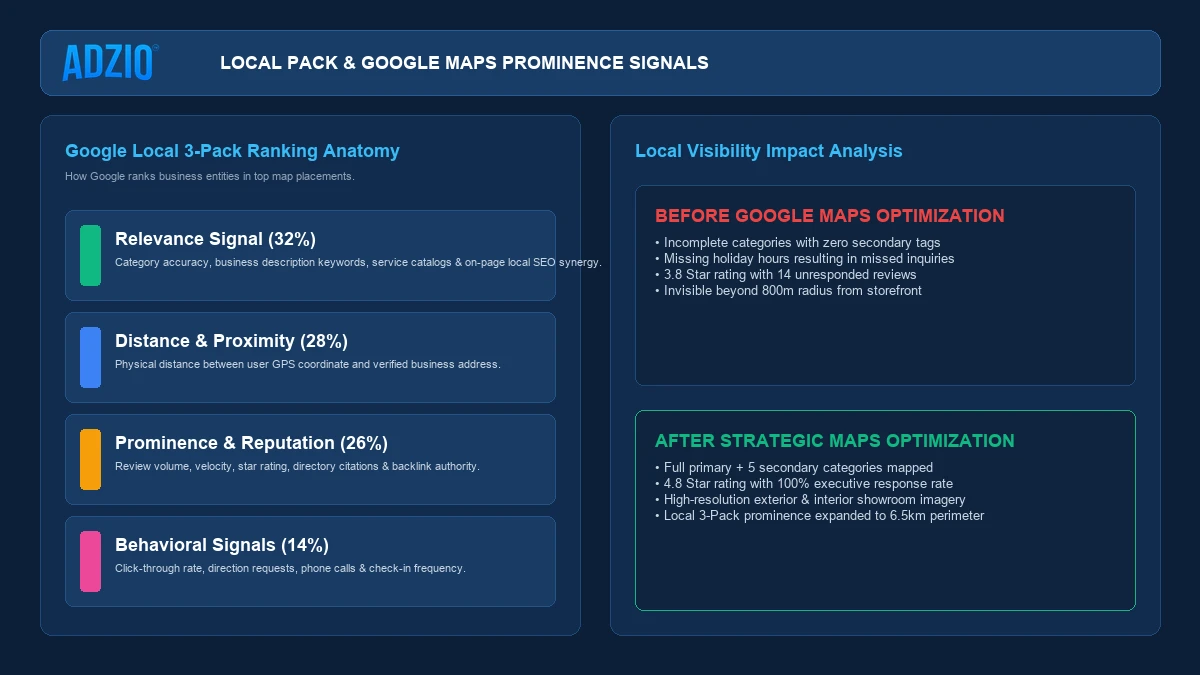
Google's core local search algorithms rank nearby entities based on algorithmic Relevance, Distance, and Prominence weights.
Entity Trust Evaluation
The consumer examines star ratings, management response etiquette, storefront imagery, and verified opening hours.
High-Intent Conversion
The user initiates GPS navigation, places a direct phone call, or books an appointment via your synchronized landing page.
Google Maps vs. Google Business Profile: Understanding the Synergy
While frequently conflated in everyday conversation, Google Maps and Google Business Profile represent distinct components of Google's local ecosystem that perform complementary functions.
Google Business Profile (The Administrative Entity)
Google Business Profile (GBP) is the backend administrative management portal and structured database where authenticated business owners and authorized agencies curate, verify, and maintain corporate entity data. It is where you submit municipal registration documents for verification, configure primary and secondary industry categories, define opening and holiday hours, craft business descriptions, upload photo catalogs, and publish official business posts.
In essence, Google Business Profile is the data repository that holds your canonical commercial information. Without an authenticated, policy-compliant Google Business Profile, your commercial entity does not possess a verified listing record within Google's Knowledge Graph.
Google Maps Marketing (The Discovery Canvas)
Google Maps, by contrast, is the consumer-facing cartographic application and navigational environment utilized by hundreds of millions of users daily across mobile operating systems (Android, iOS) and desktop browsers. Google Maps marketing encompasses the strategic optimization of how your business appears, competes, and converts within this dynamic spatial environment.
While GBP holds your raw business data, Google Maps marketing focuses on consumer search psychology, localized competitive grid dominance, turn-by-turn navigation capture, in-store footfall acceleration, and location-based customer acquisition across the broader geographic territory.
Key Takeaway: You cannot execute effective Google Maps marketing without a verified Google Business Profile, but merely possessing a profile does not guarantee prominence across Google Maps. Professional Maps marketing bridges administrative data with strategic consumer discovery.
How Google Maps Visibility Integrates with Local SEO
Google Maps rankings do not exist in an algorithmic vacuum. Your prominence on Google Maps is inextricably linked to the organic search authority of your official website.
A common misconception among business operators is that Google Maps visibility operates entirely independently from traditional search engine optimization. In reality, Google's local search algorithms continuously crawl your linked website to cross-reference entity facts, gauge domain authority, and extract semantic context. If your website is technically sluggish, lacks mobile optimization, fails to display matching Name, Address, and Phone (NAP) details, or lacks structured Schema.org markup, your Google Maps ranking strength is severely undermined.
Conversely, when your Google Maps listing is anchored by an authoritative, fast-loading, and mobile-first website developed through rigorous local SEO services, a powerful compounding effect occurs. The organic backlink authority, local topical relevance, and localized citation consistency earned by your website feed directly into Google's Prominence calculations for Maps. Every localized blog post discussing community health, every municipal directory citation, and every localized service page strengthens Google's algorithmic confidence in your physical commercial presence.
At AdZio, our Google Maps marketing programs operate in lockstep with comprehensive search engine optimization. We ensure that your target landing pages feature structured LocalBusiness JSON-LD markup, clear geographic service headers, embedded interactive maps, and authentic customer testimonials, establishing an unshakeable digital foundation that propels your map pin to the forefront of local search.
Structured Schema Synergy
Deploying Schema.org LocalBusiness JSON-LD markup on your website to reinforce geo-coordinates, opening hours, and service menus directly to Google's indexing crawlers.
Organic Domain Prominence
Leveraging high-quality localized backlinks, press mentions, and community citations to elevate your website's domain authority, which directly boosts map ranking weight.
Mobile Technical Health
Ensuring lightning-fast mobile page speed, seamless viewport responsiveness, and frictionless tap targets so referred map visitors convert effortlessly.
Business Information Optimization for Flawless Map Discovery
Precision in your core business data represents the primary algorithmic checkpoint. Discover how meticulous information structuring builds lasting search trust.
At the heart of Google Maps marketing lies fundamental data hygiene. When Google's entity algorithms evaluate a commercial profile, they seek absolute certainty regarding what the business is called, where it operates, when it is open, and how customers can contact its representatives. If conflicting variations of your business name, street address, or telephone number exist across external directories, government registrations, and social platforms, Google's algorithmic confidence drops, suppressing your listing in high-density local results.
A vital principle enforced by Google—and strictly upheld by AdZio—is the prohibition of keyword stuffing in official business titles. While adding phrases such as "Best Eye Surgeon" or "Cheapest Packers & Movers" into a business name historically yielded temporary ranking surges, Google's automated entity matching now actively penalizes and suspends offending profiles. Your business title on Google Maps must mirror your real-world corporate identity, exterior storefront signage, and municipal licensing.
Equally critical is the maintenance of operational schedules, split-shift hours, and special holiday timings. When a prospective customer travels across town based on an "Open" status on Google Maps only to find locked doors, the resulting frustration produces scathing 1-star reviews and navigational abandonment. Maintaining accurate business hours and responsive contact channels protects customer trust and reinforces profile health.
The Google Maps Data Checklist
Categories & Relevance: Mapping Consumer Search Intent
Category selection serves as the single strongest relevance signal in Google's local search algorithm. Learn how precision category architecture anchors your map visibility.
In Google Maps marketing, business categories dictate whether your entity is considered eligible to compete for a user's search query. Chosen from Google's standardized taxonomy of over 4,000 distinct commercial classifications, your primary category defines the fundamental nature of your establishment. Selecting "Hospital" vs. "Diagnostic Centre" vs. "Medical Clinic" triggers distinct algorithmic matching rules, unlocks specific profile features (such as appointment scheduling tabs or medical department listings), and directly influences your map pin's baseline relevance.
A foundational strategic principle is selecting the most specific available primary category rather than a broad, generic classification. For instance, an establishment dedicated exclusively to corrective vision surgery achieves significantly sharper algorithmic alignment for high-intent searches by designating "Eye Care Centre" or "Ophthalmology Clinic" as its primary category, rather than the diluted category "Doctor."
Beyond the primary category, Google allows businesses to designate up to nine secondary categories. These secondary tags allow multi-faceted commercial enterprises to accurately capture subsidiary revenue lines—such as an automobile dealership designating "Used Car Dealer," "Auto Repair Shop," and "Car Inspection Station." However, adding irrelevant or loosely related categories merely to capture extraneous search impressions dilutes your entity's core semantic focus and can trigger manual policy reviews. At AdZio, we perform rigorous category audits to ensure absolute alignment with authentic commercial operations.
Primary Category Precision
Identifying the singular classification that encapsulates the primary economic activity of your establishment as a whole to maximize core keyword relevance.
Secondary Service Taxonomy
Strategically assigning verified secondary categories that represent legitimate, fully staffed, and readily available commercial services at that physical location.
Eliminating Category Dilution
Removing contradictory or peripheral categories that confuse Google's entity indexing models and dilute primary local 3-pack ranking authority.
Customer Reviews: The Heart of Google Maps Prominence
Customer reviews on Google Maps serve a dual purpose: they act as a major algorithmic ranking weight within Google's Prominence calculations, and they represent the primary trust filter prospective buyers use to evaluate competing establishments. When a user examines a Local 3-Pack, listings boasting higher review volumes, consistent recent feedback, and superior star ratings naturally capture disproportionately higher click-through and direction request rates.
However, review velocity and sentiment must be earned through authentic customer service excellence rather than deceptive manipulation. Purchasing synthetic reviews, deploying automated bots, or implementing "review gating" (filtering dissatisfied customers from leaving public feedback) directly violates Google's User Contributed Content policies and consumer protection laws. Google's machine learning models aggressively detect artificial review spikes, purging fabricated feedback and penalizing offending listings.
At AdZio, our online reputation management strategies center on building sustainable, compliant review acquisition frameworks. We help businesses integrate automated review request touchpoints into post-service communications, train staff on customer satisfaction protocols, and establish professional, empathetic response workflows for every incoming review—transforming public customer feedback into a powerful marketing asset.
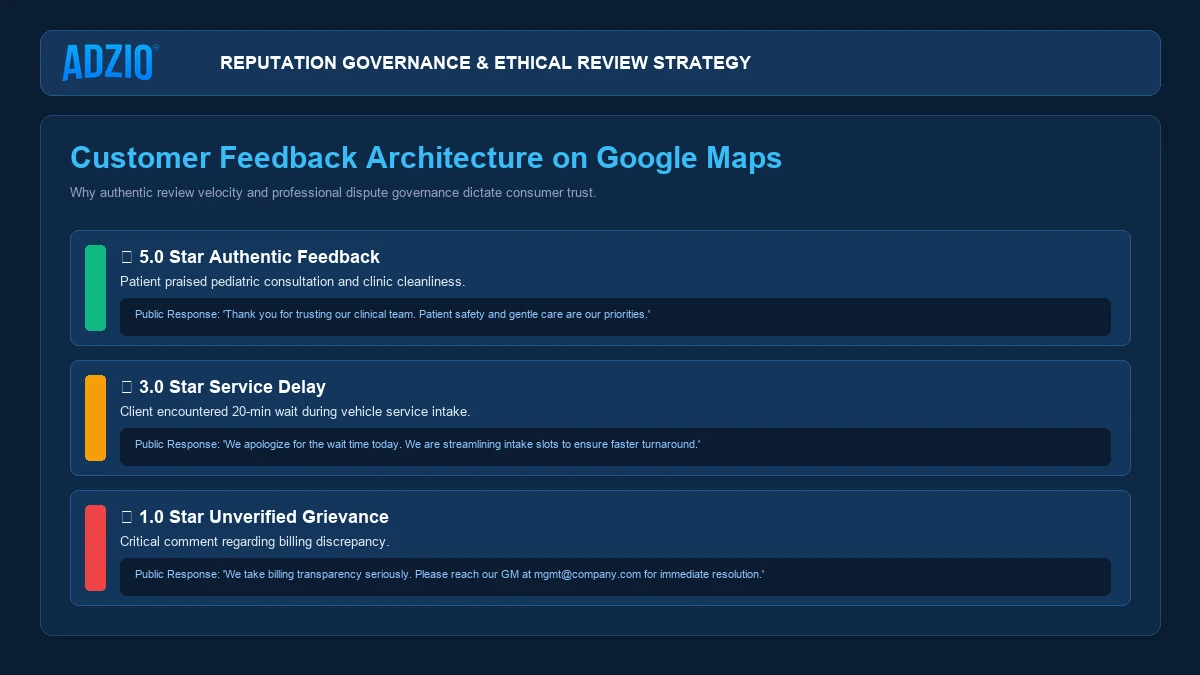
Positive Review Amplification
Expressing sincere appreciation while naturally referencing the specific services or staff members praised, reinforcing brand warmth and local credibility.
Neutral Feedback Neutralization
Acknowledging perceived inconveniences with humility, outlining ongoing operational improvements, and inviting patrons back to experience refined service.
Critical Dispute Governance
Responding calmly and professionally without defensiveness, immediately providing direct management contact details to transition grievances into private resolution channels.
Storefront Photography: Transforming Map Pins into Destinations
Visual content on Google Maps is not merely decorative; it serves as real-world navigational proof and the primary aesthetic driver of physical footfall.
When mobile users navigate toward an unfamiliar commercial establishment, visual confirmation eliminates anxiety and hesitation. Official Google performance data consistently demonstrates that business listings featuring authentic, regularly updated photography receive 42% more requests for driving directions on Google Maps and 35% more direct website click-throughs compared to profiles with sparse or generic imagery. High-quality imagery establishes immediate tangible credibility, reassuring prospective visitors regarding the cleanliness, scale, professionalism, and accessibility of your facility.
A comprehensive visual strategy requires curated photographic coverage across multiple dimensions: exterior building views captured from various street angles and daylight conditions (enabling drivers to instantly spot your physical signage from a moving vehicle); welcoming interior photographs highlighting client reception lounges, consultation rooms, or dining halls; high-resolution imagery showcasing proprietary equipment, diagnostic technologies, or retail inventory; and professional portraits of licensed practitioners or customer service teams.
Crucially, businesses must avoid populating their Google Maps presence with generic commercial stock photography, computer-generated 3D mockups, or heavily filtered AI imagery. Modern consumers immediately recognize artificial graphics, and encountering a physical facility that fails to match exaggerated digital visuals shatters brand trust upon arrival. AdZio coordinates authentic photography curation guidelines that showcase your genuine commercial operations in the most compelling, realistic light.
Street-Level Exterior
Clear facade and street corner perspectives showcasing prominent exterior signage, parking bays, and entrance ramps for effortless driver navigation.
Interior Atmosphere
Clean, well-lit views of reception lounges, waiting areas, diagnostic bays, or dining spaces conveying comfort, hygiene, and modern amenities.
Team & Operations
Authentic photographs of licensed physicians, technicians, or service specialists actively assisting patrons, adding human warmth and credibility.
Products & Equipment
Sharp product spotlights, diagnostic hardware, vehicle showroom displays, or culinary dishes reflecting authentic, available offerings.
Capturing On-the-Go Consumers via Mobile Maps Optimization
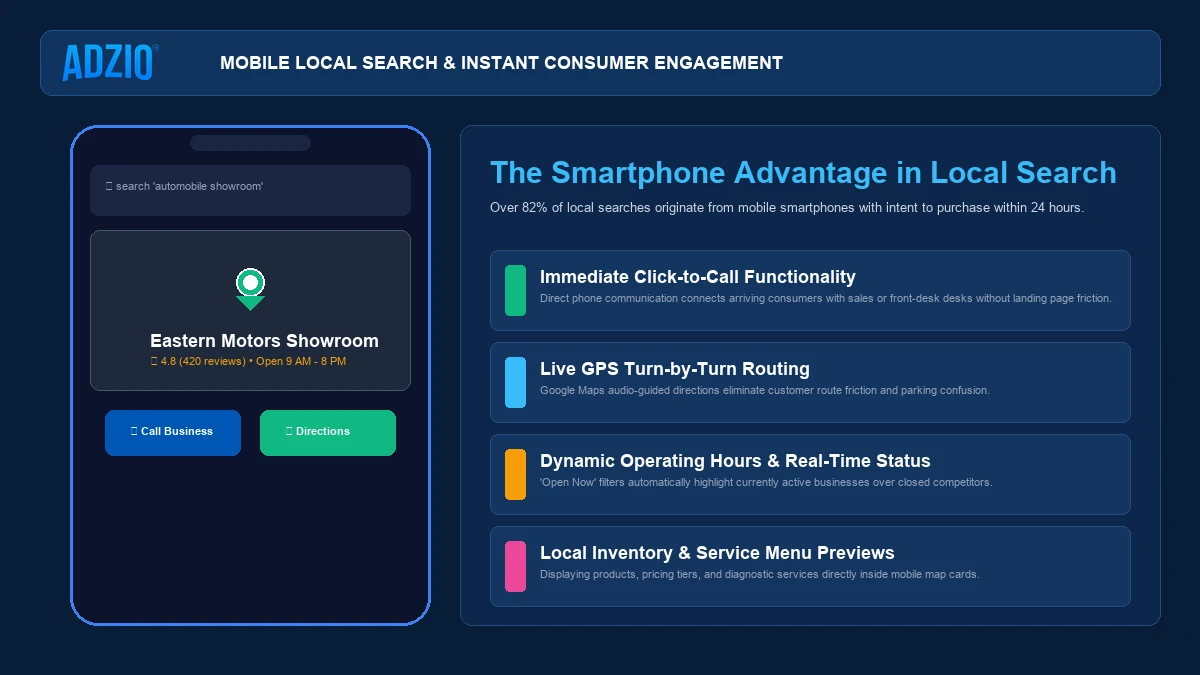
Over 80% of local commercial searches originate from mobile handheld devices. When a consumer uses Google Maps on a smartphone, their behavioral mindset is defined by urgency and immediate intent: they are seeking real-time answers, rapid directions, and frictionless telephone access. A desktop-centric marketing approach completely fails to capture these fast-moving consumer journeys.
Mobile Maps marketing prioritizes immediate conversion triggers. The presence of a prominent "Call" button allows mobile users to place an instant voice inquiry to your reception desk without copying digits or navigating away from the map interface. Similarly, the "Directions" button leverages Google Maps' native turn-by-turn GPS navigation, routing motorists, public transit riders, or pedestrians directly to your physical doorstep with dynamic traffic re-routing and parking guidance.
Furthermore, mobile search algorithms actively favor businesses that are currently operating. The dynamic "Open Now" filter is one of the most frequently applied search parameters by mobile users seeking evening dining, weekend healthcare, or emergency automotive repairs. If your business profile fails to reflect extended evening hours or holiday schedules, you forfeit qualified footfall to nearby competitors. AdZio optimizes your mobile Maps ecosystem to capture high-velocity smartphone opportunities around the clock.
Deconstructing 'Near Me' Searches: Implicit vs. Explicit Geolocation
The explosive rise of "near me" search queries—such as "hospital near me," "automobile showroom near me," or "diagnostic centre near me"—has redefined local search engine optimization. However, many business operators mistakenly assume that ranking for "near me" searches requires synthetically forcing the phrase "near me" into their business name, metadata, or website copy. In reality, Google's advanced semantic and geocoding algorithms treat "near me" as an implicit geospatial instruction, calculating relevance based on the searcher's physical GPS location rather than text matching.
To dominate "near me" searches across Google Maps, a business must optimize the underlying ranking triad: Proximity, Prominence, and Relevance. Proximity cannot be artificially faked; Google calculates the exact geographic distance between the searcher's mobile coordinates and your verified physical address. However, by optimizing your primary and secondary categories, earning consistent authentic reviews, and establishing localized website topical equity, you expand your effective "Prominence Radius"—enabling your listing to outrank closer competitors who suffer from incomplete data or inferior review profiles.
AdZio's Google Maps marketing methodologies systematically fortify your prominence signals across surrounding neighborhoods and district corridors, ensuring your establishment surfaces prominently whenever high-intent local patrons seek top-tier providers in their vicinity.
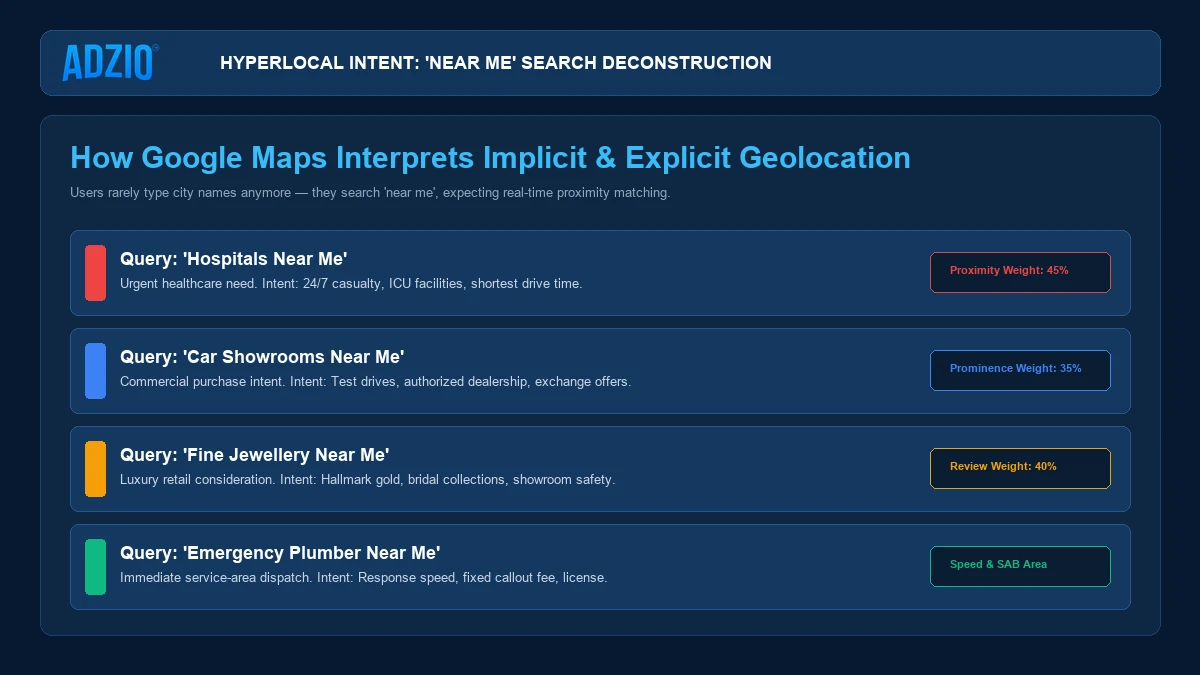
'Near Me' Search Intent & Signal Weight Simulator
Select a sample search query to see how Google Maps weights algorithmic signals (Proximity, Relevance, Prominence, and Behavioral Intent) across diverse commercial verticals.
Intent Characteristic:
Urgent clinical need where physical proximity and 24/7 operating status dictate initial discovery, followed closely by clinical accreditations.
Healthcare Intent Profile
Demonstration ModelLocal 3-Pack Proximity Radius Visualizer
Drag the radius slider to observe how competitive density, physical distance, and prominence scores dynamically reshape a business's Local 3-Pack ranking position across urban perimeters.
At this close distance, your high proximity signal combines with strong category relevance to easily secure top placement within the Local 3-Pack.
Industry-Specific Google Maps Marketing Strategies
Local search behavior, decision timelines, and consumer trust criteria vary widely across commercial sectors. Discover how AdZio tailors Google Maps marketing for industry dominance across 8 major verticals.
1. Healthcare, Hospitals & Clinics
For multi-specialty hospitals, outpatient clinics, diagnostic pathology labs, dental surgeries, and eye-care centres, Google Maps discovery is frequently an emergency or high-stress touchpoint. Prospective patients and their families require instantaneous, unambiguous verification of 24/7 emergency casualty facilities, intensive care capabilities, ambulance contact hotlines, on-site pharmacy availability, and wheelchair accessibility.
Our healthcare Google Maps framework prioritizes medical department segregation (such as creating dedicated listings for Pediatric or Cardiology wings within hospital campuses), strict adherence to medical advertising ethics, responsible patient privacy in review management, and transparent operational scheduling—without making unsubstantiated clinical efficacy claims.
2. Automobile Showrooms & Service Bays
Authorized car dealerships, motorcycle showrooms, and multi-brand service centres operate in a high-ticket, consideration-heavy commercial environment. Motorists utilize Google Maps to schedule vehicle test drives, locate certified original equipment manufacturer (OEM) service facilities, check express maintenance turnaround times, and explore inventory pricing.
We configure distinct showroom vs. service workshop profiles where permitted, integrate dynamic service booking links, showcase authentic vehicle delivery celebrations and bay equipment photography, and institute post-service review generation campaigns that build long-term local trust.
3. Fine Jewellery & Luxury Showrooms
Fine jewellery establishments, hallmark gold retailers, and luxury diamond boutiques depend heavily on consumer trust, physical showroom prestige, and bridal shopping footfall. Local searchers evaluate security, hallmark accreditations, parking convenience, and private consultation amenities before visiting in person.
Our Maps strategy highlights verified hallmark credentials, publishes high-resolution showroom exterior and bridal lounge photography, maintains precise festival and wedding season operating hours, and showcases authentic patron experiences that reassure high-net-worth buyers.
4. Restaurants, Cafes & Dining
Culinary establishments thrive on spontaneous, mobile-driven local discovery. Prospective diners scrutinize menu items, dietary attributes (such as vegetarian or halal certifications), outdoor seating options, live music schedules, and visual food presentations directly within Google Maps cards.
We integrate Reserve with Google table reservation engines, structure comprehensive digital menus with clear pricing tiers, curate appetizing dish photography, and implement rapid-response protocols for diner feedback to maintain high average star ratings during peak dining hours.
5. Real Estate & Property Showrooms
Real estate brokerages, property consultants, and residential township developers utilize Google Maps to guide prospective home buyers and commercial tenants to on-site sales galleries, model sample flats, and corporate offices.
We establish pinpoint geographic coordinates for active development projects, publish aerial site progress photography, configure appointment booking schedules, and link profiles to rich neighborhood-level property landing pages that answer local infrastructure and transit questions.
6. Education, Institutes & Academies
Higher education colleges, professional coaching institutes, private K-12 schools, and vocational training centers rely on Google Maps to guide prospective students and parents during seasonal admission cycles and campus open houses.
We optimize campus perimeter routing, publish library and laboratory facility photography, highlight academic accreditations, configure direct prospectus download links, and manage alumni review sentiment to project academic excellence.
7. Hospitality, Hotels & Resorts
Business hotels, luxury resorts, boutique homestays, and banquet conference venues require sophisticated Google Travel and Google Maps integration. Travelers evaluate room rates, guest amenities (such as swimming pools, airport shuttles, and complimentary breakfast), and check-in schedules directly on map pins.
Our hospitality Maps program coordinates verified hotel attribute tags, high-resolution room and banquet hall galleries, direct Google Hotel Center rate parity feeds, and wedding/conference inquiry triggers that capture traveling guests.
8. Legal, Financial & Corporate Services
Corporate law firms, chartered accountants, architectural consultancies, and management advisors require dignified, authoritative representation on Google Maps. Corporate clients evaluate permanent office suite signage, partner credentials, and discreet meeting facilities.
Our approach validates permanent corporate premises within multi-tenant complexes, avoids promotional keyword stuffing, highlights professional accreditations, and links listings to detailed partner biography and service capability pages on the firm's website.
Google Maps Marketing as an Equalizer for Small Businesses
Independent storefronts and local retailers can outmaneuver national conglomerates by mastering localized proximity, authentic community rapport, and impeccable data hygiene.
For independent retailers, neighborhood specialty clinics, and standalone dining establishments, competing against multi-billion-dollar national corporations in broad organic search results can feel daunting. Large corporate brands possess massive backlink profiles and enormous domain authority. However, Google Maps operates on an entirely distinct algorithmic paradigm governed by physical proximity and authentic local prominence. On Google Maps, a well-managed single-location dental clinic or local boutique can easily outrank an international hospital chain or national franchise if the local business is physically closer to the searcher, maintains higher review velocity, and presents richer, more accurate local data.
Small business Google Maps marketing focuses intensely on hyper-focused radius dominance. By optimizing every available field—from granular primary categories and complete attribute checklists to authentic photo uploads showing the real business owner and staff—small businesses project an authentic, warm, and trustworthy presence. When coupled with proactive post-purchase review requests, an independent storefront can rapidly accumulate an enthusiastic community rating profile that large corporate chains struggle to replicate.
At AdZio, we construct cost-effective, high-impact Google Maps marketing programs specifically engineered for small and medium-sized enterprises (SMEs) across India. We eliminate technical friction, rectify citation inconsistencies, and provide small business owners with actionable operational workflows that turn neighborhood proximity into recurring, loyal footfall.
Proximity Leverage
Capitalizing on natural geographic proximity to capture immediate neighborhood searches before national competitors can intervene.
Authentic Community Proof
Leveraging personal customer relationships to earn genuine, detailed 5-star customer reviews that outshine impersonal corporate chains.
Cost-Effective Customer Acquisition
Generating sustainable, high-intent local phone calls and physical visits without the continuous, escalating costs of paid advertising campaigns.
Multi-Location Maps Marketing: Scaling Consistency Without Duplication
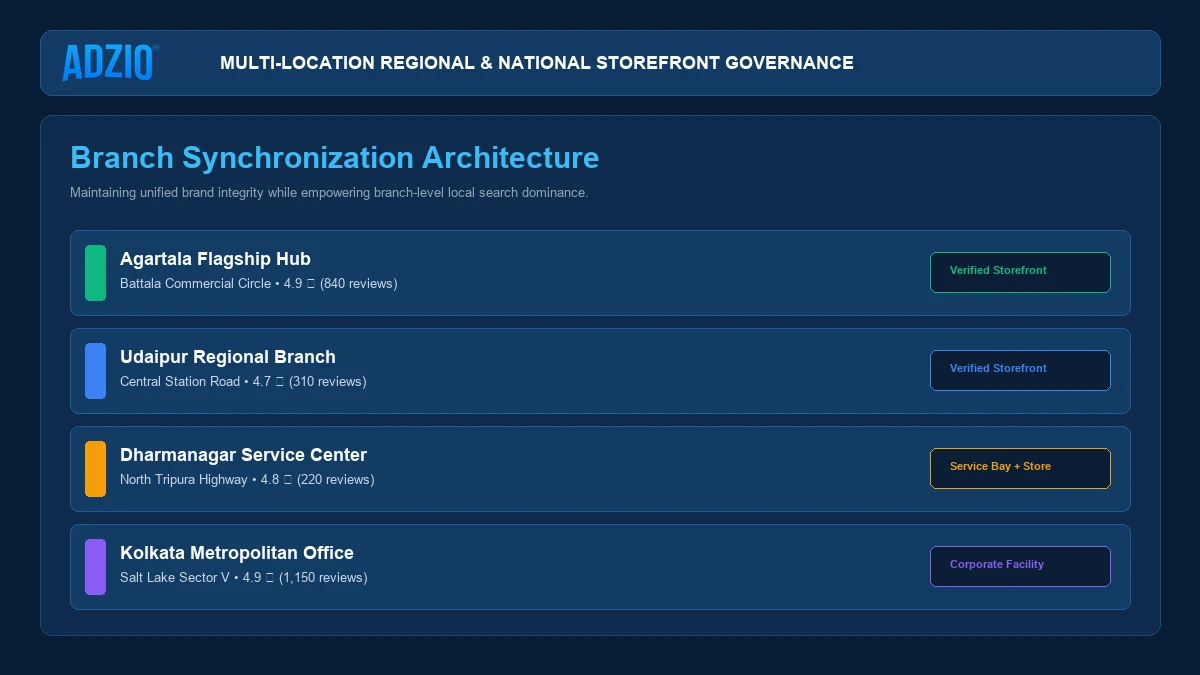
For regional retail chains, multi-branch healthcare networks, and automotive franchise systems, managing a multi-location presence across Google Maps presents complex technical hurdles. A frequent mistake is centralizing all locations under a single telephone number or redirecting every Google Maps profile to a generic homepage. Such practices severely dilute local relevance signals and confuse Google's entity indexing algorithms.
A successful multi-location architecture requires strict branch-level individuation. Every legitimate physical establishment must maintain its own authenticated Google Maps listing featuring its exact street address, a dedicated local landline or branch mobile number, distinct operational hours reflecting local staffing, and unique photo galleries depicting the real exterior and interior of that specific facility.
Furthermore, each branch listing must link to its own dedicated, high-performance local landing page (e.g., example.com/locations/agartala-battala) equipped with localized Schema.org LocalBusiness markup. This reinforces geographic parity, enables granular conversion tracking, and safeguards against duplicate listing penalties. AdZio coordinates enterprise-grade multi-location governance that scales seamlessly across dozens of regional storefronts.
The Maps-to-Website Conversion Funnel
How your Google Maps profile and corporate website collaborate to guide prospective patrons from exploratory discovery to confirmed appointments.
While Google Maps enables instant actions such as phone calling and navigation, a substantial proportion of high-value consumers—particularly in healthcare, luxury retail, automotive sales, and professional consulting—desire deeper verification before committing to a physical visit. They click the "Website" button on your Google Maps listing to inspect clinical doctor biographies, review transparent pricing schedules, explore facility accreditations, or verify inventory availability.
If your target landing page is slow, clunky on mobile devices, or visually disconnected from the information presented on your map profile, the consumer experiences cognitive friction and bounces back to Google Maps to select a competing establishment. Your website must serve as an authoritative extension of your Google Maps presence: immediately reiterating your verified business name, physical street address, phone number, embedded map coordinates, and clear call-to-action buttons (such as "Schedule Consultation" or "Request Test Drive").
Through our specialized website development and conversion rate optimization frameworks, AdZio builds frictionless, high-speed landing page experiences that convert referred Google Maps visitors into confirmed, high-value commercial transactions.
1:1 Geographic Parity
Ensuring the destination landing page matches the exact NAP, operational hours, and primary services listed on the corresponding Google Maps pin.
Sub-Second Mobile Load Times
Optimizing Core Web Vitals to deliver instantaneous mobile page rendering for users browsing on cellular data networks.
Frictionless Lead Funnels
Deploying clear, prominent appointment booking forms, WhatsApp consultation buttons, and click-to-call banners optimized for thumb-driven mobile interaction.
Architecting Legitimate Local Landing Pages vs. Prohibited Doorway Pages
Understanding Google's strict quality standards governing geographic content to build lasting organic authority without triggering algorithmic spam penalties.
Legitimate Local Landing Pages (AdZio Standard)
A legitimate local landing page represents a genuine physical establishment or authenticated service territory. It contains rich, original, and deeply useful content tailored specifically to that geographic community:
- Specific branch staff, resident clinicians, or store manager profiles.
- Detailed driving instructions, parking availability, and local transit landmark notes.
- Branch-specific photo galleries of the physical building and interior bays.
- Unique local customer testimonials and community case studies.
- Interactive Google Maps embed with calibrated geo-coordinates.
Prohibited Doorway Pages (Violations to Avoid)
Doorway pages are spammy, mass-produced web pages created solely to manipulate search rankings for multiple city names without offering genuine local value:
- Programmatically generated duplicate text swapping only the city name.
- Targeting locations where the business maintains zero physical operations or staff.
- Thin, unhelpful pages directing all traffic into an identical centralized funnel.
- Inventing fake satellite branch addresses or virtual mailbox coordinates.
- Subject to severe Google spam penalties and site-wide de-indexing.
AdZio Policy: We strictly construct high-value, compliant local landing pages for verified physical locations and legitimate service territories, ensuring sustainable long-term search prominence while rejecting manipulative doorway schemes.
Bridging Cartographic Discovery with Real-World Revenue
A high-ranking map pin is valuable only when it translates into tangible business outcomes: physical footfall, qualified phone inquiries, and completed transactions.
Many marketing agencies measure local search success solely through vanity metrics such as map view counts or total search impressions. At AdZio, our Google Maps marketing framework is anchored in conversion architecture. An impression on Google Maps represents potential interest, but real commercial velocity occurs when a user initiates a high-intent action: tapping the "Directions" icon to drive to your showroom, tapping "Call" to inquire about product availability, or clicking your booking link to secure a clinical consultation.
Converting map discovery into physical footfall requires eliminating friction across every physical and digital touchpoint. For example, if a consumer initiates driving directions but encounters ambiguous parking instructions or an obscure building entrance upon arrival, the probability of transaction abandonment escalates. By publishing detailed landmark guidance, dedicated parking photographs, and clear check-in protocols directly on your profile and linked landing pages, you shepherd the consumer effortlessly across the final hundred meters of their journey.
Furthermore, we institute end-to-end local conversion tracking wherever technically feasible: utilizing dynamic call tracking numbers, custom UTM campaign parameters on website URLs, and integrating point-of-sale customer intake questionnaires to correlate localized map exposure directly with confirmed top-line revenue growth.
Local Footfall & Inquiry Estimator
Simulate potential customer actions generated from estimated monthly Google Maps impressions based on industry conversion benchmarks.
Interpreting Google Maps Performance Metrics
Effective marketing management requires transparent, actionable analytics. Google provides a robust suite of native performance reporting data, allowing business owners to monitor how prospective customers find their listing and what actions they take upon discovery. However, interpreting these metrics requires understanding the difference between raw search visibility and qualified engagement.
Key performance indicators include Discovery Searches (users discovering your profile while searching for a category or product, such as "car service"), Direct Searches (users searching specifically for your brand name or address), Map Views (impressions rendered inside the Google Maps application), Search Views (impressions generated on Google Search Local Packs), Driving Direction Requests (broken down by the postal zip code or municipality of origin), and Direct Telephone Inquiries (tracked by day of the week and time of day).
AdZio analyzes these interaction signals to continuously refine your localized marketing strategy. By identifying which postal areas generate the highest volume of direction requests, we help multi-location enterprises optimize local advertising spend and evaluate physical territory expansion with empirical confidence.
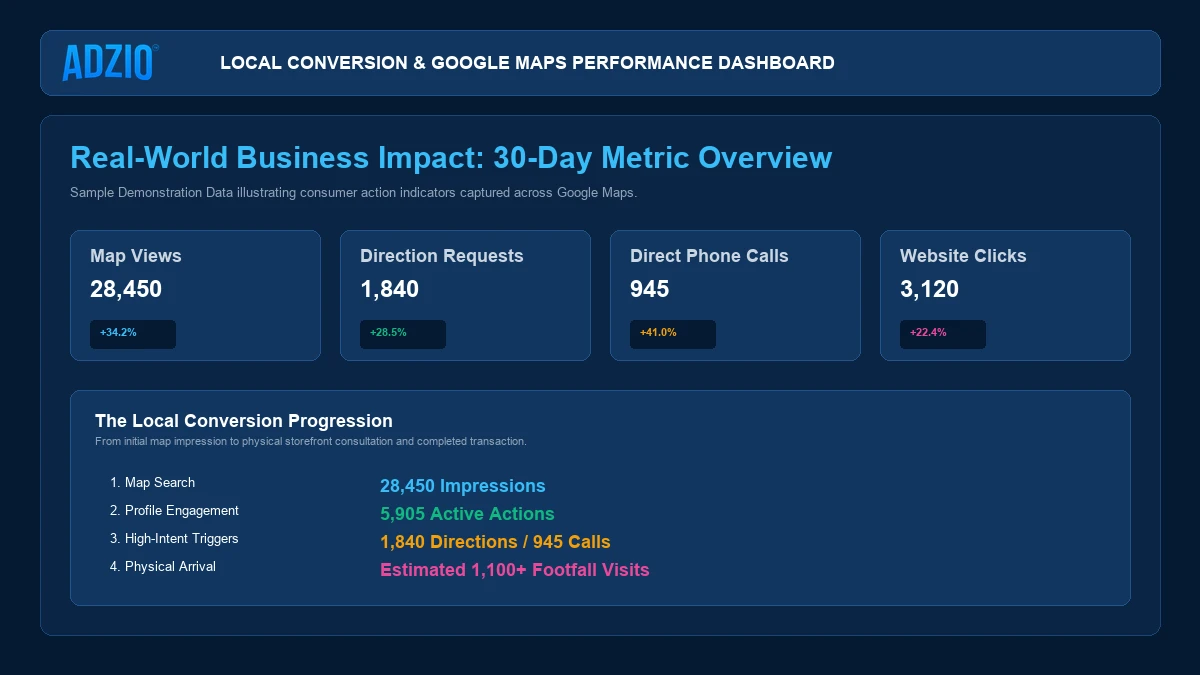
Sample Google Maps Local Performance Overview
Interactive demonstration illustrating representative local engagement metrics captured over rolling timeframes.
13 Critical Google Maps Marketing Mistakes to Avoid
Local visibility is fragile. Review the essential technical, operational, and policy pitfalls that frequently cause listing demotions, lost footfall, and profile suspensions.
1. Incorrect Business Information
Publishing conflicting phone numbers, misspelled addresses, or mismatched suite numbers across external directories confuses Google's entity indexing algorithms, severely dampening baseline local pack ranking confidence.
2. Outdated Opening Hours
Failing to update holiday hours, lunch closures, or seasonal shifts causes arriving customers to encounter locked doors, producing devastating 1-star reviews and elevated navigational abandonment rates.
3. Irrelevant Business Categories
Selecting peripheral or unrelated categories in hopes of siphoning tangential search impressions dilutes your entity's core semantic relevance and often triggers manual profile reviews by Google.
4. Duplicate Map Profiles
Creating multiple listings for the same physical address or overlapping services fragments your authority, confuses searchers, and violates Google's duplicate listing policies.
5. Keyword-Stuffed Business Names
Appending geographic tags or promotional service keywords to your registered business title directly breaches Google guidelines and triggers sudden hard listing suspensions without warning.
6. Fabricating or Buying Fake Reviews
Paying third-party syndicates for fake 5-star reviews triggers Google's automated spam filters, resulting in mass review purges, reputational scandal, and permanent listing penalties.
7. Neglected Customer Reviews
Leaving critical reviews unaddressed signals operational indifference to prospective patrons, whereas a composed, professional management response reassures future buyers.
8. Poor-Quality or Stock Photos
Relying on generic corporate stock imagery, blurry smartphone snaps, or synthetic 3D renders damages consumer trust and fails to provide drivers with recognizable street-level landmarks.
9. Inconsistent Contact Details
Displaying toll-free numbers that disconnect or routing calls into unattended IVR queues causes prospective customers to abandon their inquiries and call immediate competitors.
10. Thin Local Landing Pages
Linking map profiles to generic homepages or thin doorway pages that lack localized staff biographies, directions, and LocalBusiness schema destroys organic ranking synergy.
11. Misleading Location Information
Registering unmanned coworking desks, PO boxes, or remote mail drops to fake geographic proximity violates Google's physical staffing rules and fails live video audits.
12. Ignoring Mobile Experience
Failing to optimize your linked website for smartphone viewports and one-thumb navigation squanders over 80% of local search traffic on slow, frustrating mobile pages.
13. Expecting Instant Overnight Ranks
Expecting instantaneous #1 placement across an entire metropolitan grid leads to impatient, risky tactics. Sustainable prominence requires steady review and citation building over time.
Google Maps Marketing vs. Paid Google Advertising
Evaluating the strategic trade-offs between long-term organic map prominence and instantaneous paid search advertising.
Organic Google Maps Marketing
Organic Google Maps marketing focuses on earning sustainable, enduring visibility within the Local 3-Pack and Maps search results through entity hygiene, review velocity, and website authority.
- Cost Model: Zero cost-per-click charges for phone calls, direction requests, or website visits.
- Trust Factor: High consumer credibility; users recognize organic 3-pack listings as established local landmarks.
- Long-Term Value: Accumulated review equity and domain authority compound over time, providing resilient ongoing discovery.
- Time to Impact: Requires steady, methodical optimization over several months to expand proximity grids.
Paid Google Advertising (Search & Local Ads)
Google Search Ads and Promoted Pins allow advertisers to secure immediate top-of-page placements above organic results by bidding on competitive local keywords.
- Cost Model: Direct pay-per-click (PPC) billing for every user interaction, requiring active ad spend.
- Speed to Market: Instant visibility within hours of campaign launch, ideal for new branch grand openings.
- Geographic Control: Precise boundary targeting, schedule bidding, and rapid keyword experimentation.
- Continuity: Traffic ceases immediately when daily advertising budgets are exhausted.
AdZio Unified Strategy: We frequently recommend a hybrid approach: deploying targeted Google Search Ads or Performance Max campaigns to capture immediate demand while organic Google Maps marketing matures to build permanent local prominence.
Comparative Framework: Maps vs. Local SEO vs. GBP
A side-by-side architectural comparison clarifying how each discipline functions within your overall local digital marketing ecosystem.
| Strategic Dimension | Google Maps Marketing | Local SEO | Google Business Profile |
|---|---|---|---|
| Primary Objective | Drive physical footfall, turn-by-turn routing, and local map discovery. | Achieve organic search rankings across localized search engine results. | Authenticate and maintain structured corporate entity data. |
| Primary Surface | Google Maps mobile application and Google Local 3-Pack cards. | Google Search organic results and localized website landing pages. | Google Knowledge Panel and Business Profile Manager dashboard. |
| Core Mechanisms | Proximity calibration, review velocity, photos, and mobile UX. | On-page content, LocalBusiness schema, citations, and backlinks. | Verification documents, category taxonomy, hours, and attributes. |
| Primary Actions | Direction requests, phone calls, and physical walk-in visits. | Website clicks, form submissions, and content downloads. | Profile views, messaging, and business information verification. |
| Strategic Role | The real-world navigational and consumer conversion engine. | The authoritative organic web and domain foundation. | The verified central database and corporate knowledge anchor. |
AdZio's 12-Stage Google Maps Marketing Framework
A structured, policy-compliant execution roadmap designed to expand your local prominence radius sustainably without risky shortcuts.
Commercial Discovery
Analyzing your target geographic radius, customer catchment zones, primary service offerings, and local competitor density.
Entity Health Audit
Auditing existing map pins for coordinate accuracy, duplicate listings, unverified edits, and historical policy flags.
GBP Synchronization
Verifying ownership credentials and aligning core backend settings within Google Business Profile Manager.
NAP Normalization
Standardizing business name, suite-level address, and local telephone details across all prominent Indian directories.
Category Architecture
Selecting the most specific primary category and mapping up to nine verified secondary categories to capture consumer intent.
Visual Content Curation
Curating high-resolution exterior street signage, interior facilities, operational staff, and inventory photography.
Reputation Protocols
Establishing post-visit review acquisition workflows and instituting professional response templates for all feedback.
Landing Page Synergy
Connecting listings to fast, mobile-first local landing pages equipped with Schema.org LocalBusiness structured data.
Local SEO Alignment
Building authoritative localized backlinks, press mentions, and localized content hubs that strengthen domain prominence.
Technical Deployment
Publishing initial Google Posts, configuring holiday schedules, and activating booking/call extension integrations.
Proximity Monitoring
Tracking multi-point local grid rankings across surrounding pin codes to evaluate ranking expansion over time.
Ongoing Optimization
Continuously refining service catalogs, monitoring competitor spam, updating seasonal hours, and reporting footfall metrics.
Who Should Invest in Google Maps Marketing?
Google Maps marketing is specifically engineered for legitimate commercial enterprises that depend on physical consumer interaction or localized service delivery.
Physical Storefronts
Businesses operating dedicated physical commercial premises where customers physically arrive during posted operating hours: hospitals, retail boutiques, auto showrooms, restaurants, and salons.
Service-Area Businesses (SAB)
Qualifying mobile operators who travel directly to customer locations within defined geographic boundaries: emergency plumbers, mobile car detailers, electricians, and home healthcare units.
Multi-Branch Networks
Regional enterprise chains, diagnostic laboratory networks, and retail franchises requiring synchronized, branch-level local visibility across diverse cities and districts.
Eligibility Notice: Businesses operating exclusively online without in-person customer contact (such as dropshipping websites or digital-only software tools) are not eligible for Google Maps listings under Google's guidelines.
Frequently Asked Questions About Google Maps Marketing
Explore practical, in-depth answers to 16 critical questions regarding Google Maps marketing, local 3-pack prominence, review management, and local SEO synergy.
Google Maps marketing is the strategic discipline of optimizing a business's local digital presence to maximize its visibility, engagement, and customer conversions within Google Maps and localized Google Search experiences (such as the Local 3-Pack). It encompasses geographic coordinate calibration, category relevance, authentic customer reviews, localized photo updates, mobile navigation readiness, and on-page local SEO synergy.
Rather than viewing Google Maps as a static address book, Google Maps marketing treats cartographic indexing as an active customer acquisition funnel that guides mobile searchers from exploratory discovery directly into physical storefront footfall.
When a user executes a local search query, Google's local ranking algorithms evaluate thousands of potential business listings based on three core pillars: Relevance (how well the profile matches the search query), Distance (physical proximity to the searcher), and Prominence (reputation, review sentiment, and website authority). Google Maps marketing optimizes all controllable data and reputation signals to elevate your business into top map viewport placements.
Once your listing surfaces within the top Local 3-Pack, rich visual content, authentic customer reviews, and clear operational hours persuade the user to initiate turn-by-turn navigation or place an immediate telephone call.
While closely intertwined, Google Business Profile is the administrative tool and database repository where a business manages its official listing information. Google Maps marketing is the broader commercial strategy focused on how consumers discover, evaluate, and navigate to that business through Google Maps search interfaces, mobile 'near me' queries, proximity grid ranking, and localized user journey optimization.
An optimized Google Business Profile is a mandatory prerequisite, but Maps marketing encompasses mobile conversion pathing, localized website landing page synergy, and competitive proximity expansion.
Improving Google Maps visibility requires verifying exact street addresses, choosing the most specific primary category, collecting authentic 5-star customer reviews, publishing high-resolution exterior and interior photography, keeping opening hours up to date, and linking your profile to an authoritative, mobile-responsive local landing page equipped with Schema.org LocalBusiness markup.
Additionally, standardizing your Name, Address, and Phone (NAP) citations across reputable regional directories builds algorithmic trust that expands your visibility radius across surrounding postal codes.
An eligible business appears on Google Maps by creating or claiming a listing through Google Business Profile, submitting physical verification documentation (such as video verification or postal verification), and completing all mandatory profile fields. Once approved by Google, the business pin becomes indexable across Google Maps.
However, simply appearing on the map when searching your exact brand name does not guarantee discovery for broad commercial queries like "best diagnostic centre". True commercial visibility requires ongoing optimization.
Google Maps acts as a premier local customer acquisition gateway. Because local mobile queries carry immense purchase intent (with over 80% leading to an in-store visit or inquiry within 24 hours), Google Maps connects ready-to-buy consumers directly with your physical facility through one-tap phone calls, GPS navigation, and appointment bookings.
Local SEO is the overarching organic search optimization discipline covering localized website content, schema markup, technical geo-signals, directory citations, and backlink authority. Google Maps marketing specifically targets map-based discovery, turn-by-turn directions, mobile click-to-call triggers, and the immediate customer journey from map pin to physical storefront footfall.
Customer reviews heavily influence Google's Prominence ranking score. Profiles with high review velocity, consistent 5-star ratings, and active management responses rank higher and enjoy dramatically higher click-through rates. However, fake reviews or review gating violate Google policies and risk listing suspension.
Primary category selection is the single most powerful relevance signal in local search algorithms. Choosing the exact specific classification that describes your core commercial enterprise (e.g. "Dental Clinic" vs "Doctor") dictates your eligibility to surface for high-intent queries and unlocks industry-specific profile features.
Yes. In fact, Google Maps is the great equalizer for independent storefronts and local retailers. Because proximity and authentic community review sentiment are heavily weighted, a single-location boutique or dental surgery can readily outrank multi-billion-dollar national conglomerates within its immediate neighborhood radius.
Yes, hospitals, multi-specialty clinics, diagnostic pathology centers, and individual practitioners rely heavily on Google Maps for emergency and scheduled patient discovery. However, healthcare profiles must strictly adhere to medical advertising ethics, avoid unsubstantiated treatment claims, and protect patient health privacy in review responses.
Yes. Google Maps consistently produces some of the highest-converting commercial leads across all digital channels through direct telephone calls, driving direction requests, appointment bookings, and website visits initiated directly from verified map snippets.
Multi-location businesses require distinct, verified listings for each physical branch with branch-specific local phone numbers, operational hours, photo galleries, and dedicated local landing pages on the corporate website (e.g., example.com/locations/agartala) equipped with LocalBusiness JSON-LD schema.
No. Google's local ranking algorithms are dynamic and evaluate real-time proximity between the searcher and the business, competitive density, review signals, and user context. No legitimate agency can guarantee #1 placement or permanent 3-pack rankings. AdZio optimizes all controllable signals to expand your prominent visibility radius sustainably.
Professional Google Maps marketing costs vary based on the number of operating commercial locations, competitive market density, historical citation hygiene, and whether multi-channel local SEO integration is required. AdZio provides tailored monthly management scopes designed to deliver clear return on investment.
AdZio executes a disciplined 12-stage methodology centered on data accuracy, category relevance, ethical review acquisition, authentic photography curation, mobile conversion optimization, and deep synchronization with your organic website architecture. We reject black-hat naming hacks in favor of permanent local prominence.
Build a Stronger Local Presence Across Google Maps
Whether you operate a premier hospital in Agartala, an automotive showroom network across Tripura, or a luxury retail brand spanning metropolitan India, real-world customer acquisition begins with cartographic prominence.
Connect directly with AdZio's local search engineering desk to audit your current geographic grid visibility, eliminate citation inconsistencies, and deploy a compliant, high-conversion Google Maps marketing strategy.
What We Evaluate in Your Maps Audit:
- Pinpoint GPS coordinate calibration and navigation accuracy
- Primary & secondary category relevance vs. local search intent
- Review volume, velocity, sentiment trends, and response coverage
- NAP citation parity across primary Indian commercial directories
- On-page website local SEO synergy and LocalBusiness schema health
Request Local Maps Consultation
Submit your business details below for an empirical Google Maps audit. We never request account passwords or private credentials.