 ISO Certified Company
+91-9233973156
ISO Certified Company
+91-9233973156
ISO Certified Company
+91-9233973156
ISO Certified Company
+91-9233973156

Performance Max unifies Google's entire advertising inventory — Search, Display, YouTube, Gmail, Discover, and Maps — under a single goal-driven campaign architecture. At AdZio, we engineer, steer, and optimize AI-powered Performance Max campaigns tailored for businesses across India, Tripura, Agartala, and nationwide markets seeking measurable conversion value without wasting budget on low-intent automated impressions.

A clear, realistic examination of Google's goal-based campaign type, its underlying mechanics, and how businesses can harness machine learning without surrendering strategic control.
Google Performance Max (commonly referred to as PMax) is a goal-based campaign type that enables advertisers to access all of Google's advertising inventory from a single, unified campaign. Introduced to replace Smart Shopping and Local campaigns while broadening reach across non-search surfaces, Performance Max operates by aligning an advertiser's specified conversion goals, creative assets, audience signals, product data feeds, and budget with Google's proprietary machine learning algorithms. Instead of manually creating separate campaigns for Search, Display, YouTube, Gmail, Discover, and Maps, an advertiser provides the foundational inputs, and Google dynamically generates and serves ad combinations designed to maximize conversions or conversion value in real time.
However, understanding what Performance Max is also requires understanding what it is not. Performance Max is not a mystical "black box" that automatically guarantees profitable sales or leads simply because artificial intelligence is running the bidding. Machine learning models require clean, statistically significant conversion data, thoughtful audience guidance, meticulously crafted creative assets, and rigorous negative exclusions to prevent budget waste. When deployed as a standalone "set-and-forget" tactic without strategic oversight, Performance Max campaigns frequently gravitate toward low-hanging fruit, cannibalizing existing brand search traffic or serving cheap impressions on mobile display apps that yield zero downstream commercial revenue.
At AdZio, our approach to Google Ads Management treats Performance Max not as an automated replacement for human strategy, but as a high-powered execution engine that requires expert navigation. We configure granular conversion values, feed verified first-party audience signals, implement comprehensive brand exclusion lists, audit asset group performance rigorously, and integrate offline CRM feedback. This ensures that the algorithm optimizes toward genuine business profitability and verified customer acquisition rather than superficial vanity clicks.
Every bid, placement, and asset assembly decision made by the system is calculated against your specific primary conversion goals — whether online transactions, consultation inquiries, or phone calls.
Google analyzes billions of real-time signals — including device, location, time, past search behavior, and browsing context — to predict the conversion likelihood of each individual impression auction.
Unlike traditional single-network campaigns, Performance Max bids across Search, Shopping, YouTube, Display, Discover, Gmail, and Google Maps simultaneously to capture cross-surface demand.
Behind the automated interface lies a complex sequence of real-time auctions, intent evaluation, and dynamic creative synthesis.
To understand how Performance Max functions, consider the multi-touch consumer journey in modern digital commerce. A prospective customer rarely searches for a high-value product or service, clicks a single text ad, and immediately completes a purchase. More commonly, a buyer might begin with an exploratory search on mobile, read editorial reviews across third-party websites on the Google Display Network, watch an unboxing or service review on YouTube, notice a personalized promotional update in their Gmail account, and finally search for local directions on Google Maps before executing a transaction.
Traditional Google Ads structures require media planners to construct discrete search ad groups, separate display remarketing campaigns, standalone YouTube video action campaigns, and distinct discovery ads. This disjointed approach frequently results in siloed budgets, competing internal bids, and attribution blind spots where channels claim credit for the same conversion. Performance Max resolves this fragmentation by evaluating the entire user journey through a centralized attribution framework.
When an auction occurs on any eligible Google property, the Performance Max algorithm evaluates the user's intent profile against your asset groups, product feed data (via Google Merchant Center for e-commerce), and designated audience signals. If the model calculates a high probability that the impression will advance the user toward your primary conversion goal at or below your target cost per acquisition (tCPA) or target return on ad spend (tROAS), it dynamically assembles the most relevant combination of headlines, descriptions, images, or video clips and submits a bid calibrated specifically for that user at that exact micro-moment.
Key Operational Reality: Performance Max operates on guidance rather than strict boundaries. When you input audience signals and search themes, you are not establishing rigid targeting walls as in legacy Google Display or Search campaigns. Instead, you are providing the algorithm with a baseline hypothesis of who your ideal customer is. As the campaign gathers real-world conversion data, the machine learning model is permitted to expand beyond your initial audience signals to discover converting customers in adjacent or unexpected segments.
How growing brands, retailers, and lead-generation enterprises utilize PMax to expand reach, unlock efficiency, and uncover hidden search demand.
The primary catalyst driving businesses toward Performance Max is the ability to unlock incremental reach that cannot be captured through keyword-targeted Search campaigns alone. Keyword search volumes represent existing, expressed commercial intent. However, millions of prospective buyers are actively researching problems, comparing alternatives, and consuming relevant industry content on YouTube, Google Discover, and editorial publisher sites without actively typing search queries into Google.com. Performance Max bridges this divide by proactively presenting tailored visual and video assets to in-market prospects before they initiate an active search.
A second critical advantage is automated bid calibration across cross-network inventory. Manually coordinating bid adjustments across devices, geographic locations, audience segments, and time of day across six separate Google campaign types is statistically impossible for human managers to execute in real time. Performance Max recalculates bids auction-by-auction, leveraging Google's proprietary contextual signals that are completely invisible to external bid management software. This allows businesses with constrained marketing teams to achieve enterprise-level bidding sophistication.
For e-commerce retailers, Performance Max represents the central artery connecting product inventory directly to shoppers across Search, Shopping, YouTube Shorts, and Gmail. By combining real-time inventory feeds with rich lifestyle lifestyle photography and video assets, brands can present immersive shopping experiences that dramatically outperform legacy plain-text shopping listings. When properly harmonized with a comprehensive E-Commerce Digital Marketing strategy, Performance Max serves as a scalable engine for consistent transaction volume.
Performance Max does not exist in a vacuum. Understand how it contrasts with, complements, and differs from traditional Google Ads campaign types and paid social advertising.
While Google Search Ads rely strictly on keyword match types (exact, phrase, broad) and manual query management to capture active bottom-of-funnel search intent on Google.com, Performance Max uses algorithmic matching, landing page indexing (via Final URL Expansion), and Search Themes across Search and five other non-search networks. In Google's internal auction hierarchy, an exact match keyword search campaign will generally take priority over a Performance Max campaign if the search query is identical, provided the search ad has sufficient Ad Rank. Therefore, high-intent exact match Search campaigns should coexist alongside Performance Max to protect core transactional keywords while allowing PMax to hunt for incremental, long-tail search queries.
Traditional Standard Google Shopping Ads offer total transparency over search terms, bid adjustments by device, and negative keyword filtering, but they are limited exclusively to the Shopping tab and Search results page. Performance Max incorporates the exact same Merchant Center product feed but automatically extends those product listings into dynamic video ads on YouTube, interactive carousel ads in Gmail, and visual product tiles across the Display Network. For retailers seeking maximum inventory exposure, PMax provides unmatched reach, whereas Standard Shopping remains essential for brands requiring strict query control and manual bidding governance.
Standalone Google Display Ads campaigns allow advertisers to manually curate specific website placements, exclude individual YouTube channels, and target distinct contextual keywords. However, standalone display campaigns historically struggle with conversion efficiency due to ad fatigue and accidental mobile app clicks. Performance Max leverages Display inventory as part of a conversion-optimized journey, only bidding on display impressions when the machine learning model detects strong signals that the user is primed to convert based on multi-channel touchpoints.
Dedicated Google Video Ads and YouTube campaigns excel at top-of-funnel brand storytelling, unskippable reach, and targeted channel sponsorship. In contrast, video assets within Performance Max are served with direct-response intent — specifically driving actions like lead form fills or online checkouts across in-stream, in-feed, and YouTube Shorts formats. Businesses with strong video production capabilities should run dedicated YouTube campaigns for top-of-funnel brand equity while feeding those same high-performing video creatives into Performance Max for automated bottom-of-funnel conversion harvesting.
Advertising on platforms like Meta Advertising (Facebook & Instagram) or LinkedIn Advertising captures audience attention during leisure browsing based on demographic and social interest graphs. Performance Max differs fundamentally because its core foundation remains grounded in Google's high-intent search ecosystem. When Performance Max serves an ad on YouTube or Gmail, it frequently leverages recent search intent and commercial browsing data. Combining paid social for demand creation with Performance Max for cross-surface demand capture represents the gold standard of modern multi-channel growth.
In a traditional Google Ads account, an agency constructs 5 to 10 separate campaigns across Search, Display, and Video, each competing for budget and requiring individual optimization routines. Under a modernized hybrid architecture, AdZio pairs core Search campaigns (protecting brand terms and high-margin transactional exact match keywords) with a strategic Performance Max campaign that acts as an omnipresent reach multiplier. This hybrid model prevents cannibalization while capitalizing on Google's algorithmic cross-surface efficiencies.
| Feature / Capability | Google Performance Max | Standard Search Ads | Standard Shopping Ads | Display / Video Campaigns |
|---|---|---|---|---|
| Eligible Inventory | Search, Display, YouTube, Gmail, Discover, Maps | Search & Search Partners | Shopping Tab & Search Results | Display Network or YouTube only |
| Bidding Automation | 100% Smart Bidding (tCPA / tROAS) | Smart Bidding or Manual CPC | Smart Bidding or Manual CPC | tCPA, tCPM, Viewable CPM, Maximize Clicks |
| Keyword Targeting | Search Themes (Algorithmic Guidance) | Exact, Phrase & Broad Match Keywords | None (Product Feed attributes) | Placement, Topic, or Keyword Context |
| Negative Keyword Control | Account-Level Negatives & Brand Lists | Full Campaign & Ad Group Negatives | Full Campaign & Ad Group Negatives | Content Exclusions & Placement Blocks |
| Creative Delivery | Dynamically assembled multi-asset formats | Responsive Search Ads (Text only) | Product Feed Image, Title, Price | Static Banners, HTML5, Video Pre-roll |
| Search Query Visibility | Search Term Insights (Grouped Themes) | Granular Search Terms Report | Granular Search Terms Report | Placement Reports (Websites/Apps) |
How Google dynamically deploys your campaign assets across search, media, communication, and geospatial platforms to surround prospective buyers at every stage of consideration.
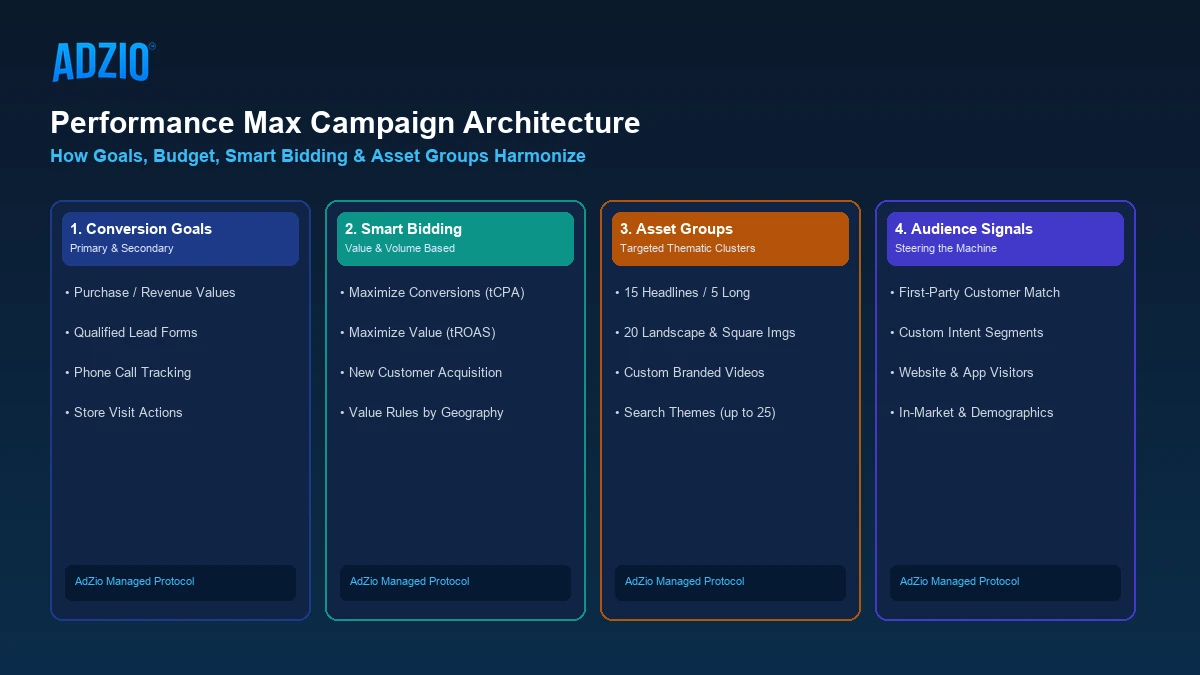
Performance Max operates as a gateway to Google's most valuable digital properties. Rather than confining your business message to a single format or isolated surface, the platform evaluates which touchpoint offers the highest statistical probability of conversion for any given prospective customer.
A key tenet of AdZio's campaign engineering is ensuring that your business delivers channel-appropriate creative assets. Many agencies make the fatal error of supplying basic landscape photos and generic text, forcing Google's automated video maker to synthesize amateurish, robotic video clips that diminish brand trust on YouTube and Discover. We craft bespoke visual assets tailored specifically to each of the six surfaces described below.
Captures bottom-of-funnel intent when users query relevant product categories, problem statements, or brand alternatives. Performance Max utilizes headlines, descriptions, sitelinks, and automated landing page matching to deliver tailored text ads.
Serves skippable video ads, in-feed video recommendations, and YouTube Shorts direct-response promotions. Video is frequently the single largest catalyst for converting cold prospects who ignore static text ads.
Reaches over 3 million partner websites and mobile applications. PMax intelligently selects high-relevance editorial placements for visual banner ads, engaging users while they consume relevant industry articles and news.
Appears natively within personalized mobile feeds on Android devices and the Google Search app. Discover reaches hundreds of millions of users daily with immersive, image-rich swipeable cards matching personal interests.
Places interactive sponsored promotions directly within the Promotions and Social tabs of personal and professional Gmail accounts, allowing users to expand ads, browse product galleries, and submit inquiries seamlessly.
Essential for brick-and-mortar retail, healthcare clinics, automobile showrooms, and local services. Promoted pins and local search listing highlights drive physical store visits, phone calls, and direction requests.
Because Performance Max is purely goal-driven, the quality, hierarchy, and accuracy of your conversion actions dictate 100% of the campaign's bidding intelligence.
In legacy pay-per-click advertising, a campaign with mediocre tracking could still generate reasonable returns through manual keyword bid management and negative search term pruning. In Performance Max, faulty conversion tracking is fatal. The machine learning model treats every designated "Primary Conversion Action" as an explicit instruction to find more users matching that exact behavioral profile. If your conversion setup mistakenly counts basic page views, newsletter subscriptions, or unverified contact form submissions as primary conversions, Google's AI will aggressively allocate your daily budget toward capturing low-cost, low-intent clicks from bots and casual browsers.
At AdZio, our conversion architecture begins with a strict division between Primary Actions (used for smart bidding optimization) and Secondary Actions (used strictly for reporting and observational diagnostics). For e-commerce businesses, primary conversion actions must transmit dynamic transaction values, currency codes, and transaction IDs to enable Value-Based Bidding (Target ROAS) and deduplicate repeat purchase data. For service businesses and lead-generation brands, primary actions are reserved for high-intent milestones: completed consultation bookings, verified phone calls with a minimum duration threshold (e.g., calls lasting over 90 seconds), and qualified quote inquiries.
Furthermore, we implement Google's Enhanced Conversions protocol. Enhanced Conversions securely hashes first-party customer data (such as email addresses, phone numbers, and physical addresses) captured during form submissions or checkouts and matches it against signed-in Google accounts. In an increasingly privacy-conscious digital ecosystem characterized by browser cookie restrictions and mobile tracking limits, Enhanced Conversions restores accurate cross-device attribution, ensuring that the Performance Max algorithm receives complete, unskewed feedback on which touchpoints actually drove revenue.
How AdZio structures enterprise Performance Max campaigns from foundation to ongoing governance.
Defining whether the initiative targets Sales, Leads, or Local Store Visits. We eliminate conflicting secondary objectives that confuse machine learning models.
Configuring verified Primary actions, assigning custom conversion values, enabling Enhanced Conversions, and excluding vanity micro-actions.
Setting daily budgets that allow the algorithm to capture at least 30-50 conversions per month, preventing starvation during the critical learning phase.
Selecting between Maximize Conversions (with tCPA constraints) for lead generation and Maximize Conversion Value (with tROAS constraints) for e-commerce.
Segmenting creative assets by distinct business offering, consumer persona, or product category to maintain tight contextual relevance across all touchpoints.
Supplying the complete asset inventory: 15 short headlines, 5 long headlines, 5 descriptions, 20 high-res images, official logos, and custom video creatives.
Guiding initial machine exploration with first-party Customer Match lists, website remarketing pools, and high-intent Custom Intent search segments.
Adding up to 25 curated thematic search concepts per asset group to inform the system of commercially relevant terminology and customer intent queries.
Integrating synchronized Merchant Center feeds with rich attributes, promotional labels, and custom label segmentation for product-based campaigns.
Ensuring destination pages offer blazing mobile speed, transparent value propositions, clear conversion funnels, and frictionless checkout or lead capture.
Asset groups are the fundamental creative containers in Performance Max. Discover how to organize them the right way and simulate dynamic ad assembly across Google surfaces.

In legacy search advertising, the "Ad Group" paired a specific list of keywords with matching text ads. In Performance Max, the Asset Group replaces this paradigm. An asset group is a cohesive bundle of creative elements — headlines, long headlines, descriptions, marketing images, square and landscape logos, video clips, and landing page URLs — unified by a common marketing theme.
A common operational mistake made by inexperienced agencies is excessive asset-group fragmentation. Creating dozens of micro-asset groups for closely related product models or services fractures budget and conversion data, preventing Google's machine learning model from accumulating sufficient conversion volume to optimize effectively. Conversely, dumping unrelated products into a single generic asset group causes Google to generate bizarre, disconnected ad combinations (e.g., showing a luxury jewellery headline alongside an industrial hardware photo).
AdZio advocates for **thematic clustering**. We structure asset groups around distinct commercial lines, customer intent stages, or specific landing page destinations. Each asset group is populated with diverse creative assets to achieve an "Excellent" Ad Strength rating, ensuring the algorithm never encounters creative bottlenecks when serving across Search, Display, YouTube, or Discover.
Experience how Google Performance Max dynamically synthesizes text, images, and videos into multi-surface ad formats.
Why custom video production is non-negotiable for high-performing PMax campaigns and how automated video fallbacks damage brand perception.
Perhaps no single component of Google Performance Max generates more operational friction — or offers greater competitive leverage — than video creative. In the system's technical specifications, uploading custom video assets is technically optional. If an advertiser launches an asset group without supplying video files, Google will automatically synthesize videos by stitching together static image assets, logos, and headline text accompanied by generic royalty-free background audio.
At AdZio, we consider relying on Google's auto-generated videos to be unacceptable for serious brands. These synthetic clips appear robotic, suffer from poor pacing, frequently clip essential product details, and display an unmistakable template aesthetic that degrades brand authority across premium YouTube in-stream and Shorts inventory. Because YouTube represents one of Google's fastest-growing conversion surfaces, poor video assets directly depress click-through rates, inflate cost per acquisition, and suppress conversion volume.
Our campaign engineering methodology integrates dedicated video creative assets designed specifically for direct-response performance. We develop video variations spanning three distinct aspect ratios: horizontal (16:9) for standard desktop and TV YouTube in-stream viewing, vertical (9:16) optimized specifically for mobile YouTube Shorts and Discover feeds, and square (1:1) for versatile in-feed display placements. Each video asset is scripted to deliver a clear value hook within the opening three seconds, introduce the brand identity before five seconds, address core consumer objections, incorporate readable text captions for silent mobile autoplay, and culminate in an unmistakable call to action.
Furthermore, we ensure that Performance Max video creative aligns seamlessly with broader Google Video Ads, dedicated YouTube Advertising, and corporate Video Marketing initiatives, establishing consistent visual storytelling across all customer touchpoints.
Ideal for desktop YouTube streams, Connected TV (CTV) viewing, and long-form video recommendations. Perfect for detailed product demonstrations and client case testimonials.
Tailored specifically for full-screen immersive playback on YouTube Shorts and Google Discover mobile feeds. Features rapid pacing, vibrant captions, and immediate problem-solution framing.
Provides universal compatibility across mobile website display grids, YouTube channel feeds, and Gmail expanded promo cards, ensuring balanced creative presentation without cropping.
How high-fidelity first-party data and search-intent segments train Google's AI to find your highest-value customers.

In traditional Google Display or YouTube campaigns, audience targeting functions as an absolute perimeter: if a user is not included in the targeted segment, they will never see your ad. In Performance Max, Audience Signals operate as algorithmic guidance rather than strict boundaries. By supplying audience signals, you provide Google's machine learning model with an authoritative hypothesis of what your ideal converting customer looks like.
During the initial campaign launch, the AI uses these signals to bypass blind trial-and-error exploration, prioritizing bids toward users who share demographic, behavioral, and search-intent affinities with your existing best customers. As the campaign accumulates statistical conversion volume, the algorithm is permitted to expand beyond the initial signal boundaries to capture converting prospects in related or emerging demographic pockets.
AdZio constructs audience signals using a rigorous three-tiered architecture. The foundational tier consists of verified first-party customer data uploaded via Customer Match (past purchasers, high-lifetime-value clients, and CRM leads). The second tier comprises Custom Intent segments built from high-commercial-intent search queries and competitor URL visit patterns. The third tier integrates in-market categories and affinity profiles that align with the specific industry vertical.
Customer Match email lists, past transaction records, CRM lifecycle stages, and high-frequency website visitors. First-party signals provide the highest predictive value for Google's machine learning models.
Users who have actively searched on Google for your exact product categories, specific brand competitors, or transactional problem-solving phrases within the preceding 7 to 30 days.
Broad Google-defined in-market audiences actively researching commercial purchases within your sector, layered with age, household income, and parental status filters to prevent irrelevant ad delivery.
How to utilize Google's Search Themes feature to steer Performance Max toward high-intent search queries without keyword stuffing.
Historically, one of the primary criticisms of Performance Max among experienced Google Ads practitioners was the lack of direct query steering. The algorithm inferred search relevance solely from landing page text, asset headlines, and broad algorithmic associations. Recognizing this limitation, Google introduced Search Themes — a feature allowing advertisers to input up to 25 curated thematic concepts per asset group.
Search Themes do not function like legacy exact match keywords. Instead, they act as high-priority intent signals indicating the specific commercial categories, service lines, and product solutions your business offers. Search Themes are particularly invaluable for new campaigns lacking historical conversion data, newly launched product categories, seasonal promotional campaigns, or businesses whose website landing pages contain limited editorial copy that Google's crawlers might otherwise misinterpret.
At AdZio, our methodology treats Search Themes as a precision instrument rather than a catch-all dumping ground. We conduct rigorous keyword research to isolate the highest-intent commercial search phrases, clustering related concepts into thematic groups. Crucially, we pair Search Themes with account-level negative keyword lists and Google Brand Exclusion lists. This dual configuration ensures that while Search Themes expand reach into valuable non-brand generic queries, your campaign is permanently prevented from bidding on irrelevant searches or wasting budget on branded navigational traffic that should be captured by exact match search ads.
Platform Evolution Note: Because Google Ads algorithms and targeting capabilities evolve continuously, AdZio maintains continuous campaign surveillance. We audit search category insights every two weeks to verify that active Search Themes are driving qualified commercial engagement rather than low-value informational traffic.
Connecting product feeds, dynamic inventory management, and value-based bidding to drive scalable e-commerce revenue.

For online retailers, Performance Max represents the direct successor to Smart Shopping. When paired with an optimized Google Merchant Center product feed, Performance Max becomes an automated transaction engine capable of showcasing individual product SKUs across the Google Shopping tab, YouTube video cards, Gmail promotions, and dynamic display banners.
However, achieving profitable return on ad spend (ROAS) requires far more than simply linking a product feed and hoping for the best. Product feed quality is the ultimate ceiling of e-commerce PMax performance. Incomplete titles, generic descriptions, missing GTIN/MPN identifiers, low-resolution product imagery, or out-of-date pricing cause Google to down-rank listings or reject items altogether. AdZio implements comprehensive feed optimization, restructuring product titles to front-load high-intent attributes (brand, model, size, color, material) and deploying Custom Labels (e.g., Best Sellers, High Margin, Clearance, Seasonal) to enable granular campaign segmentation.
Additionally, we evaluate whether a client benefits from a "Feed-Only" Performance Max configuration (which suppresses text and video assets to confine delivery strictly to Shopping placements) or a "Full-Asset" configuration (which deploys lifestyle photography and videos to capture cross-surface demand). By harmonizing product feed management with an overarching Google Shopping Ads strategy, we maximize profitable inventory turnover.
Automated synchronization between your e-commerce platform and Merchant Center ensures stock availability and pricing are 100% accurate.
Segmenting inventory by profit margin, seasonality, and sales velocity allows budget allocation toward your most lucrative product lines.
Bidding dynamically calibrated on total cart checkout value rather than flat conversion count, maximizing bottom-line revenue efficiency.
Leveraging Customer Acquisition Goals to bid higher for first-time buyers while minimizing spend on existing loyal customers.
How high-ticket service providers, healthcare clinics, and B2B enterprises capture qualified inquiries while eliminating automated lead fraud and bot spam.
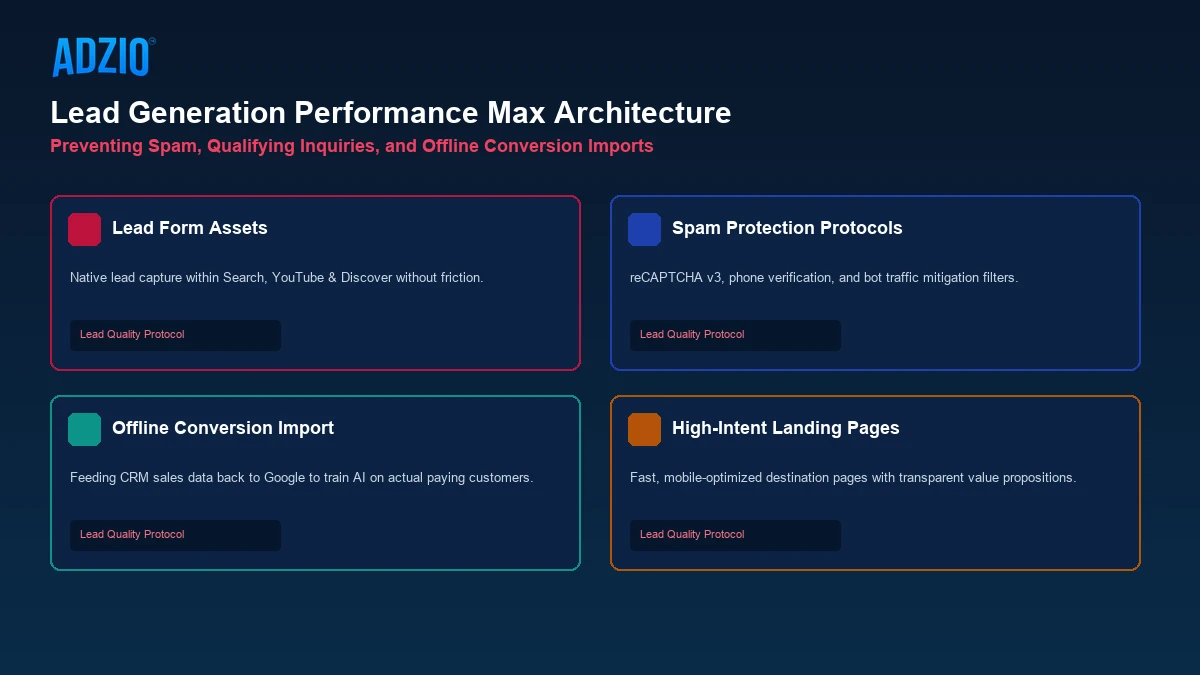
Deploying Performance Max for lead generation requires an entirely different operational posture than e-commerce. While e-commerce transactions are verified instantly by credit card payment gateways, lead generation forms can easily be manipulated by web bots, click-farms, and casual users submitting fake contact information. If an unmonitored PMax campaign is instructed simply to "Maximize Conversions" on standard form submissions, the algorithm will rapidly locate cheap display placements and spam-heavy networks, flooding your sales inbox with worthless inquiries.
AdZio solves this challenge through a multi-tiered lead validation and quality protocol. First, we secure destination landing pages with invisible reCAPTCHA v3, honeypot fields, and strict input validation to block automated submissions at the root. Second, we configure Google's native Lead Form Assets with qualifying multi-step screening questions (e.g., verifying budget threshold, timeline, or business requirements) that filter out low-intent curiosity clicks before a submission can occur.
Third — and most crucially for long-term ROI — we implement Offline Conversion Imports (OCI). By passing unique Google Click IDs (GCLID / WBRAID) into your CRM (such as Salesforce, HubSpot, or custom databases), we track which inquiries advance to "Sales Qualified Lead," "Proposal Sent," and "Closed Won Deal." We then upload these verified milestone values back into Google Ads. This trains the Performance Max algorithm to optimize for genuine, paying customers rather than empty form submissions, integrating tightly with our specialized Lead Generation and Conversion Rate Optimization services.
Multi-step question flows and qualifying criteria embedded within forms prevent unqualified applicants from registering as primary campaign conversions.
Call tracking algorithms measure inbound phone calls originating from ad clicks, recording call duration and caller geography to identify high-intent prospects.
Feeding revenue data from closed contracts back into Google Ads trains the smart bidding algorithm on true downstream commercial value.
Driving qualified traffic across six Google surfaces is futile if destination landing pages fail to convert. Discover AdZio's post-click optimization principles.
A critical setting within Performance Max is Final URL Expansion. When enabled, Google's algorithm evaluates search intent and dynamically replaces your specified landing page with what it perceives to be the most relevant alternative page on your domain, automatically generating matching headlines based on that page's content. While Final URL Expansion can uncover unexpected search queries, it can also send valuable paid traffic to outdated blog posts, policy pages, or generic homepages if left unmanaged.
AdZio enforces strict landing page governance. We utilize URL Exclusion rules to block non-commercial pages (such as career pages, terms of service, and informational articles) from receiving paid traffic, or disable Final URL Expansion entirely when client campaigns require pinpoint messaging control. Furthermore, every destination page is engineered for mobile speed, visual trust, and frictionless conversion actions.
Our development and CRO teams ensure that landing pages maintain absolute "message match" with asset group themes. If an asset group promotes a specialized cardiac consultation or a specific luxury watch model, the user lands directly on a dedicated, distraction-free page tailored to that exact service or product. Combining high-converting architecture from Landing Page Development with rigorous Conversion Rate Optimization maximizes the return on every ad dollar spent.
How to establish sustainable budget thresholds, choose the right smart bidding strategy, and navigate algorithmic ramp-up periods without panic.
One of the most frequent reasons Performance Max campaigns underperform or fail completely is budget miscalculation during the initial launch phase. Machine learning algorithms require data density. If a business establishes a target cost per acquisition (tCPA) of ₹1,000 but only allocates a daily budget of ₹500, the campaign can only statistically generate a conversion every other day. Under such data-starved conditions, the algorithm takes months to identify behavioral patterns, leading to erratic performance and prolonged learning cycles.
As a general operating standard, AdZio recommends setting a daily budget equal to at least 3 to 5 times your target CPA (or historical average cost per conversion). This provides the system with sufficient financial headroom to capture at least 30 to 50 conversion actions per month per campaign — the statistical threshold required for smart bidding algorithms to achieve stability.
Furthermore, advertisers must respect the Algorithmic Learning Period. When a new Performance Max campaign is activated or significant structural edits are introduced, the campaign enters a learning status that typically lasts 1 to 2 weeks. During this window, Google tests diverse asset permutations across all eligible inventory. Performance fluctuations, higher initial CPAs, and variable impression volumes are completely normal. Panicking and altering budgets, bidding targets, or creative assets every 48 hours resets the learning phase, trapping the campaign in permanent algorithmic instability.
Instructs the system to generate the highest possible number of qualified conversion actions within your allocated daily budget. Adding an optional Target CPA constraint keeps acquisition costs anchored to your financial targets once historical baseline data exists.
Instructs the algorithm to optimize for total revenue or weighted conversion value rather than raw conversion count. Crucial for e-commerce stores with varied price points and B2B brands tracking multi-tier lead milestone values.
Performance Max is not a "set-and-forget" campaign. AdZio applies a rigorous 15-stage recurring audit and optimization routine to protect margins and drive continuous growth.

Many agencies treat Performance Max as an excuse to abdicate management responsibility, assuming Google's automation handles everything. This passive approach is the quickest route to wasted ad spend. While Google handles real-time auction bidding and asset combination, human strategists remain entirely responsible for the quality of the data inputs, creative direction, audience guidance, and financial parameters.
AdZio's 15-stage framework ensures that every variable influencing campaign performance is audited, calibrated, and refreshed on a disciplined schedule. We monitor asset fatigue, inspect search categories, evaluate lead quality downstream in CRM pipelines, and adjust bidding targets to ensure sustained profitability across market cycles.
Auditing Google Tag Manager, Enhanced Conversions status, and primary vs. secondary action classifications to ensure zero data drift.
Aligning campaign target metrics with current commercial priorities, such as seasonal promotions, new service rollouts, or inventory clearance.
Inspecting asset performance ratings ('Low', 'Good', 'Best') within asset groups and replacing low-performing copy or imagery.
Splitting top-performing product or service clusters into dedicated asset groups to provide more granular budget allocation and creative tailoring.
Refreshing first-party Customer Match lists, updating CRM past purchaser data, and adding emerging custom search-intent segments.
Reviewing active Search Themes against actual search category insights, pruning outdated terms, and testing high-intent seasonal queries.
Checking Merchant Center for item disapprovals, price discrepancies, missing attributes, and updating Custom Labels for segmented bidding.
Benchmarking destination page load speeds, reviewing heatmaps, auditing URL exclusion rules, and running A/B headline tests.
Evaluating impression share lost to budget and adjusting daily spend limits to avoid starving campaigns during high-converting peak hours.
Analyzing grouped search term reports in the Insights tab to identify emerging negative keywords and prevent brand cannibalization.
Matching recorded campaign conversions against sales team feedback and CRM records to eliminate fraudulent spam and identify high-LTV patterns.
Testing fresh video hooks, vertical YouTube Shorts cuts, and problem-solution variations to prevent video ad fatigue across channels.
Reviewing placement reports and adding low-quality mobile gaming apps, clickbait websites, and irrelevant domains to account exclusion lists.
Adjusting Target CPA or Target ROAS constraints incrementally (by no more than 10-15% at a time) to guide scaling without resetting the algorithm.
Synthesizing cross-channel data into executive performance dashboards, reviewing profitability margins, and establishing next month's roadmap.
How AdZio measures cross-surface campaign success and an interactive demonstration of our campaign reporting analytics.
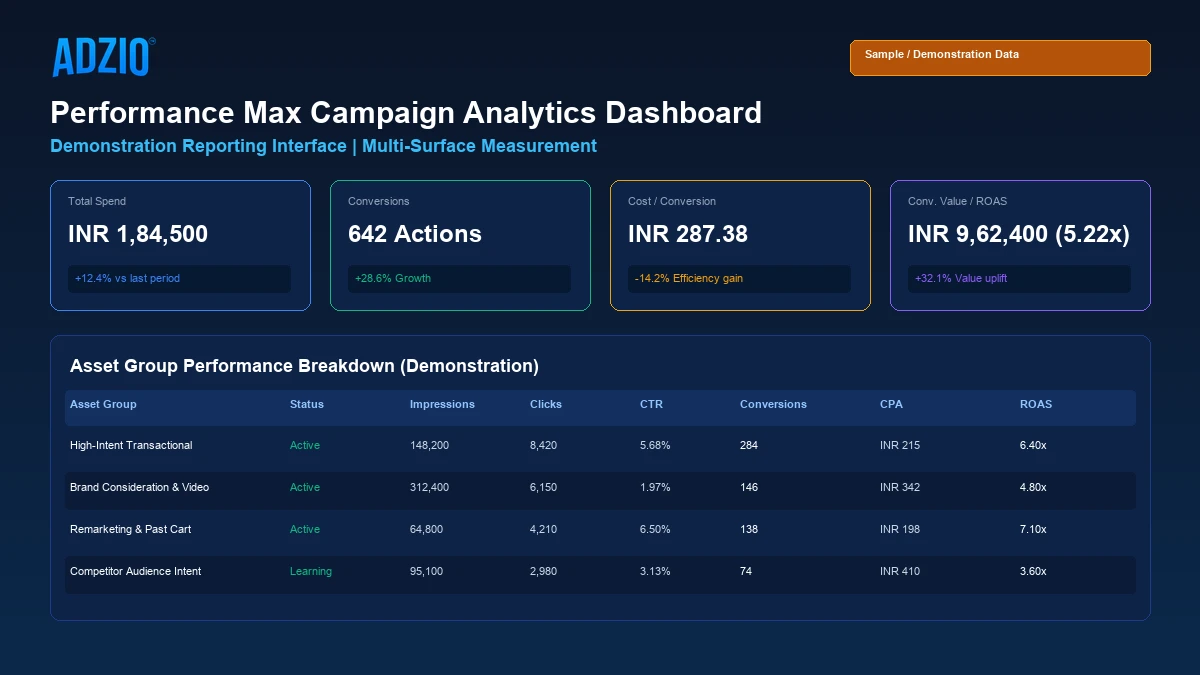
Evaluating Performance Max requires looking past standard click-through rates and vanity impressions. Because the campaign bids across disparate channels — from high-intent Google Search to passive Display banners and casual YouTube Shorts browsing — aggregate metrics can easily mislead advertisers. A campaign delivering thousands of ultra-cheap display clicks might appear active on paper, yet yield zero real revenue.
AdZio's analytics framework evaluates Performance Max through three distinct lenses: Efficiency Metrics (Cost Per Conversion, ROAS, and Conversion Rate), Volume Metrics (Total Qualified Conversions, Conversion Value, and Reach), and Downstream Business Metrics (Lead-to-Opportunity Rate, Average Order Value, and Customer Acquisition Cost).
Below is an interactive demonstration simulating our reporting dashboard, illustrating how different asset groups contribute to overall commercial performance across date ranges.
| Asset Group Name | Status | Impressions | Clicks | Avg. CTR | Conversions | Cost / Conv. | Conv. Value | Est. ROAS |
|---|---|---|---|---|---|---|---|---|
| Core Commercial & High-Intent | Active | 148,200 | 8,420 | 5.68% | 284 | ₹215.10 | ₹3,91,920 | 6.40x |
| Brand Consideration & Video Push | Active | 312,400 | 6,150 | 1.97% | 146 | ₹342.40 | ₹2,39,440 | 4.80x |
| Remarketing & Cart Abandonment | Active | 64,800 | 4,210 | 6.50% | 138 | ₹198.50 | ₹1,94,580 | 7.10x |
| Competitor Search Intent Segment | Learning | 95,100 | 2,980 | 3.13% | 74 | ₹410.20 | ₹1,36,460 | 3.60x |
How Google Performance Max adapts across commercial verticals. Each industry demands unique conversion goals, asset themes, audience guidance, and measurement governance.
How brick-and-mortar storefronts, showrooms, healthcare facilities, and regional service providers leverage PMax to dominate local search and maps.
For businesses that depend on foot traffic, physical consultations, or localized service dispatching, Performance Max replaced legacy Google Local campaigns with an upgraded cross-surface framework. When linked to a verified Google Business Profile, Performance Max automatically surfaces promoted pins on Google Maps, highlights localized service extensions on Google Search, and displays promotional offers in Google Discover to users currently located within your operational radius.
A critical distinction that AdZio enforces in local campaign architecture is separating physical location destinations from service area radii. If a dental clinic operates from a single facility in Agartala, the campaign must be strictly calibrated around drive-time distances (typically 5 to 15 kilometers), preventing wasted ad spend on prospects located in distant districts who will never travel for routine care. For regional service businesses (such as HVAC technicians, commercial cleaners, or caterers) that travel to the customer, we establish defined postal code boundaries and optimize for direct phone call initiation.
Furthermore, for multi-location retail chains and automobile dealerships eligible for Google Store Visits measurement, we configure localized landing pages that automatically detect user proximity, displaying the nearest branch address, current operating hours, real-time local product inventory, and direct one-tap driving directions.
Your business logo and promotional callout appear prominently on Google Maps when users navigate or search for nearby category services.
Prominent click-to-call buttons served on mobile search and display inventory connect high-urgency local buyers instantly to your front desk.
Showcases in-store product availability directly on Google Search and Maps, informing local shoppers that an item is currently in stock nearby.
Overcoming long decision horizons, multiple corporate stakeholders, and lead quality hurdles in enterprise B2B advertising.
Applying Performance Max to business-to-business (B2B) marketing requires navigating fundamentally different realities than consumer advertising. B2B transactions rarely conclude in a single session. They involve extended evaluation cycles spanning weeks or months, multi-member procurement committees, stringent compliance reviews, and high average deal values. If a B2B company launches Performance Max with generic conversion settings, the algorithm will quickly optimize for the easiest possible conversions — often resulting in junior job seekers downloading free guides rather than decision-makers booking enterprise software demos.
AdZio's B2B Performance Max playbook addresses these challenges through three structural safeguards. First, we enforce strict qualification gates on landing page forms (requiring work email addresses, company size, and specific project timelines) to deter casual submissions. Second, we configure audience signals around verified professional data: custom segments targeting competitor software terms, B2B industry search queries, and Customer Match lists of existing enterprise decision-maker contacts.
Third, we align Google's smart bidding with downstream sales velocity. Using Offline Conversion Imports (OCI), we assign progressive conversion values to intermediate sales milestones: e.g., ₹1,000 for a completed discovery call, ₹10,000 for a formal security review, and ₹100,000 for an executed commercial contract. This signals the algorithm to seek prospects with the firmographic profile of buyers who actually finalize contracts, harmonizing paid advertising with Digital Marketing Consulting governance.
How early-stage ventures and newly launched brands navigate PMax without historical conversion data or massive budgets.
Startups operate under unique constraints: limited brand awareness, zero historical Google Ads account data, tight capital runways, and an urgent requirement for validated customer acquisition. While Google promotes Performance Max as an accessible all-in-one solution for small businesses, launching PMax on a brand-new Google Ads account without historical conversion data carries substantial algorithmic risk. Without baseline conversion data, the algorithm is forced into a blind exploration phase that can rapidly burn through seed capital.
AdZio's startup deployment protocol mitigates this risk through a phased ramp-up. In Phase 1, we often recommend running tightly controlled, exact-match Search campaigns alongside targeted landing pages to harvest existing bottom-of-funnel demand and establish an initial baseline of 30 to 50 verified conversions. This populates the account with clean statistical data.
In Phase 2, we introduce Performance Max with rich first-party waitlist data, highly curated Custom Intent segments, and bespoke video assets. We start with "Maximize Conversions" without aggressive CPA caps to allow the machine learning model to explore efficiently, only applying Target CPA constraints once steady daily conversion volume is achieved. This measured sequence ensures that early-stage ventures scale customer acquisition predictably without wasteful expenditure.
The operational pitfalls, configuration blunders, and strategic errors that drain advertising budgets in automated Google campaigns.
Counting page views or unverified thank-you page hits as primary conversions. Google's AI will aggressively optimize toward capturing bots and accidental clickers who trigger shallow conversion actions.
Setting secondary micro-actions (e.g., social shares, PDF downloads) as primary bidding objectives, confusing the machine learning model about your true commercial goals.
Supplying only 3-4 headlines and a couple of images. Incomplete asset groups achieve 'Poor' Ad Strength ratings, throttling delivery and forcing low-performing ad combinations.
Allowing Google to auto-generate synthetic videos from static photos. These robotic video clips look amateurish and severely suppress conversion rates on YouTube in-stream and Shorts.
Directing paid traffic to slow, non-responsive, or generic homepages with weak value propositions and complex navigation. High bounce rates destroy campaign profitability.
Using overly broad affinity segments that guide the algorithm toward general browsers rather than individuals with active commercial intent.
Failing to optimize product feed titles, descriptions, and custom labels. Poor feed quality severely limits Shopping impressions across Google properties.
Creating dozens of tiny asset groups with minimal budget, fragmenting conversion volume and preventing the algorithm from ever exiting the learning phase.
Increasing daily budgets by 50% to 100% overnight. Rapid budget jumps reset smart bidding learning models and trigger erratic, inefficient bid exploration.
Judging campaign health by click-through rates. Cheap display clicks can yield high CTRs while generating zero actual revenue or commercial inquiries.
Celebrating high form submission volumes without inspecting whether sales teams are actually closing deals or dealing with bot spam and wrong numbers.
Optimizing purely for top-line revenue without accounting for COGS, shipping costs, payment processing fees, and product return overheads.
Changing bidding targets, budget limits, asset copy, and audience signals on the same day. When performance shifts, you cannot diagnose what caused the change.
Abandoning ongoing creative refreshes, search term insights inspection, negative placement pruning, and landing page testing after initial setup.
Using exaggerated or non-verifiable superlatives ("#1 in India", "Guaranteed 100% cure") that trigger Google Ads policy disapprovals or account suspensions.
Evaluate whether your proposed campaign assets meet enterprise deployment standards before investing media budget.
Estimate click volume, conversion potential, and channel budget distribution based on industry benchmarks.
We bridge the critical gap between Google's automated machine learning and your business's bottom-line profitability.
We never treat AI as an excuse for passivity. We guide the algorithms with curated audience signals, search themes, brand exclusions, and strict budget allocations.
We deploy negative placement exclusions, reCAPTCHA protection, and qualifying form questions to ensure your budget captures real customers rather than bots.
We produce custom direct-response video assets in horizontal, vertical, and square formats, ensuring your brand looks commanding across YouTube, Shorts, and Discover.
Traffic is only half the battle. Our development team optimizes landing page speed, mobile hierarchy, and checkout friction to maximize post-click conversion rates.
We implement Offline Conversion Imports (OCI), connecting Google Ads directly with your CRM so the AI bids on paying customers rather than hollow form submissions.
You retain total administrative ownership of your Google Ads account, data assets, and Merchant Center feeds. We provide clear, honest reporting with zero hidden markups.
How PMax integrates with search, paid social, SEO, and content marketing to form an unstoppable customer acquisition engine.
Performance Max delivers its greatest commercial impact not when operating in isolation, but when functioning as the automated demand-capture layer within a synchronized multi-channel digital marketing ecosystem. When prospective customers are introduced to your brand via organic search (Search Engine Optimization), social storytelling (Social Media Marketing), or industry authority content (Content Marketing), Performance Max ensures that those engaged audiences are re-encountered and converted across every eligible Google surface.
Simultaneously, exact-match Google Search Ads campaigns protect high-value brand terms and priority commercial keywords, while dedicated YouTube Advertising builds top-of-funnel consideration. By aligning your broader digital architecture with Digital Marketing governance, AdZio builds resilient, scalable acquisition infrastructure for enduring business growth.
In-depth, candid answers to the most critical technical, strategic, and financial questions business owners and marketing leaders ask about Performance Max.
Google Performance Max (PMax) is an automated, goal-based campaign type that grants advertisers access to Google's complete advertising inventory — including Google Search, the Google Display Network, YouTube, Gmail, Google Discover, and Google Maps — from a single, unified campaign. Operating on real-time machine learning, Performance Max dynamically synthesizes provided text headlines, imagery, video clips, and product data to construct and deliver personalized ads across whatever Google surface offers the highest statistical probability of driving your specified conversion actions.
Google Performance Max services comprise professional campaign management, strategic asset production, conversion tracking engineering, and continuous data governance delivered by a certified agency like AdZio. Rather than relying blindly on automated defaults, our services encompass full-funnel conversion value modeling, first-party audience signal curation, bespoke high-impact video creative development, Merchant Center product feed diagnostics, account-level brand exclusions, and closed-loop CRM integration to maximize commercial return.
Performance Max works by pairing your specified commercial conversion goals (such as e-commerce purchases or verified phone leads) with Google's real-time auction bidding algorithms. When an eligible user searches or browses across any Google surface, the algorithm evaluates billions of contextual intent signals — including browsing history, device, location, and past query themes. It then dynamically combines your provided assets into the optimal ad format and submits an auction bid calibrated to acquire that conversion at or below your target cost or efficiency threshold.
A Performance Max campaign is a single campaign structure within Google Ads designed to run alongside or in coordination with your broader advertising architecture. Instead of managing separate standalone campaigns for Search, Display, YouTube, and Discovery, a Performance Max campaign centralizes budgeting, smart bidding targets (such as Target CPA or Target ROAS), asset groups, and geographic targeting under one administrative entity, reducing account fragmentation while unlocking cross-surface reach.
Asset groups are the core creative containers within a Performance Max campaign, replacing traditional ad groups. Each asset group contains a themed collection of marketing assets — including up to 15 short headlines, 5 long headlines, 5 descriptions, 20 marketing images, 5 official logos, and 5 video creatives — associated with a specific final landing page URL and targeted audience signal. Proper asset group strategy clusters assets around distinct product lines, service categories, or buyer personas.
Audience signals are data inputs provided by the advertiser to guide Google's machine learning models toward your ideal prospective customers. Unlike traditional rigid targeting perimeters that restrict ads only to designated lists, audience signals function as steering hypotheses. They allow the algorithm to start exploring auctions within high-affinity customer pools (such as first-party Customer Match lists, website remarketing visitors, and Custom Intent search queries) before algorithmically expanding into adjacent converting demographics.
Search Themes are curated keyword concepts (up to 25 per asset group) that inform Google's AI of the specific commercial queries and terminology relevant to your business offerings. Search Themes help guide the algorithm toward high-value search intent, especially when launching new campaigns without historical conversion data, promoting new service lines, or operating landing pages with limited textual copy that Google's crawlers might otherwise misunderstand.
Performance Max uses Google Ads automation across three distinct pillars: Smart Bidding (auction-time bid calculations based on real-time contextual signals), Smart Creative (dynamically assembling headlines, images, and videos into optimal combinations tailored for the viewer's device), and Smart Inventory Allocation (instantly directing budget toward whichever surface — Search, YouTube, Display, or Maps — currently presents the lowest-cost path to a qualified conversion).
To achieve an 'Excellent' Ad Strength rating, a Performance Max asset group requires: up to 15 short headlines (30 characters), up to 5 long headlines (90 characters), up to 5 descriptions (up to 90 characters), up to 20 high-resolution marketing images (in 1.91:1 landscape, 1:1 square, and 4:5 vertical ratios), up to 5 official logos (square and landscape), up to 5 custom video assets (in 16:9 horizontal, 9:16 vertical, and 1:1 square formats), business name, and final destination URLs.
While custom video upload is technically optional, relying on Google without video is strongly discouraged. If an advertiser does not upload custom video files, Google will automatically synthesize low-quality, template-based video clips from static images and text. These synthetic videos appear robotic and severely depress click-through and conversion rates across YouTube in-stream and Shorts inventory. AdZio mandates bespoke direct-response video creative for all client campaigns.
Yes, Performance Max can be highly effective for lead generation when configured with strict lead qualification protocols. Because PMax has access to expansive display and mobile inventory, unmonitored campaigns can attract bot traffic and spam form submissions. AdZio implements reCAPTCHA verification, multi-step qualification questions on forms, dynamic phone call tracking, and Offline Conversion Imports (OCI) to train the algorithm on verified, paying customers rather than shallow inquiries.
Yes, Performance Max is one of Google's premier drivers of direct e-commerce transactions and retail sales. By synchronizing your product feed from Google Merchant Center, PMax serves dynamic shopping tiles, carousel listings, and video promotions across Search, YouTube, and Display. When combined with Target ROAS bidding and accurate value tracking, Performance Max systematically identifies shoppers with high purchase intent.
Performance Max was originally developed to succeed Smart Shopping and remains the primary Google Ads solution for e-commerce growth. E-commerce businesses leverage PMax to showcase their entire catalog, promote seasonal deals, acquire new customers at targeted acquisition costs, and run dynamic remarketing across YouTube, Gmail, and Display to recover abandoned shopping carts.
Yes, local businesses — including medical clinics, automobile showrooms, restaurants, and retail stores — can utilize Performance Max linked to their Google Business Profile. The campaign automatically serves promoted pins on Google Maps, local search ads with one-tap calling, and localized Discover cards, driving verified store visits, phone calls, and direction requests within specific geographic service radii.
Yes, B2B companies can successfully leverage Performance Max, provided they account for longer decision-making cycles and multiple procurement stakeholders. Rather than optimizing for casual PDF downloads, B2B PMax must be guided by high-intent Search Themes, Custom Intent competitor audiences, strict work-email validation on landing pages, and CRM milestone tracking that rewards high-value commercial contracts.
Healthcare providers, multi-specialty hospitals, diagnostic centers, and clinics can deploy Performance Max to acquire patient consultations and elective treatment bookings. However, healthcare campaigns must strictly adhere to Google's sensitive health advertising policies: zero personalized medical remarketing, no unsupported clinical guarantees, and strict patient privacy compliance with zero personal health data passed in conversion tags.
Performance Max integrates directly with Google Merchant Center via an automated product data feed. The campaign extracts product titles, descriptions, pricing, availability, images, and custom labels, dynamically converting this data into Shopping listings on Google Search, product carousels in Gmail, and shopping overlays on YouTube. Maintaining clean, enriched product attributes in Merchant Center is essential for maximizing PMax delivery.
Conversion tracking in Performance Max is the measurement infrastructure that informs Google's AI whether an ad interaction resulted in a valuable business action. It requires implementing Google Tag Manager, enabling Enhanced Conversions (which securely hashes customer data for cross-device attribution), configuring dynamic transaction values for e-commerce, and categorizing actions into Primary (used for bidding) and Secondary (observational) goals.
Performance Max is measured through a blend of efficiency, volume, and downstream business metrics. Key indicators include Cost Per Acquisition (CPA), Return on Ad Spend (ROAS), Conversion Rate, Total Conversion Value, and Impression Share. Additionally, AdZio inspects the Insights tab to evaluate search category trends, audience segment affinities, asset performance ratings ('Low', 'Good', 'Best'), and downstream CRM sales velocity.
Return on Ad Spend (ROAS) in Performance Max represents the ratio of total commercial revenue generated by the campaign relative to the advertising media spend invested (calculated as Total Conversion Value divided by Total Ad Spend multiplied by 100). For example, generating ₹5,00,000 in tracked sales from ₹1,00,000 in media spend represents a 500% or 5.0x ROAS. Businesses utilize Target ROAS bidding to instruct the AI to optimize for revenue efficiency.
There is no fixed minimum fee mandated by Google to run Performance Max, but statistical data requirements dictate practical budget thresholds. Because smart bidding requires approximately 30 to 50 conversions per month to exit the learning phase and maintain algorithmic stability, AdZio recommends establishing a daily budget equal to at least 3 to 5 times your target cost per acquisition. Agency management fees vary based on campaign scope and technical requirements.
No. A larger budget does not automatically guarantee superior results or higher profitability. If conversion tracking is inaccurate, landing pages suffer from high bounce rates, creative assets are weak, or audience signals are misaligned, inflating daily budget simply accelerates the rate at which money is wasted. Strategic foundation, asset quality, and conversion hygiene must always precede budget scaling.
No, Performance Max does not guarantee leads. No ethical or certified advertising agency can guarantee specific lead volumes because external market variables — including consumer demand, competitive pricing, seasonal trends, and landing page conversion efficiency — directly dictate results. AdZio guarantees rigorous campaign engineering, continuous optimization, and transparent governance designed to maximize acquisition probability.
No, Performance Max cannot guarantee sales. Advertising drives qualified, in-market traffic to your digital storefront, but final checkout completion depends on your product pricing, brand reputation, shipping costs, payment gateway reliability, and overall consumer trust. We ensure that your products receive optimal exposure across eligible Google surfaces to maximize conversion opportunities.
No, setting a Target ROAS in Google Ads does not guarantee that the campaign will achieve that exact return. A Target ROAS serves as an algorithmic constraint: if the target is set realistically based on historical data, the AI will bid accordingly. However, if an unrealistic ROAS target is set without sufficient conversion history, the algorithm may simply stop spending budget because it cannot find auctions that satisfy the mathematical threshold.
No, return on investment (ROI) cannot be guaranteed by any advertising platform or agency. Net ROI depends on complete business economics, including cost of goods sold (COGS), operational overhead, customer service quality, and post-sale retention rates. Performance Max provides the cross-surface marketing engine, while AdZio works with clients to align ad strategy with underlying commercial margins.
Google Search Ads appear exclusively on Google Search results and Search Partner sites based on explicit keyword match types (exact, phrase, broad) and manual query management. Performance Max encompasses Search inventory while also serving across YouTube, Display, Discover, Gmail, and Maps using AI-driven asset assembly and Search Themes. Search campaigns offer granular search term control, whereas PMax maximizes multi-channel reach.
Standard Shopping Ads display product inventory solely within Google Shopping search results and the Shopping tab, providing complete control over search query negatives and device bid adjustments. Performance Max incorporates the exact same Merchant Center product feed but dynamically generates video ads on YouTube, carousel ads in Gmail, and visual banners across Display, dramatically expanding retail reach beyond the search page.
Standalone Google Display Ads campaigns are typically used for broad brand awareness or static remarketing across partner websites and apps, where advertisers manually pick placements or audiences. Performance Max utilizes Display inventory as part of a conversion-focused multi-touch journey, bidding on display impressions only when machine learning models predict a high probability of immediate conversion.
AdZio approaches Performance Max through an engineering-led philosophy of active machine steering. We reject passive 'set-and-forget' automation. We design custom high-resolution creative assets and direct-response videos, configure Enhanced Conversions with dynamic values, feed rich first-party audience signals, implement comprehensive negative brand lists, conduct bi-weekly optimization audits, and connect CRM pipeline data to ensure measurable business growth.
Yes, Performance Max is exceptionally powerful across regional Indian markets, including Tripura, Agartala, and Northeast India, as well as Tier-2 and Tier-3 urban centers. With high smartphone penetration and rapid growth in YouTube Shorts and Discover consumption across regional languages, PMax captures local consumer intent effectively when campaigns feature localized creative assets, clear regional contact options, and precise geographic targeting.
Creative assets within Performance Max should be audited bi-weekly and systematically refreshed every 45 to 60 days. In the Asset Group reporting tab, Google assigns performance ratings ('Low', 'Good', 'Best') once sufficient impression volume is gathered. AdZio proactively replaces any asset rated 'Low' with fresh headline angles, updated promotional photography, or new video hooks to combat ad fatigue and maintain peak Ad Strength.
Share your current campaign status and growth objectives. Our certified Google Ads specialists will inspect your account architecture and deliver a tailored roadmap within one business day.